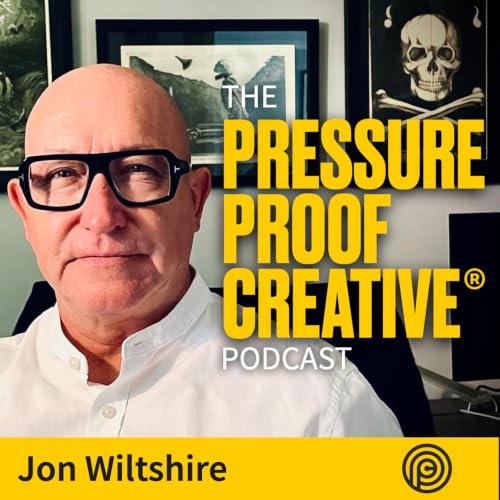
Couverture de The Pressure Proof Creative® Podcast

The Pressure Proof Creative® Podcast

The Pressure Proof Creative® Podcast

De : Matt Follows
Écouter gratuitement

Sustainable High Performance For Creative Athletes™ Fusing 25 years experience as an adman turned leadership coach, with candid conversations, practical tips, and no-nonsense advice from multi-award-winning creative leaders, CEO's, performance psychologists, and neuroscientists at the cutting-edge of brain science, this is the show which talks about the good, the bad, and at times ugly effects that the pressure to generate genius-on-demand, can have on the creative brain. And how you, like my guests, can better protect your most vulnerable, and most valuable, tool-of-the-trade.Matt Follows Hygiène et vie saine Psychologie Psychologie et psychiatrie
Épisodes
  • Barney Robinson – Founder & CEO Orchard
    Aug 17 2026

    What happens when the career you spent decades building suddenly feels irrelevant?

    And the things you called success... stop mattering at all?Barney Robinson is the Founder and CEO of Orchard Creative in New York. Before that, he spent 14 years at BBH in its heyday, eventually joining the global board as President.But this episode isn't just about building a successful agency.Because as Barney was questioning the politics, pressures and future of the industry, his beloved wife Torrey was diagnosed with incurable cancer.Suddenly, building something new wasn't just entrepreneurial ambition.It was personal. Maybe even survival.Barney wanted freedom.Freedom to determine his own future. Freedom from corporate politics. And freedom to prove that you could produce extraordinary creative work without treating people like shit in the process.In this remarkably candid conversation, we explore what building businesses taught Barney about pressure, resilience and success, and what watching the person he loved die taught him about life.Because when you've seen the end, your definition of success changes.The awards disappear. The titles disappear. The houses, money and status disappear.What remains is love.And for Barney, freedom.We also dig into the uncomfortable reality of entrepreneurship.Because talent isn't always the differentiator.Pain tolerance is.Success is on the other side of the pain most people aren't prepared to feel.Then there's what Barney calls the "success tax": the politics, envy, distractions and bullshit that start appearing around the work once you're doing well.And we tackle the existential question facing millions of creatives right now.When technology means everyone can create and everything is content, where does our value come from?Barney's answer is beautifully simple:Quality. Originality. Authenticity.We also explore burnout and why Barney has managed to stay in love with advertising after decades in the business.Which leads us to something I believe deeply:Sometimes it isn't too much work that burns us out. It's too little work that feels meaningful.Finally, for anyone questioning whether to stay in the creative industries or walk away, Barney offers two deceptively simple questions:Who are you?And why are you?Because changing careers won't necessarily solve an identity problem.This is a conversation about creativity, entrepreneurship, grief, identity, pressure, resilience and what happens when life forces you to work out what actually matters.And Barney's conclusion might be the simplest lesson of all:Stay in love. Stay free.In this episode:

    • Why there's always a market for better
    • The painful reality of entrepreneurship
    • The hidden "success tax"
    • Why career security may be an illusion
    • Why quality becomes more valuable in the age of AI
    • Meaningful work, burnout and staying in love with what you do
    • The two questions to ask before leaving your career
    • What grief taught Barney about success, love and freedom

    https://orchardcreative.com

    Afficher plus Afficher moins
    1 h et 10 min
  • Jon Wiltshire – Founder: Create@AddictivePixel
    Jun 26 2026

    In this episode, Matt sits down with creative production pioneer Jon to explore one of the biggest questions facing the creative industries today.

    How do we embrace AI without sacrificing creativity?

    With more than four decades spent helping some of the world's biggest agencies and brands bring ambitious ideas to life, Jon has witnessed every major technological shift the industry has faced.

    From hand-rendered illustration and retouching dyes to digital, CGI and now AI, he's spent his career sitting between creative ambition and production reality.

    What quickly becomes clear is that this isn't really a conversation about technology.

    It's a conversation about time.

    Jon argues the industry isn't losing its creative edge because of AI.

    It's losing it because creativity is no longer being given the time it deserves.

    Instead of using technology to improve thinking, we've used it to demand more output.

    Faster.

    Cheaper.

    More.

    And somewhere along the way, the thinking became secondary.

    That leads to one of the central ideas in the episode.

    Technology should never lead the idea.

    The idea should always lead the technology.

    Jon explains why the best production partners don't simply execute concepts. They help creatives discover what's possible before the work is ever sold. Not by limiting ideas, but by expanding them.

    He calls it discovering "the new possible."

    From there, the conversation turns to AI.

    Not as a replacement for creative people.

    But as another person in the room.

    A collaborator that can accelerate research, production and adaptation while giving something infinitely more valuable back.

    Time.

    Time to think.

    Time to experiment.

    Time to make ideas better.

    Because creativity isn't something you switch on at 9am on a Monday morning.

    It needs space.

    It needs wandering.

    It needs permission to fail before it succeeds.

    The discussion then shifts to something surprisingly human.

    Imperfection.

    Jon explains why audiences instinctively reject work that's too perfect. Whether it's illustration, CGI or AI-generated imagery, perfection rarely feels real.

    Grain.

    Texture.

    Flaws.

    They're what give work its soul.

    From there, the conversation widens into the future of the industry itself.

    As large agency networks continue to struggle, Jon believes a different model is emerging.

    Smaller.

    More agile.

    Creative teams supported by specialist partners instead of massive infrastructures.

    He argues today's independent creatives have opportunities previous generations never had. With the right collaborators around them, they can compete for global work without needing thousands of employees or a marble reception.

    The infrastructure can be shared.

    The creativity can't.

    And that's where the episode lands.

    The future doesn't belong to whoever creates the most content.

    It belongs to whoever protects the quality of the thinking.

    Because AI isn't the enemy.

    Speed isn't even the enemy.

    The real danger is allowing efficiency to become more valuable than imagination.

    If creativity is going to thrive over the next decade, it won't happen because we worked faster.

    It will happen because we used technology to give ourselves permission to think again.

    If you've ever wondered where creativity is heading, how AI fits into that future, or whether the industry has forgotten what made great work great in the first place...

    This one's for you.

    Like, subscribe and share if you want more conversations with the people who built the industry, are reshaping it, and refuse to let creativity become an afterthought.


    Contact Jon here >>> jon.wiltshire@addictivepixel.co

    Afficher plus Afficher moins
    47 min
  • MARK DENTON ESQ. – Creative Boss at COY! Communications & Author
    Apr 10 2026

    In this episode, Matt sits down with Mark Denton, legendary creative, co-founder of Simons Palmer, and the mind behind some of the most iconic campaigns in British advertising, to unpack what 50 years in the industry really looks like and what’s quietly gone wrong along the way.

    Mark starts by tracing an unlikely path into advertising. From leaving school without the qualifications for art college, to stumbling into the industry via a chance conversation on his dad’s driveway, his story isn’t polished. It’s instinct, graft, and figuring it out as he went.

    What emerges early is a tension that never leaves him. Low confidence alongside relentless ambition.

    He talks about feeling completely out of place at Leo Burnett, surrounded by Oxbridge graduates while staying silent in meetings for three years, convinced he’d be found out.

    But underneath that self-doubt was a drive to make things. To be the one with the ideas.

    From there, the episode opens into what the industry used to be.

    Long hours. Big personalities. Hard drinking.

    But also something that feels rare now. Apprenticeship, immersion, and proximity to greatness.

    Not just how ads were made, but how they landed.

    Because back then, advertising wasn’t just effective. It was culture.

    Kids sang jingles. Families watched ads together. Posters felt like art.

    And that’s where the conversation turns.

    Mark draws a sharp line between that era and now.

    Agencies forgot what they were selling.

    Not time. Not process.

    Magic.

    And when that disappeared, so did the trust.

    Clients stopped asking for bold ideas and agencies stopped offering them.

    What replaced it?

    Safe thinking. Endless process. “Vanilla sludge.”

    From there, we get the stories that define his career.

    Breaking rules. Doing the opposite.

    Making work that wasn’t asked for and presenting it anyway.

    From Nike to Wrangler, some of his biggest successes came from giving clients something better than they thought possible.

    Not to prove a point, but because he wanted to give them a gift.

    Don’t just deliver what’s asked.
    Overdeliver what’s possible.

    But it’s not all nostalgia.

    Mark opens up about the hardest period of his life during COVID, when personal crisis collided with the loss of work, identity, and relevance.

    For the first time, he couldn’t escape into work.

    And what followed was a long recalibration.

    Instead of waiting to be picked again, he reinvented himself.

    Put himself out there as a “65-year-old intern.”

    Walked back in with curiosity instead of ego and started again.

    That becomes the turning point.

    Because despite everything, the politics, the fear, the drop in standards, he’s still obsessed with the craft.

    Still coming up with ideas every day.

    Still chasing the same thing.

    Work that people actually care about.

    And that’s where the episode lands.

    Not on tactics. Not on trends.

    But on a simple truth.

    The industry isn’t lacking talent.
    It’s lacking courage.

    A lack of persuasion.
    A lack of entertainment.

    A lack of belief in what great advertising can do.

    The conversation closes with a perspective that cuts through everything.

    If no one remembers it,
    If no one talks about it,
    If it doesn’t move anything,

    It doesn’t matter how many awards it wins.

    Because at its best, advertising isn’t wallpaper.

    It’s culture.

    And if you’re willing to push further and give people something they didn’t ask for but actually need,

    You might just bring the magic back.

    If you’ve ever felt the industry’s lost its edge, your work’s getting diluted, or the game has quietly changed,

    This one will hit.

    Like, subscribe, and share if you want more conversations with the people who built it, broke it, and are still trying to fix it.

    Afficher plus Afficher moins
    1 h et 24 min
adbl_web_anon_alc_button_suppression_t1
Aucun commentaire pour le moment