Couverture de The Institute talks

The Institute talks

The Institute talks

De : Institute for Apprenticeships and Technical Education
Écouter gratuitement

3 mois pour 0,99 €/mois

Après 3 mois, 9.95 €/mois. Offre soumise à conditions.

À propos de ce contenu audio

We’re building a joined up and high quality skills system in England by putting employers at its’ heart, making it easier to navigate for all and improving the system now and in the future.Copyright 2021 All rights reserved. Politique et gouvernement Sciences politiques
Les membres Amazon Prime bénéficient automatiquement de 2 livres audio offerts chez Audible.

Vous êtes membre Amazon Prime ?

Bénéficiez automatiquement de 2 livres audio offerts.
Bonne écoute !
    Épisodes
    • The Institute talks...about apprenticeships in construction and the built environment
      Apr 6 2022
      In this episode of The Institute talks, we talk about the exciting construction route review and the various areas that are being improved, including health and safety, sustainability and much more. In this podcast, our host Neil Jones, is joined by route panel members Ruth Devine and Paul Skerry as well as two apprentices, Joe McGilley, a civil engineering apprentice and Shannon Maine,  bricklaying apprentice. Ruth and Paul explore areas of the construction route review that are improving, and the vast apprenticeships available within the route. They focus on key areas, such as mental health and modern methods in construction, and how it will help the industry as well as apprentices. The two apprentices, also share on how their apprenticeship experience has been, and ways they think the route can be better. Shannon also highlights her ambition to encourage more women to be apart of the industry. Transcript Neil Jones Hello. I'm Neil Jones, senior product manager here at the Institute and your host today for this podcast about our recent construction review. I'm joined by two panel members, Ruth Devine and Paul Skerry, as well as two apprentices, Joe McGilley and Shannon Maine. Welcome, everybody, Would you like to introduce yourselves? Ruth Devine I'm Ruth Devine. I'm managing director of SJD Associates, electrical contractor based in Milton Keynes. I've been on the panel for five years now. Paul Skerry Hi I’m Paul Skerry, early years careers and professional development manager for BAM in the UK. I've been with the panel for about six months now. Joe McGilly I'm Joe McGilly. I'm an apprentice civil engineer working for ACORN, currently based out of Bedford. I've been in the industry for about four years now. Shannon Maine Hi, I'm on Shannon Maine, a bricklaying apprentice, and I started it last October. Neil Jones Thanks. I'm grateful you can all join me today. So to start with, a bit of background on the review. So, there are almost 100 apprenticeship standards in the construction route as well as technical qualifications. And the route review is basically an opportunity for us to take a strategic look across the route to ensure that our occupational map is correct, that the occupational standards on it remain relevant, and that the occupations and skills match the needs of employers both now and in the future. So, it's a bit of a stocktake and there are obvious benefits in doing so, but we also have a statutory obligation to do so at regular intervals around every three years or so. As part of the review, the Institute's Employer Panel for Construction developed a set of key principles and characteristics which we will talk about today that represent key concepts that employers are asked to consider for future inclusion in occupational standards. These are things like sustainability, digital skills, mental health, building safety, amongst others. So, without further ado, if I start with an open question for everybody, how do you think the review will benefit apprentices, employers and training providers in the future? Ruth Devine I think it's a good opportunity just to see where we are and what skills needed for the future. So, a lot's happened in the last five years and many of these standards were around before the institute existed. So, it's a good opportunity to see where are we? What's going on? The industry issues like the building safety agenda, competence, the EDI agenda, trying to make the industry fair or equal for all. And it's a good opportunity here to look at the content and make sure that the Apprentice of the future meet the needs of employers. Paul Skerry I think that's something that now we've moved through during very challenging times. The last two years in particular have been a particular challenge. The fact is, outside of the control of many within construction and we've learnt a lot from that, we've learnt to work in different ways but has had to face some things like mental health and a lot of things. And we're starting to see that we need to move into new areas, things always changing. The institution has done a lot of work with its Green Apprenticeship panel. There are changes there and certainly in terms of building safety, we've sadly seen a bias in the UK to things like racket review and needing our engineers to be much more aware of safety in buildings and things like that. Neil Jones Great, and I mentioned principles and characteristics before. Are there any for route that particularly stood out to you? Ruth Devine Well, I've been involved the Lighthouse charity now for nearly two years and understanding more about the mental health landscape in construction, I really think it's fantastic the Institute and the panel members and employers do appreciate that we've got some way to go to improve mental health. I think this is an opportunity to build in skills like resilience, emotional wellbeing and just improve the outcomes for the industry really and make it a ...
      Afficher plus Afficher moins
      23 min
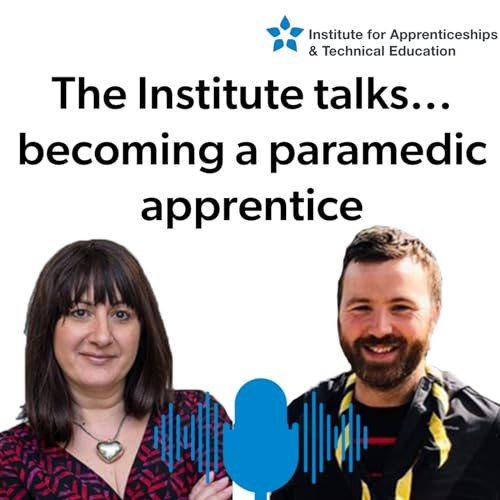
    • The Institute talks...about becoming a paramedic apprentice
      Feb 10 2022
      In this episode of The Institute talks, we talk about the invaluable experience gained through a paramedic apprenticeship and the range of progression opportunities available. In this podcast, our host Fariba Carr is joined by Justin Honey-Jones, a senior paramedic and a member of our Health and Science route panel. He is also an associate lecturer in Paramedic Science at Anglia Ruskin University. Justin speaks about his own experience from routine calls to the bigger emergencies such as Grenfell Tower and how to decide if an apprenticeship is the best path and where to apply. He also mentions how apprentices on average gain 1600 to 1500 hours of front-line clinical experience per year, whereas university students will have 750 hours per year of frontline experience. All that experience allows apprentices to see the whole system, and as Justin stated: “The paramedic qualification is just the start of a wonderful journey, but it's a golden ticket and it's what you do with that ticket that kind of opens up your path and your aspirations.” Transcript Fariba Carr Hello. I'm sorry, Fariba Carr, head of membership, communities and events at the Institute and your host for this podcast. Today for this Employer podcast. I’m delighted to be joined by Justin Honey Jones, a senior paramedic and a member of our Health and Science Route Panel. Welcome, Justin.   Justin Honey Jones Thanks for having me, Fariba.   Fariba Carr So, give yourself a little bit of an introduction.   Justin Honey Jones I'm Justin, I'm a senior paramedic with east of England Ambulance Service, and since the first of January this year, I started as a clinical educator with St John Ambulance. And also, I'm an associate lecturer in Paramedic Science at Anglia Ruskin University.   Fariba Carr Thank you, I'm so glad that you could join me today. So, let's get started, and perhaps you could tell me a little bit about how you found your way to being a paramedic. What made you choose this profession?   Justin Honey Jones To be honest, there's a few key events really throughout my life, and I've ever since a young child, it's all I ever wanted to do was to be a paramedic. I mean, there was no specific reason. But more more events that happened. I mean, 911 was a key event. I remember being the age of 15, I was doing my work experience and I was at the Fire Service Training College in South Wales. I remember literally over lunch seeing the tragic events that happened at 911. And it was the first experience of seeing quite a large-scale incident of firefighters, paramedics, police officers all working together. It was key public services and I had quite a significant impact and that was also linked with work I was doing as an army cadet at the time outside school. We were learning about first aid and developing first aid competitions and ultimately led to my sort of started my career really as an army reservist with the Royal Army Medical Corps, and I trained as a combat medical technician. That’s when I started having my first interactions with paramedics and nurses and doctors, and it kind of cemented my career. I knew that's what I wanted to do.   Fariba Carr Thanks. That was really interesting to hear what inspired you. Do you feel that the career that you've had since then has lived up to what you thought you were going to be doing? Is it is it different in any ways?   Justin Honey Jones You know, it's really interesting. If I think back when I was a child, you know, what you think of a paramedic was what you would see on casualty or E.R. or those type of medical programs. But it's nothing like the TV shows. To actually be a paramedic, you start to see that, you know, it's anything and everything in life. Colleagues and I will frequently say the job is about the circle of life. I remember one of my most significant shifts was when I started in the morning and we delivered this beautiful baby boy who came into the world at 7:00 in the morning, in the back of back of a taxi, which was quite an experience, if you could imagine starting the day and no coffee early. It was quite a shock with this event, and we attended numerous calls throughout the day. And then sadly, we finished off the end of the day and we had a patient that was an older patient that sadly went into a cardiac arrest and didn't survive. And that full shift is a classic example of the anything and everything that you can get as a paramedic. And that's what makes it a wonderful job is you don't know what you're going to do and you have to be prepared for literally anything and everything. It certainly keeps you on your toes, and it never disappoints.   Fariba Carr That's really interesting to hear about that kind of span of activity that you're going to have from one day to another. My 16-year-old and Justin, I know, you know, this is really interested in this and I asked her a little bit about why she wanted to do it and the questions that she might have. So, some of...
      Afficher plus Afficher moins
      33 min
    • The Institute talks...about ‘raising the standards: the apprentice guide to quality apprenticeships‘
      Sep 13 2021
      In this episode of The Institute talks, we talk about the new guidance created by our apprentice panel, ‘raising the standards’. In the podcast, our host Jonathan Mitchell, Deputy Director at the Institute was joined by Jamilah Simpson, former digital marketing apprentice at Google, Dillion Jones, electrician apprentice at Derry Building Service. Launched by the Institute’s apprentice panel, the ‘raising the stands’ guidance sets out what to expect during an apprenticeship, welfare and wellbeing considerations, and recommendations for how training programmes can be tailored to give apprentices the best possible experience.  Transcript Jonathan Mitchell Hello, I'm Jonathan Mitchell. I'm a deputy director at the Institute for Apprenticeships and Technical Education, and I'm your host for this podcast and today we're launching the raising the standards. Best practice guidance that's been written by The Apprentice panel for training providers and employers and also apprentices. To show them what really great looks like in apprenticeships and hopefully extend that really great practice that we've all seen in loads and loads of areas across the whole apprenticeship landscape. Today I'm joined by three members of the Institute's apprentice panel, they are Jamila Dillon and Amelia. So welcome Jamilah Dillon and Amelia. Would you like to introduce yourself? Jamilah Simpson Sure. Hi everyone, I'm Jamilah. I'm a former Google Digital marketing apprentice. I'm now the programs associate at Multiverse, where we're building an outstanding alternative to university and corporate training through apprenticeships. My role aims to provide apprentices with opportunities that lie outside their apprenticeship qualification, and day-to-day roles for personal and professional development. I will soon be moving into the creative industry to become a graphic design freelancer. I've always wanted to pursue a career in the creative world. So I thought now was the time to make that change and try something new. Jonathan Mitchell That sounds amazing Jamila thanks so much. And Dillon over to you. Tell us a bit about yourself and what apprenticeship you're doing, what you're doing at work at the moment. Dillon Jones Hi everyone, I'm Dillon. I completed a four-year Level 3 apprenticeship to become an electrician. Once I completed it, I got offered a position in the office to become an electrical design engineer. Where I have just recently completed my Level 4. I'm potentially moving on to my Level 5 soon.   Jonathan Mitchell Thanks Dillon and also Amelia, you've also joined us today. Would you like to introduce yourself and tell us a bit about yourself? Amelia Russell Yeah, sure, so my name is Amelia Russell and I'm a governance and external affairs officer at the Institute and also lead on the apprentice panel and also have recently completed a Level 3 business administration apprenticeship. Jonathan Mitchell Terrific thanks so much and welcome to all of all of you. So I've got a lot of questions which we'll try and share to help demystify the raising the standards guidance that you guys have been working on. Dillon, I'll turn to you first what? What's the apprentice panel responsible for? Dillon Jones To me, the apprentice panel is responsible for challenging in reviewing the boards decisions. They make some key decisions for apprentices or whole throughout every industry and two times a year we have to update the board on what we do. Another thing that we do is we voice the opinion of current and previous apprentices. This is what we were trying to achieve with our survey in 2020. Jonathan Mitchell Fantastic. So, moving on, Jamilah can you tell us a bit what were the key findings that you that you found from the apprentice panel 2020 survey? Jamilah Simpson And so we received over 1000 responses to our 2020 apprentice panel survey, and there were four key main findings that we got from it. The first was that 85% of respondents had signed a commitment statement. The commitment statement is a contract which is signed by the Employer, Apprentice and training provider before the apprenticeship begins. The second key finding was at 62% of respondents reported receiving at least 20% off the job training. The third was 70% of respondents were satisfied that they're off the job training was useful in their job, and the fourth was 87% of respondents would recommend their apprenticeship. Jonathan Mitchell Thanks Jamilah and I know that the panel work really hard to think about what those findings and the many other findings of fact they came out of the apprentice panel survey what they might mean and what recommendations might be made. Amelia, do you think you could tell us a little bit about the recommendations that were made from the apprentice panel survey? What kind of things did the apprentice panel decide to recommend that they were hoping that that the Institute and other parts of government might take forwards?...
      Afficher plus Afficher moins
      25 min
    Aucun commentaire pour le moment