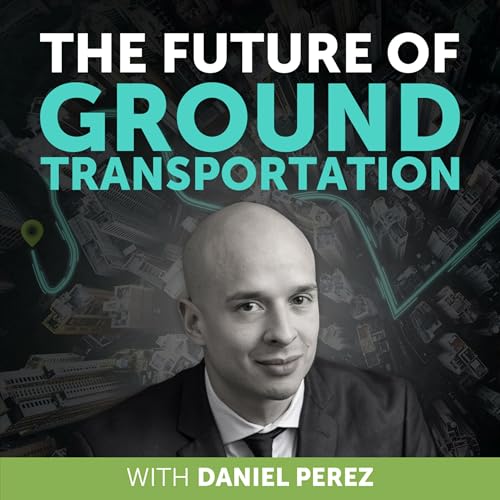
Couverture de The Future of Ground Transportation

The Future of Ground Transportation

The Future of Ground Transportation

De : The Future of Ground Transportation
Écouter gratuitement

À propos de ce contenu audio

Welcome to the Future of Ground Transportation podcast, where we’ll be driving home all things related to the future of organizational ground transportation. The podcast will truly be visionary, where each episode, we’ll be spending 30-45 minutes covering innovation in ground transportation, to share our expertise and insights. It will be purpose driven, relying on our host Daniel Perez’s values he’s used to build the culture of his own successful ground transportation company.The Future of Ground Transportation Economie
Les membres Amazon Prime bénéficient automatiquement de 2 livres audio offerts chez Audible.

Vous êtes membre Amazon Prime ?

Bénéficiez automatiquement de 2 livres audio offerts.
Bonne écoute !
    Épisodes
    • EP58: Building a CDL Program from Scratch: Operations & Scalability
      Dec 17 2025

      In this episode of The Future of Ground Transportation, host Daniel Perez sits down with Blaise Sullivan, Program Director of the Boston CDL Driving School. Blaise shares his journey of revitalizing a dormant educational program and the strategic operational shifts required to build a high-performance training facility from the ground up.

      We explore the critical intersection of workforce development and future technology. Blaise offers a pragmatic, 10-year forecast on autonomous trucking, debunking myths about "robot takeovers" while highlighting where automation will actually dominate. If you are a fleet executive, investor, or operations leader looking to navigate the talent shortage and the evolution of logistics, this is a must-listen.

      We Deep-Dive Into:

      • The strategic revitalization of the Boston CDL School and its operational roadmap.

      • A realistic 10-year market forecast: Autonomous highway transit vs. human-centric urban delivery.

      • Workforce development strategies to bridge the gap between talent shortages and industry demand.

      • The "No Shortcuts" management philosophy for building high-reliability organizations.

      • The psychology of training: Overcoming fear barriers to build a confident, high-performance driver fleet.

      • Leveraging team dynamics and perspective to fix operational dysfunctions.

      Episode Highlights:

      Market Dynamics: The real constraints on driver availability.We analyze the impact of strict federal compliance standards on the current talent pool and the recruitment challenges facing fleet operators. The discussion highlights why regulatory friction is reducing the workforce and how the industry must pivot to attract a new generation of logistics professionals.

      Future Tech: Why autonomous vehicles will dominate highways but struggle in cities.A realistic forecast of the "hub-to-hub" model where automation handles long-haul highway efficiency. Blaise details why complex urban logistics, backing into docks, and "last-mile" maneuvering will remain human-centric operations for the foreseeable future due to unpredictable environmental variables.

      Management: Applying "Type A" efficiency to blue-collar teams.Translating the "no shortcuts" philosophy into a scalable operational strategy. We discuss how enforcing high-performance standards and accountability can drive productivity in operational teams, proving that doing things the "hard way" often yields the highest long-term ROI.


      Resources Mentioned:

      • Book: The Five Dysfunctions of a Team by Patrick Lencioni

      • Book: The 7 Habits of Highly Effective People by Stephen Covey

      • Organization: Boston CDL School

      • Organization: DPV Transportation

      About the Guest

      Blaise Sullivan serves as the Program Director for the Boston CDL School, where he leads the strategic revitalization and operational expansion of the institution's commercial driving programs. With a diverse 40-year tenure in the transportation sector, Blaise has held management roles ranging from Hazardous Waste Safety Director to logistics training.

      His expertise lies in workforce development, safety compliance, and operational scalability. Currently, he focuses on bridging the gap between traditional transportation methods and the future of logistics technology, preparing the next generation of professionals for a hybrid industry.


      Afficher plus Afficher moins
      18 min
    • EP57: Is Your Fleet Ready? The Shift to Proactive Maintenance is Here w/ Proaction CEO Drake Bauer
      Nov 19 2025

      In this episode of The Future of Ground Transportation, host Daniel Perez sits down with Drake Bauer, Co-Founder and CEO of Proaction, a groundbreaking workspace platform designed to transform fleet management. Drake shares his journey and the mission behind Proaction: to provide modular solutions that eliminate the inefficiencies of outdated, disconnected systems. We explore how Proaction is moving the industry from a reactive "firefighting" model to a proactive, data-driven approach. Discover the power of their AI, which can automatically process invoices and even allow technicians to conduct vehicle inspections simply by speaking. If you're involved in fleet operations, logistics, or the future of transportation, this is a must-listen.⚡️ We Deep-Dive Into:* The founding story of Proaction and its mission. * The critical need for a unified workspace in fleet management. * Real-world applications of AI: Automated invoices and audio-powered inspections. * The strategy for moving from reactive to proactive maintenance. * How to manage mixed fleets of traditional, EV, and autonomous vehicles. 👏 Episode Highlights:- The critical need for a unified workspace in fleet management.Discover why relying on a patchwork of spreadsheets and disconnected software is costing your business time and money. Drake explains how a "single pane of glass" creates a single source of truth for all your operations, from maintenance to compliance.- Real-world applications of AI: Automated invoices and audio-powered inspections.Go beyond the buzzwords and see how AI is practically applied today. We break down how Proaction's technology can process a service invoice from a simple photo and allow technicians to perform detailed inspections just by using their voice.- The strategy for moving from reactive to proactive maintenance.Learn the philosophy that separates best-in-class fleets from the rest. Drake outlines the strategic shift from a "firefighting" mentality to a predictive model that uses historical data to fix issues before they become costly breakdowns.- How to manage mixed fleets of traditional, EV, and autonomous vehicles.The future of transportation is complex, with a mix of gas, electric, and autonomous assets. Drake shares insights on how a flexible, modern platform can unify the management of these different vehicle types, preparing your fleet for tomorrow's challenges.#FleetManagement #AI #ArtificialIntelligence #FutureOfTransportation #Logistics #SupplyChain #ProactiveMaintenance #Telematics #EV #ElectricVehicles #AutonomousVehicles #FleetTech #Automation #SaaS #Proaction 📚 Resources Mentioned:Book: How to Win Friends and Influence People by Dale CarnegieBook: The Simple Path to Wealth by JL Collins🗣️ About the GuestDrake Bauer is the Co-Founder and CEO of Proaction, a fleet management software startup focused on providing modular solutions for complex operations. Their workspace platform supports multi-location, enterprise clients and is designed to eliminate inefficiencies associated with outdated, disconnected systems. Drake has been involved with the mobility industry since a young age and has two successful exits in his career. Today, he and his team are disrupting the multi-billion dollar fleet management information systems (FMIS) market by leveraging modern development tools and artificial intelligence. The result has been rapid growth into a few of the largest rental, leasing, & mixed-asset fleets in North America.

      Afficher plus Afficher moins
      27 min
    • EP 56: The Autonomous Leap: Why AI-First is the Future of Mobility Commercialization
      Nov 5 2025

      In this high-impact episode, host Daniel Perez sits down with mobility and autonomy expert Nandini Maheshwari (Uber Director) to break down the critical factors driving the future of ground transportation. From scaling billion-dollar companies to the technological pivot to AI-led autonomous development, Nandini offers an unparalleled, data-driven look at the opportunities and obstacles ahead.👏 We Deep-Dive Into:* Nandini's journey from Investment Banking to Uber's exponential growth and global expansion.* The strategic differences between AI-first and traditional robotics approaches to autonomy.* The 4 Key Hurdles to successful commercialization: Technology, OEM Integration, Customer Adoption, and Public Trust.* Why the next generation may never own a personal vehicle.* The necessity of building complex partnership ecosystems (OEMs, Infrastructure, Software)💫 Episode Highlights:Nandini's Journey from Investment Banking to Global Mobility: Hear the strategic lessons learned from advising tech giants on Wall Street, and how that expertise powered Uber's exponential growth, IPO, and global scaling across diverse markets like Asia Pacific.The Strategic Differences Between AI-First and Traditional Robotics: Understand why Foundation Models and an AI-led development approach are fundamentally changing the game, making autonomous technology deployment faster, less capital-intensive, and inherently safer than legacy robotics approaches.The 4 Critical Hurdles to Successful Commercialization: Nandini breaks down the four non-negotiable pillars—Technology, OEM Integration, Customer Adoption, and Regulatory/Public Trust—that must converge to move autonomous tech from pilot to true market scale.Why the Next Generation May Never Own a Personal Vehicle: Explore the generational shift where the value of time, convenience, and a seamless, autonomous fleet experience will override the desire for private car ownership, dramatically reshaping urban infrastructure and economics.The Necessity of Building Complex Partnership Ecosystems: Learn why the future of mobility is not a single-company win, but a collaborative ecosystem that requires shared value and incentivized partnerships between software developers, vehicle manufacturers (OEMs), and infrastructure providers.📚 Resources Mentioned:Book (Memoir/Business): Bob Iger’s The Ride of a LifetimeBook (Memoir/Business): Phil Knight’s Shoe DogCompany/Technology: Waymo (Provider of early data on autonomous safety)Company/Technology: Aurora (Leading player in autonomous trucking)Former Project: Uber Air (Mentioned in the context of flying vehicles)🗣️ About the GuestNandini Maheshwari is a prominent leader and executive in the global mobility and technology sectors. She brings a wealth of experience from her tenure as a senior leader at Uber, where she played a crucial role in the company's exponential growth, IPO, post-IPO global expansion, and the launch of Uber Eats. Prior to Uber, she honed her financial and strategic skills in investment banking on Wall Street, focusing on the tech industry.Currently, Nandini is on the frontier of autonomous technology, leveraging her expertise at Wabi, an AI company building autonomous software based on cutting-edge Generative AI (GenAI) and Foundation Models. Her work is focused on the commercialization of the next generation of mobility, particularly autonomous trucking, making her a leading voice on scaling, partnerships, and the crucial convergence of AI and ground transportation.AutonomousVehicles #VentureCapital #B2Btech #AIMobility #Uber #FutureofMobility #Wabi #AutonomousTrucking #TechStrategy

      Afficher plus Afficher moins
      23 min
    Aucun commentaire pour le moment
