Couverture de The Experience Dividend: Demographics, AI And The Redesign Imperative

The Experience Dividend: Demographics, AI And The Redesign Imperative

The Experience Dividend: Demographics, AI And The Redesign Imperative

Écouter gratuitement

Voir les détails

À propos de ce contenu audio

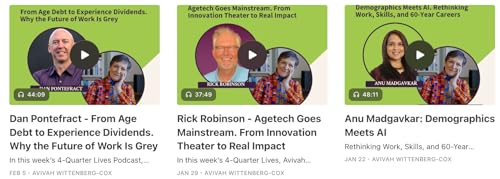
As we move into 2026, I’m launching a series of focused mini-series conversations on my 4-Quarter Lives podcast — three or four episodes clustered around one big strategic theme. And this is our first synthesis episode.Over the past few weeks, I’ve spoken with Anu Madgavkar from McKinsey on the hard economics of demographic decline and AI, Dan Pontefract on what he calls “age debt” inside organisations, and Rick Robinson from AARP Innovation on the commercial scale of the longevity economy.Individually, each conversation stands alone.Together, they tell a much bigger story.We are living through a structural convergence: shrinking workforces, accelerating automation, and a rapidly ageing consumer base. These are not separate trends. They are interlocking forces reshaping how we design work, build companies, and define growth.So in today’s episode, I’m stepping back from the individual interviews to connect the dots.What happens when demographic scarcity meets artificial intelligence?What are organisations quietly losing when they mishandle experience?And why is the so-called “longevity economy” less a niche and more the new baseline?If you’re leading a company, designing strategy, or simply trying to make sense of what the next twenty years look like — this one is for you.Let’s zoom outThese three recent conversations converge on a reality that most executive teams still underweight:We are not entering a demographic shift. We are already operating inside one.And AI has arrived at precisely the same moment.Ageing is still too often treated as a soft HR issue. AI is still too often treated as a technical IT issue. Both framings are now strategically obsolete. Demographic contraction and technological acceleration are twin forces reshaping labour supply, productivity, and market demand — simultaneously.This is not incremental change. It is structural redesign.Here’s 3 key lessons you can pull from these three experts.1. Scarcity Meets AutomationTwo-thirds of the global population now lives in countries with fertility rates below replacement. In advanced economies, the ratio of “working-age” adults (I know, I struggle with this outdated segmentation too) to over-65s is heading from roughly 4:1 toward 2:1 by mid-century.That is not an “ageing story.”It is a growth constraint.Shrinking labour supply is not a temporary market distortion. It is the new operating environment. The post-war demographic dividend has flipped into a headwind — and it will not reverse on any five-year strategic timeline.At the same time, AI is expanding productive capacity. A significant share of today’s work can technically be automated. A growing proportion of work hours will be repurposed says Anu Madgavkar (and the two essential McKinsey reports we discuss).The word that matters is not “replacement.” It is redesign.Demographic contraction reduces available human labour. AI increases task efficiency. Automation becomes the economic buffer against depopulation — but only if leaders redesign work to match.Waiting for talent markets to “normalise” is waiting for a world that no longer exists.In ageing societies, AI is not a discretionary innovation programme. It is a competitiveness necessity.2. The Hidden Liability: Age DebtInside organisations, a quieter cost is accumulating.Dan Pontefract calls it age debt — the liability companies build when they mishandle later careers, push out experienced professionals too early, and assume succession is a neat baton pass rather than a fragile knowledge transfer.Age debt shows up as:* institutional memory walking out the door* overstretched middle managers carrying unrecorded expertise* expensive hiring cycles to replace tacit knowledge* subtle cultural signals that ageing equals irrelevanceThe career architecture most firms still operate on was built for 40-year lives and retirement at 65. We are now building 60-year careers inside systems that were never redesigned for them.The cost is not sentimental. It is operational.Now add AI.As AI systems scale, the need for human judgment increases. Algorithms generate output; humans remain accountable. Context, pattern recognition, risk intuition, ethical calibration — these do not sit neatly inside code.Here is the paradox most boards have not fully absorbed:The more AI you introduce, the more you need experienced judgment.Automation raises the premium on wisdom.Push out seasoned professionals prematurely and you are not rejuvenating the workforce. You are eroding the human governance layer that makes AI safe and valuable.Retain and redesign later careers and you convert age debt into an experience dividend — a compounding asset of judgment, mentorship, decision quality, and system stability.Experience is not a cost centre. It is a strategic hedge.3. Innovation Beyond TheatreExternally, the blindness is just as pronounced.The so-called “longevity economy” is still widely misunderstood as a ...
Aucun commentaire pour le moment