Épisodes

  • The Classiest Plane Hijacking of All Time
    Feb 22 2026
    At 9:15 A.M. on November 10, 1961, a Lockheed Super Constellation of Portugal’s TAP airlines lifted off from Casablanca, Morocco. Aboard were nineteen passengers - mostly American tourists - bound for Lisbon. The skies that day were clear, and the flight looked to be smooth and uneventful. But just 45 minutes after takeoff, the pilot, Captain José Siqueira Marcelin, felt the cold barrel of a gun pressed against the back of his neck. The gun’s owner, a 39-year-old antifascist terrorist named Hermino da Palma Inácio, ordered Captain Marcelin to divert and fly over the cities of Lisbon, Barreiro, Beja, and Faro. Marcelin protested, arguing that the plane did not have enough fuel. But Inácio, a pilot and onetime aircraft mechanic himself, wasn’t fooled, and after glancing at the flight plan determined that the diversion was indeed possible. Out of options, Captain Marcelin had no choice but to obey. While in the early 1960s aerial terrorism was still a relatively new phenomenon, nothing could have prepared Marcelin and his passengers for what happened next. This is the outlandish story of history’s classiest hijacking. Author: Gilles Messier Editor: Daven Hiskey Host: Daven Hiskey Producer: Caden Nielsen Sponsor: Incogni - Use code BRAINFOOD and get 60% off an annual plan using the link ⁠https://incogni.com/brainfood Learn more about your ad choices. Visit megaphone.fm/adchoices
    Afficher plus Afficher moins
    19 min
  • Murphy’s Law in Action
    Feb 21 2026
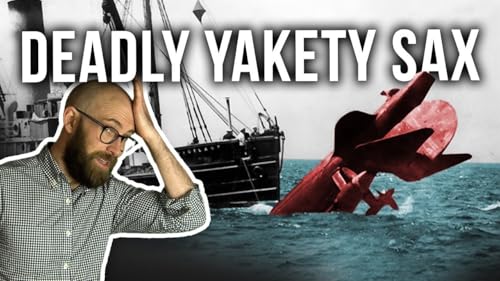
    It has been called the “silent service.” Since their introduction in the early 20th century, service aboard submarines has been among the deadliest military occupations, with a full 70% of German U-boat crews during WWII never returning from patrol. But the hazards faced by submariners go well beyond enemy guns, depth charges, and torpedoes; submarines are complex machines operating in an extremely hostile environment, and can prove just as deadly in peacetime as in war. So the crew of the British submarine HMS Thetis was to discover in June 1939 when a seemingly routine shakedown cruise ended in tragic accident where Murphy’s Law was proven an immutable rule of the universe. (By the way, if you’ve not seen our video on Who was the Murphy in Murphy’s Law, we strongly suggest you go watch it. Go ahead, we’ll wait. The man behind it, Dr. John Paul Stapp, is the unsung hero and saver of millions of lives since his incredibly badass work and balls of solid steel did what he did to give us Murphy’s Law.) Sponsor: Incogni - Use code BRAINFOOD and get 60% off an annual plan using the link https://incogni.com/brainfood Learn more about your ad choices. Visit megaphone.fm/adchoices
    Afficher plus Afficher moins
    15 min
  • How to Scratch an Itch in Space, the Surprisingly Long Time You Can Survive in Space Without a Spacesuit, Why the Apollo 13 Astronauts Got Cold, and Much, Much More
    Feb 20 2026
    In this episode of The Brain Food Show, we begin by following up on a previous discussion on Daimler and what exactly a little girl named Mercedes had to do with things. We then jump into the surprisingly oft’ requested follow up on Simon’s first ranch dressing experience. Next up we move into the meat of the episode, discussing how astronauts scratch an itch in their space suits, followed by looking at the surprisingly long time you can survive in space without a space suit or any other protection, with no long term damage. During that discussion we get side tracked talking about why the Apollo 13 crew got so cold on their trip when space is not cold at all, but rather a great insulator, and why they didn’t simply put on their space suits to keep warm. We then discuss at length the amazingly fascinating way in which airline planes get oxygen to passengers when there is no central oxygen store aboard the plane, outside of the pilot’s emergency supply. Then we look at the equally interesting way in which they get oxygen to passengers when there is a loss of cabin pressure- again, given there is no central oxygen store aboard the plane for passengers. Sponsor: Incogni - Use code BRAINFOOD and get 60% off an annual plan using the link https://incogni.com/brainfood Learn more about your ad choices. Visit megaphone.fm/adchoices
    Afficher plus Afficher moins

    1 h et 20 min
  • The Incredible Black Arrow Rocket
    Feb 19 2026
    When it comes to technological achievement and national prestige, few feats can compare to launching a satellite into space. Since the Soviet Union launched the world’s first satellite, Sputnik I, on October 4, 1957, 11 other government bodies have developed indigenous orbital launch capability: the United States, France, Japan, China, India, Israel, Ukraine, Iran, North Korea, South Korea, and a group of 22 nations represented by the European Space Agency. Conspicuously absent from the list is the United Kingdom, which in the late 1960s succeeded in developing this capability only to immediately abandon it. This is the story of the tragically brief British space program. At the end of the Second World War, Britain was well-positioned to start its own advanced rocketry program. Like the United States and the Soviet Union, the victorious ally had captured dozens of the German V2 rockets which had rained down on Southern England and Belgium at the end of the war - along with many of the scientists and technicians who had built and fired them. In October 1945, the British Army launched Operation Backfire, in which three captured V2s were assembled, launched, and filmed near Cuxhaven in Northern Germany. These experiments gave the British a wealth of knowledge and experience on the workings of the German terror weapon. One year later, on December 23, 1946, R.A. Smith and H.E. Ross of the British Interplanetary Society submitted to the Ministry of Supply a design for a modified V2 that could carry a man into space. Their concept replaced the rocket’s one-ton explosive warhead with a pressurized capsule that would detach at apogee and parachute to earth. Alas Britain, shattered both physically and financially by the war, could not afford to fund such a project, and all plans for military and civilian rocketry were quietly shelved... Author: Gilles Messier Editor: Daven Hiskey Host: Simon Whistler Producer: Samuel Avila Sponsor: Incogni - Use code BRAINFOOD and get 60% off an annual plan using the link ⁠https://incogni.com/brainfood Learn more about your ad choices. Visit megaphone.fm/adchoices
    Afficher plus Afficher moins
    18 min
  • The Junior High Dropout That Created Dunkin' Donuts
    Feb 18 2026
    In 1847 at the tender age of 16, seaman Hanson Gregory looked at some frying dough and said, “Everything is better with holes”… except his ship hull probably… and created the staple of breakfasts the diabetes lovin’ world over- the doughnut! Or so the story goes anyway. In truth, Captain Gregory’s account of how and why he supposedly invented the doughnut varied over time, and despite a statue being made of him in Rockport, Maine in 1947 commemorating his fried genius, nobody really knows where the holed doughnut came from. Some, including Captain Gregory, claim putting the hole in it makes it so you don’t get a mouthful of grease when you eat the center, but plenty of doughnuts exist that have no holes with no such issue. And people have been frying up such cakes for millennia with no apparent inclination to take the center out, except for occasionally to replace it with things like fruit and other fillings. Nevertheless, it was in the late 19th and early 20th century that suddenly many decided a hole should be present in such fried dough. As to why, the timing of the change gives arguably the best hypothesis, or at least potentially why it became popular. Around the same time doughnuts with holes first popped up in New York City, bagels were also becoming very popular in the same place and were commonly put on display and sold stacked on wooden dowels. Thus, it is sometimes hypothesized that bakers in New York first got the bright idea to put holes in the dough before frying when one or more of them thought to sell the doughnuts in the same way as bagels- on dowels, which saved display space and, perhaps more significantly, made it easier to sell en masse on street corners. With this hypothesis, making more evenly fried dough may or may not have come into play. Whatever the case, this holey fried dough rapidly gained in popularity in the early 20th century, particularly receiving a huge boost thanks to WWI and soldiers’ love of them in the trenches. This all leads us to the topic of today- that time a Jr High dropout might as well have put a hole in people’s pockets with how fast they started throwing money at him when he created one of the most successful franchise businesses in history- The Open Kettle… Author: Daven Hiskey Host: Simon Whistler Producer: Samuel Avila Sponsor: Incogni - Use code BRAINFOOD and get 60% off an annual plan using the link https://incogni.com/brainfood Learn more about your ad choices. Visit megaphone.fm/adchoices
    Afficher plus Afficher moins
    14 min
  • Inventing Color in a World That was Black and White
    Feb 17 2026
    When we think of the past prior to the 1960s or so, we tend to picture it in black and white. Much of the visual media of this period - including still photographs to films to television - was rendered in shades of grey, making relatively recent history seem that much more distant and alien. But colour photography did exist in the first half of the 20th Century; just think of classic films like The Wizard of Oz, released in 1939. But if this technology existed, why wasn’t it more common? And who first figured out how to capture the world in full living colour? Well, prepare to go from sepia to technicolour like Dorothy as we dive into the fascinating - and surprisingly long - history of colour photography. Throughout the black-and-white photography era, people added colour to photographs and film by hand-tinting them with paint and ink. However, the development of true colour photography required a scientific understanding of how humans perceive colour. In 1850, German physicist Hermann von Helmholtz developed the trichromatic theory of vision, which postulated that the human eye contained three different kinds of light receptors - today known as cone cells - each sensitive to one of three colours: red, blue, and green. In 1861, English photographer Thomas Sutton, working with Scottish physicist James Clerk Maxwell, applied Helmholtz’s theories to create history’s first colour photograph. Sutton took three separate photographs of a tartan ribbon through a red, blue, and green filter, then converted these photographs into slides and projected them back through their respective filters, the three slides combining to create a full colour photograph. Though this image could not be fixed on a physical medium, Maxwell’s demonstration nonetheless pioneered the additive colour process, which would form the basis of colour photography for the next few decades. Shortly after Sutton’s experiment, French physicist... Author: Gilles Messier Editor: Daven Hiskey Producer: Caden Nielsen Host: Simon Whistler Sponsor: Incogni - Use code BRAINFOOD and get 60% off an annual plan using the link https://incogni.com/brainfood Learn more about your ad choices. Visit megaphone.fm/adchoices
    Afficher plus Afficher moins
    18 min
  • How Astronauts Go to the Bathroom in Space and How Women Can Safely Pee Standing Up
    Feb 16 2026
    ⁠⁠In this episode of The Brain Food Show, we begin by following up on a previous discussion on what the first good movie based on a computer game was. We then jump right into the various ways in which astronauts have managed their necessary expulsions over the years and some hilarious stories and interesting related facts that go along with that, including the teased Apollo 10 incident from The Final Frontier Part 1. We then discuss the lost skill of women peeing standing up without getting any pee on themselves or their underwear in the process, and how exactly this is done with no equipment required. Sponsor: Incogni - Use code BRAINFOOD and get 60% off an annual plan using the link https://incogni.com/brainfood Learn more about your ad choices. Visit megaphone.fm/adchoices
    Afficher plus Afficher moins
    1 h et 15 min
  • How They Ruined Superhero Movies
    Feb 15 2026
    “In mutant heaven there are no pearly gates, but instead revolving doors.” - Professor X In the realm of comic books, the rules of the respective universe you’re reading about tend to differ wildly from the rules of our own. Besides the obvious thing of the world of say Marvel or DC being populated with virtual gods, iron plated dictators who sit atop flying laser thrones and a CEO who beats up criminals in a billion-dollar ninja-themed fur suit, problems in these universes sort of seem to just, go away. Property damage, the judicial process and paper works are just a handful examples of things that don’t particularly seem to matter in comics and as a result, are rarely dwelled upon. There are exceptions of course, but for the most part the stories told by comics are allegorical so such details don’t really matter. Perhaps the most unusual reality of life comics have made a habit of sidestepping though is the idea of death, which is often portrayed as being about as much of an inconvenience to a comic character as an out of office hours work email. A trope so common even the characters in these stories have started to call it out. Now, to begin with, think of a comic character. Do you have one in mind? Good. Okay so there’s a good chance that, at some point, that character has died, been buried, mourned and memorialised before springing back to life to continue slapping aside criminals and supervillains in form-fitting spandex as if nothing happened. And if they haven’t “died” there’s a good chance they were presumed dead after an explosion or something and then came back as if nothing had happened. Starting with some of the heavier hitters from the DC side we have Batman, Superman, Wonder Woman, Green Lantern, The Flash, Martian Manhunter, Green Arrow and Robin. All of whom, at some point in their comic history have “died” and then came back. Author: Karl Smallwood Editor: Daven Hiskey Producer: Samuel Avila Host: Simon Whistler Sponsor: Incogni - Use code BRAINFOOD and get 60% off an annual plan using the link https://incogni.com/brainfood Learn more about your ad choices. Visit megaphone.fm/adchoices
    Afficher plus Afficher moins
    18 min