Épisodes

  • The Digital Deadbolt: Trump, Chinese AI, and the Iranian Resistance
    Apr 10 2026
    I have never been a friend to war. I recoil from the kinetic certainty of missile strikes and the automated geometry of aerial bombardment; there is no "glory" in the sterile violence of Operation Epic Fury. Yet, my distaste for conflict is matched only by my profound understanding of the threat that lives within Tehran. We are not dealing with a rational actor in the conventional sense. The current government, a far-right, theocratic echo chamber of the IRGC, views the development of multiple nuclear weapons not as a strategic deterrent, but as a righteous end state, a tool for divine leverage in a temporal world. This quest, which is both existential and non-negotiable for the regime, must be neutralized. This is the tragic premise. I see the righteousness in the mission to make sure that Iran, currently under the control of murderous far-right religious lunatics, is never a world nuclear power and giving the Iranian people a voice from this choking grip. The aspiration of President Trump to catalyze a bottom-up revolution, an "en masse" rising, is noble. It is the only moral outcome. I want the streets of Iran to be reclaimed by those who truly live in them. But wanting the Gordian Knot cut is not the same as having the sword. And right now, the sword of American military power, despite its immense kinetic capability, is being blunted not by traditional armor, but by an integrated digital mesh. We are not just fighting the IRGC; we are fighting the ghost of Chinese authoritarianism that the IRGC has imported. This is where the variable of Tiandy Technologies moves from a footnote to the entire thesis. Tiandy Technologies Co., Ltd. is a privately held surveillance giant based in Tianjin, China. It is currently ranked as the 7th largest security company in the world. The company is controlled by its founder and Chairman, Dai Lin, who owns a majority stake. Dai Lin is a billionaire whose wealth is directly tied to the expansion of China's domestic and international surveillance contracts. The company also receives significant state support and funding from the Tianjin municipal government and Chinese state-owned banks. As of 2026, Tiandy is estimated to have an annual revenue exceeding $950 million to $1.1 billion. While not publicly traded, its market valuation in the private sector, driven by its dominance in the "safe city" markets of the Global South, is estimated at approximately $4.5 billion. Tiandy has operated in Iran since at least 2011, but its role became critical in 2021 when it signed a multi-year deal to provide "AI-enabled public safety solutions" to the IRGC and the Law Enforcement Forces (LEF). Tiandy does not just sell cameras; they provide a "total solution" for detention and questioning. These tools are designed to use AI to break a prisoner's psychological resolve. Approximately $12,000 to $18,000 per unit depending on the sensor suite. These tables are embedded with high-definition cameras and "emotion detection" sensors. They track pupil dilation, heart rate, and skin temperature. The AI analyzes these biometrics in real-time to provide the interrogator with a "sincerity score." If the prisoner’s heart rate spikes during a specific question about a protest organizer, the system flags it as a "likely deception," prompting the interrogator to escalate pressure. Iran has adapted China's Social Credit System (SCS) to create a digital caste system. In the Iranian context, "Trustworthiness" is redefined as "Loyalty to the Wilayat al-Faqih" (the Guardianship of the Jurist). Earned through participation in pro-government rallies, "Basij" volunteer work, or reporting "un-Islamic" behavior in neighbors. Triggered by participation in strikes, posting "subversive" content on Telegram/Instagram, or being flagged by AI for improper hijab. The IRGC spent an estimated $85 million in 2025 to link the national "Nazer" (Monitor) database with the Social Credit platform. A citizen who drops below a "C-Rating" (approximately 600 points) is automatically blocked from buying airline or high-speed rail tickets, a direct copy of the Chinese "Deadbeat Map" strategy. "We are moving toward a 'Smart Governance' model where technology ensures that those who serve the revolution are rewarded, and those who seek to burn the country are identified before they can strike." - Alireza Zakani, Mayor of Tehran (2024). In early 2024, a leaked contract revealed €400 million (approx. $435 million) purchase for "smart cameras" from Chinese firms to blanket Tehran. The standard AI Bullet Camera costs $625–$785 and the 4K Pan-Tilt-Zoom (PTZ) with 40x Optical Zoom costs $3,200+. These are used to identify individual faces in crowds from over 500 meters away. By early 2025, Iran committed $115 million to a "National AI Cloud" to host the massive data generated by these millions of sensors. During the opening of Operation Epic Fury (Feb 28, 2026), President Trump’s call for a mass uprising was met with a technical "...
    Afficher plus Afficher moins
    5 min
  • Marxists Suck at Competent Leadership on Homelessness: The Fiscal Fiasco on California’s Streets
    Apr 9 2026
    As a political centrist, my concern lies not in ideological extremes, but in pragmatic governance and the responsible stewardship of taxpayer dollars. The escalating crisis of homelessness in California is not just a humanitarian tragedy; it has become a dangerous blight on our communities, impacting public safety, sanitation, and the overall quality of life for all residents. What is particularly infuriating is the apparent inability of our state leadership to effectively utilize the vast sums of money allocated to address this issue. With prices remaining high for necessities like gasoline, electricity, food, and housing, and consumer credit card debt reaching alarming levels, the relatively recent revelation that California cannot fully account for nearly $24 billion spent on homelessness is particularly shocking. It is not simply an accounting error but a damning indictment of incompetence and a profound betrayal of the public trust. For years, Californians have witnessed the growth of encampments, the rise in both petty and more violent crimes and drug use associated with untreated homelessness, and a palpable sense of insecurity in our public spaces. We, the taxpayers, have consistently supported efforts to alleviate this suffering, with the understanding that our contributions would translate into tangible solutions. Yet, the staggering figure of $24 billion spent with questionable accountability raises a fundamental question: where did the money go, and what tangible progress, backed by data, has it actually yielded? Growing up in Southern California with KROQ as my ever-present soundtrack of 80s alternative music, I, like many Gen X’ers who were impacted by the 1986 Comic Relief concert for the homeless, was always inclined to support measures like propositions and tax increases to aid this cause. Yet, nearly 40 years have passed, and despite paying significantly more now, I’ve observed not just stagnation on the homelessness issue, but a disheartening regression. The lack of a unified, effective strategy is glaring. Responsibility for addressing homelessness is scattered across numerous state agencies, local governments, and non-profit organizations, creating a bureaucratic labyrinth where funds can disappear into a black hole of fragmented systems and inconsistent data collection. The absence of standardized reporting and outcome measurement has allowed for a situation where billions can be spent without a clear understanding of what works, what doesn’t, and whether taxpayer money is actually making a difference in the lives of those experiencing homelessness or the safety of our communities. The excuses offered — the complexity of the issue, the lack of affordable housing, the challenges of mental health and substance abuse — while partially valid, do not absolve state leadership of their responsibility to ensure fiscal accountability. Competent governance demands the establishment of robust tracking mechanisms, transparent reporting requirements, and rigorous oversight to guarantee that public funds are used efficiently and effectively. The fact that audits reveal “poor data quality and integration” at the local level, coupled with concerns about insufficient financial controls, paints a picture of systemic failure in managing a crisis of this magnitude. Having recently earned a humble Google Data Analytics Certificate, I’ve gained a new insight as to the significance of reliable and clean data and this has made the apparent lack of reliable and clean data for the state of California particularly concerning. As W. Edwards Deming famously said, “In God we trust, all others must bring data,” emphasizing the primacy of evidence over ideology. Given the modern value placed on data, often described as “the new oil,” why isn’t California run with more business-like precision, focusing on stated objectives and data-driven solutions, instead of what many see as a failing progressive experiment? While I respect the right to hold leftist progressive ideals, a state governed by unchecked ideology, devoid of centrist or conservative counterbalances, and relying on substandard data is not progressive; it’s unacceptable! This same style of ideological governance hindered effective wildfire response during intense windstorms in January of 2025. Speaking of incompetent California governance, ideological hires, and its struggles to meet the challenge of devastating wind-fed wildfires in Southern California, the data emerging from Los Angeles County regarding the connection between homelessness and fire incidents is deeply concerning and demands serious attention. The data indicates a significant problem: one report from early 2025 suggests that 54% of all fires in Los Angeles during 2023 were linked to homeless encampments. Alarmingly, another report from May of last year cited nearly 17,000 fires in the city of Los Angeles alone attributed to homeless individuals in 2024. Even...
    Afficher plus Afficher moins
    6 min
  • A Comparative Study of Michael Corleone and Thomas Shelby OBE: The Psychology, the Physical Presence, and the Economics of the Head that Holds the Crown
    Apr 8 2026
    In the pantheon of cinematic crime, few figures cast a longer shadow than Michael Corleone and Thomas Shelby OBE. Though separated by decades and the vast expanse of the Atlantic, the protagonists of The Godfather and Peaky Blinders are cut from the same cloth, a durable, blood-stained fabric of post-war trauma and relentless ambition. Their stories are not merely chronicles of lawlessness; they are profound explorations of how the individual is consumed by the systems they seek to master. By comparing their psychological trajectories and the tangible economic ripples their stories have sent through the real world, we uncover a shared narrative of the high cost of the "American Dream" and its British industrial counterpart. The foundation of both men is built upon the scorched earth of global warfare. Michael Corleone, a decorated Marine of the Second World War, and Thomas Shelby OBE, a tunnel-digging Sergeant Major of the Great War, are introduced to the audience as men whose souls have been cauterized by mechanized slaughter. This shared "veteran’s burden" is the engine of their success. Unlike their more volatile siblings, the impulsive Sonny Corleone or the fractured Arthur Shelby, Michael and Tommy operate with a cold, tactical detachment. They do not view violence as an emotional release, but as a necessary line item in a ledger. Their military service provided them with the organizational discipline and emotional numbness required to treat a criminal empire like a sovereign state. However, their leadership styles diverge through the lens of their specific ambitions. Michael Corleone is the ultimate "Architect" of isolation. His trajectory is a tragic irony: he enters the family business to protect it, yet his methodology, marked by silence, calculation, and the preemptive strike only when the board is perfectly set, as seen in the "Baptism Murders." It eventually leaves him ruling over a graveyard of his own making. Michael’s primary struggle is the transition to legitimacy, a goal that remains forever out of reach because he cannot reconcile the morality of the "straight" world with the ruthlessness required to protect his father’s legacy. In contrast, Thomas Shelby OBE is the "Commander" of expansion. While Michael often reacts to threats, Tommy is more overtly ambitious and expansive. Tommy is a colonialist of the underworld, aggressively pushing from the slums of Small Heath into the halls of Parliament. He is more comfortable with the grime of the street than Michael, leveraging personal charisma and Romani mysticism to maintain a loyalty that Michael can only buy through fear. The moral decay of these characters is punctuated by the loss of the women who anchored them to their humanity. The deaths of Apollonia and Grace, and the eventual alienation of Kay, serve as the "price of the crown." For Michael, this decay results in a spiritual hollow, a man who ends his life alone in a Sicilian courtyard, having saved the "business" but lost the family it was meant to sustain. For Tommy, the decay is more hallucinatory, a battle with PTSD that he attempts to outrun through political power and social influence. OBE stands for Officer of the Most Excellent Order of the British Empire. It is a prestigious chivalric honor bestowed by the British monarch to recognize a major role or contribution to society. For Tommy Shelby, it signifies his transition into a legitimate, respected member of the upper class. While Michael represents the death of the soul, Tommy represents the desperate search for its redemption. Beyond their strategic minds, much of the enduring power of these characters lies in their overwhelming physical and emotional presence. Their fashion is not merely clothing but armor; for Michael, the transition from his baggy Marine uniform to the sharp, dark, high-collared silk suits of the 1950s signals his total immersion into the underworld. His presence is defined by stillness and the "Corleone Stare,” an unblinking, predatory gaze that investigates and intimidates without a single word. A definitive moment occurs in The Godfather Part II during the Senate hearings: Michael sits perfectly still, his eyes burning with a quiet, lethal intensity that makes him the most dangerous man in a room full of federal power. This stillness is most terrifying during his interrogations; Michael often sits across from a subordinate or enemy, asking a question he already knows the answer to. The audience feels the crushing weight of his gaze as he waits for a lie, creating a sense of psychological entrapment where his eyes act as a mirror to the victim's guilt. In contrast, Thomas Shelby OBE possesses a kinetic, almost "superhero" quality defined by the famous "Peaky Blinders Walk." Tommy’s strut, a forward leaning, brooding, rhythmic pace with squared shoulders and arms held wide as if perpetually prepared to draw from his leather gun holsters, commands the very air around him. This movement...
    Afficher plus Afficher moins
    19 min
  • The Costs of a Nuclear Free Iran and the Costs of Iran as a Nuclear Power
    Apr 7 2026
    Launched February 28, 2026, the joint U.S.-Israeli strikes successfully neutralized primary enrichment infrastructure at Natanz and Fordow. As of April 2026, the Middle East stands at a precipice that has been decades in the making. The smoke rising from the enrichment facilities at Natanz and Fordow, is not merely the result of a month-long air campaign; it is the physical manifestation of a collapsed diplomatic order. For forty-seven years, the United States engaged in a "slow-bleed" strategy of containment, spending upwards of $122 billion specifically to neutralize Iranian-backed groups (Hezbollah, Houthis, and PMF). An additional $12 billion was spent in the two years leading up to the current war to defend the Red Sea and Israel from drone saturation attacks. Today, that strategy has been discarded in favor of a high-stakes, high-impact military intervention aimed at a definitive conclusion to the "Iran Problem." The immediate fiscal reality of this shift is staggering. In just thirty-two days, the direct military outlay has reached nearly $28 billion, a burn rate that would have been unthinkable during the era of strategic patience. Retaliatory strikes from Iranian forces have destroyed approximately $2.52 billion in U.S. hardware, including an AN/FPS-132 early warning radar ($1.1B). With the Pentagon requesting an additional $200 billion in emergency funding, the American taxpayer is being asked to fund a gamble: that an intense, expensive surge today is more sustainable than another half-century of proxy skirmishes. Yet, proponents of the intervention argue that even this massive price tag is a bargain compared to the alternative. A single nuclear breakout by the Iranian regime could trigger a regional exchange with a global economic toll exceeding $6 trillion, potentially ending the U.S. dollar’s reign as the global reserve currency. Potential Targets of a Nuclear-Armed Iran would be Israel (Tel Aviv/Haifa) with an estimated $1.4 trillion in immediate economic destruction; 300,000+ casualties. The KSA, or the Kingdom of Saudi Arabia, specifically an attack on Dhahran and Riyadh oil infrastructure could trigger a $4 trillion to $6 trillion global energy depression. A nuclear attack on the UAE, Dubai and Abu Dhabi would result in an Immediate wipeout of $120 billion in market capitalization and systemic banking failure. The United States response and costs would trigger the "Decapitation Doctrine,” a full-scale thermonuclear response targeting IRGC command. The estimated response cost within the first 24 hours of retaliation would cost $45 billion, with a total war cost potentially reaching $3 trillion. However, the war is not being fought only in the silos and command centers of the Islamic Revolutionary Guard Corps (IRGC). There is a second, parallel conflict, a "war against the people," waged by a far-right theocratic government that has prioritized ideological purity and domestic survival over the basic welfare of its eighty-five million citizens. The economic cost of this domestic repression is a self-inflicted catastrophe. Iran’s GDP is projected to contract by 10% in 2026 alone. Capital is fleeing the country at a record pace of $15 billion per quarter, and hyper-inflation has pushed nearly two-thirds of the population below the poverty line. The human toll of this internal crackdown provides the most haunting evidence of the regime’s character. The "2026 Massacres" have claimed thousands of lives, including students like twenty-three-year-old Robina Aminian and athletes like champion wrestler Saleh Mohammadi, who was executed in Qom this past March despite global outcries. The state’s use of advanced Chinese supplied, AI-driven surveillance has created what activists call "algorithmic fear," a system where dissent is identified and crushed before it can reach the streets. As Nazanin Zarei, an underground organizer, noted from her hiding place, the Iranian people are not just fighting men with guns, but a "ghost in the machine" that logs their faces and threatens their families within hours of a protest. Despite President Trump's explicit calls for revolution, success is impeded by the Iranian people remaining trapped in "survival mode." When the search for bread takes ten hours a day, there is little energy left for heroism. Fragmented opposition lacks the heavy weaponry to face the IRGC. Furthermore, the external bombardment, while targeting the regime’s nuclear teeth, has inadvertently stoked a "rally around the flag" effect, where even the most ardent critics of the theocracy fear that a revolution mid-war might lead to a foreign-installed puppet state. The financial trajectory of the Iran conflict presents a stark choice between "Slow Bleed" and "High Impact" expenditure. Approximately $122 billion has been spent in a multi-generational effort to contain the IRGC's regional expansion and proxy networks. This represents a steady drain on U.S. resources with no ...
    Afficher plus Afficher moins
    7 min
  • Reflection on Gold Star Spouses Day 2026
    Apr 6 2026

    In the quiet landscape of American military remembrance, few days carry as much weight or as personal a history as April 5th. Known as Gold Star Spouses Day, it is a date that marks more than just a place on the calendar; it is a testament to the enduring resilience of those left behind when the cost of freedom is paid in full. To understand the purpose of this day is to understand a legacy of mutual aid that began in a small Manhattan apartment over eighty years ago and continues to shape national policy and community support in 2026.

    The specific choice of April 5th serves as a living monument to the founding of the Gold Star Wives of America. On that day in 1945, while the world was still gripped by the closing chapters of World War II, four young widows gathered in the home of Marie Jordan. Their goal was simple yet revolutionary: to create a support system for women who, like themselves, were navigating the sudden, hollow silence of a life interrupted by war. The organization’s gravity was solidified just a week later when President Franklin D. Roosevelt passed away. His widow, Eleanor Roosevelt, joined the fledgling group, eventually becoming one of the fifteen original signers of its 1945 charter. Her involvement transformed a private support circle into a national movement, lending the prestige of the White House to the struggles of military widows.

    The evolution of the day’s name reflects a broadening of the American heart. While the observance began as "Gold Star Wives Day," officially recognized in 2010 and tied to the April 5th date by the Senate in 2012, it was renamed in 2016. This shift to "Gold Star Spouses Day" was a necessary acknowledgment that grief is not gendered. It honored the husbands, as well as the wives, who stand as the surviving pillars of military families.

    In 2026, the observance has taken on a renewed significance, framed by the upcoming Semiquincentennial—the 250th anniversary of the United States. This year has seen a transition from mere recognition to radical support. For instance, the Tunnel to Towers Foundation marked the season by providing thirty mortgage-free homes to Gold Star families, a move Chairman Frank Siller described as a way to ensure children of heroes have a "place to call home, free from any financial burden." Simultaneously, the Department of Veterans Affairs has intensified its focus on the "Edith Nourse Rogers STEM Scholarship," ensuring that the sacrifice of a spouse does not result in the end of a family’s educational dreams.

    The spirit of the day is perhaps best captured by the voices of those who live it. Early member Myrtle Tedesco once reflected on the raw necessity of their community, noting, "I watched her kids at night so she could work, and she watched my kids during the day... we didn't get much money back then." This tradition of "carrying the torch" continues with modern spouses like Annie Cox, who observes that the honor belongs to those who continue the journey long after the flags have been folded.

    This sentiment has been echoed at the highest levels of government. In his 2026 State of the Union address and subsequent proclamations, President Donald Trump highlighted the "unfathomable heartache" of survivors. He described Gold Star families as those who "know better than anyone the tremendous cost of our freedom," emphasizing that their loved ones "forfeited their hopes and dreams so that others may live with peace." By pledging "enduring support and respect" through a policy of peace through strength, the 2026 observance reaffirms a sacred national contract: that while a soldier may fall, their family will never be left to stand alone.

    Gold Star Spouses Day is not merely a look backward at the tragedies of the past. It is a day that celebrates the strength of the survivors who, since 1945, have turned their private grief into a public service, ensuring that the legacy of their loved ones remains a guiding light for the nation.

    Afficher plus Afficher moins
    5 min
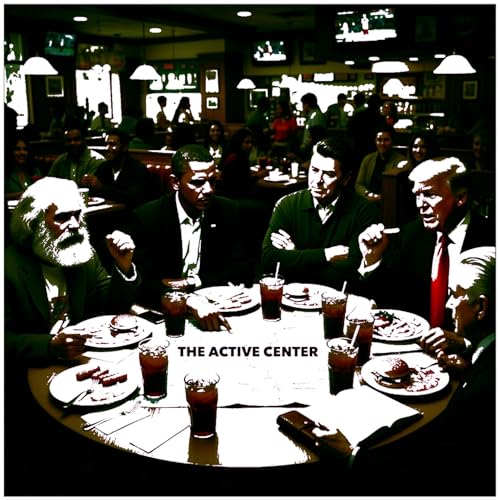
  • The Active Center: A Biological Blueprint for Civic Action
    Apr 3 2026

    For David Sepe (pronounced "Seh-pee"), the name of his creative project, The Active Center, is more than just a title; it is a philosophy. Through a diverse range of podcasts, essays, and music, Sepe explores the political, economic, and social architecture of America. The name is borrowed from a fundamental concept in biology to describe a vision for a more functional and productive society.

    In biology, the "active center" (or active site) of an enzyme is a highly optimized region where catalysis occurs. It is where substrates are converted into products, lowering the energy required for a reaction to take place. At the molecular level, the active center does more than just host a reaction; it orchestrates it through precise orientation and "induced fit." By bringing disparate molecules into exactly the right alignment, the enzyme overcomes the natural chaos and repulsion that usually prevent a bond from forming.

    This biological phenomenon creates a micro-environment where the "activation energy" is dramatically lowered, allowing life-sustaining processes to occur that would otherwise be impossible or too slow to matter. Without this focused center, the biological system would be a soup of potential energy that never translates into action.

    Sepe believes our political, economic, and social systems should function the same way. Rather than retreating to the extreme left or right, where energy is often wasted in friction and ideological purity tests, we need to move forward from a place of pragmatism, reason, and action. This "Dynamic Center" is not a place of lukewarm compromise, but a high-energy zone of alignment where the actual work of representative government happens. It is the site where diverse interests are oriented toward common goals, lowering the barriers to progress and ensuring that freedom and democracy are not just abstract concepts, but functional tools that work better for more people. The Active Center is his contribution to that movement: content for those who believe in the American System but demand that it work better for more people.

    Hello, and thanks for listening to my podcast For years, my mission has been to foster a community around engagement, unique takes on interesting stories, and conversation. If you value what I do, please consider supporting me. I've started a GoFundMe to cover my production and operational costs, including those pesky social media fees. If you can’t contribute to my GoFundMe, I get it, but you can help me by subscribing to my account or sharing this particular story with friends and family that you think would appreciate it. Your contribution, big or small, helps me keep going. Thank you.

    GO FUND ME

    Afficher plus Afficher moins
    6 min
  • The Lunar Economy, 8th Continent, and Lunar Sovereignty, Oh My!
    Apr 2 2026
    As a lifelong observer of the stars, I see this NASA mission as more than a daring flyby. The Artemis II flight is the starting gun for a multi-decade economic expansion. It is the moment the Moon stops being a distant, silver lantern in our sky and starts becoming what many are already calling the "Eighth Continent." By 2030, the Moon is projected to transition from a scientific outpost to a commercial hub, often referred to as the "Eighth Continent." We are no longer just visiting; we are preparing to move in, and the political, economic, and spiritual implications for both Earth and its satellite are profound. For decades, we viewed space as a government-funded "temple,’ a place for flags, footprints, and prestige. But the transition we are witnessing now is the birth of a true lunar economy, built on the backbone of what NASA calls "In-Situ Resource Utilization." In simpler terms: living off the land. As nations return to the Moon, the political landscape is defined by a tension between international law and strategic "boots on the ground." Under the 1967 Outer Space Treaty, no nation can claim sovereignty over the Moon or its territory. However, the treaty allows for the "use" of lunar land. While the Moon isn't legally divided like Earth's continents, nations are establishing "safety zones" around their outposts to prevent interference, creating a de facto patchwork of operational control. Two primary blocs have emerged. The Artemis Accords, led by the U.S. and joined by over 40 nations, emphasize commercial rights. In opposition, China and Russia are leading the International Lunar Research Station (ILRS). The "real estate" of the century due to Water Ice and Peaks of Eternal Light (near-constant sunlight for power). The Lunar South Pole has become the most coveted real estate in the solar system, not for its view, but for its "black gold,” water ice. Hidden in the shadows of craters like Shackleton, this ice is the "gas station" for the next century. By splitting water into hydrogen and oxygen, companies like Intuitive Machines and Astrobotic aren't just looking for a drink; they are creating the propellant that will fuel the first human footsteps on Mars. The transition from exploration to economy is being funded by NASA's Commercial Lunar Payload Services (CLPS), which has a total contract ceiling of $2.6 billion through 2028. NASA awarded Intuitive Machines approximately $118 million for the IM-2 mission (PRIME-1), which features a drill to harvest ice. Astrobotic was previously awarded $320.4 million for the Griffin lander to deliver the water-prospecting VIPER rover. "We will find, characterize and eventually utilize the water-ice on the Moon. VIPER will inform our human landing," said former NASA Administrator Jim Bridenstine. Primarily private venture capital. In 2024, Interlune secured a hundred-million-dollar deal with the Finnish firm Bluefors to purchase lunar Helium-3 for quantum computing applications. Interlune aims to be the first to commercialize lunar resources. CEO Rob Meyerson stated, "Interlune will provide the huge amounts of helium-3 that are critical for the development and operation of quantum computers." As for cislunar logistics and transportation, SpaceX holds a $2.9 billion contract for the initial Human Landing System (Starship). Blue Origin was awarded $3.4 billion for the "Blue Moon" lander as a second provider to ensure competition. NASA Administrator Bill Nelson noted, "We want more competition. We want two landers... that means you have more reliability and you have a backup." NASA awarded Nokia $14.1 million under the "Tipping Point" program to build the first 4G/LTE cellular network on the Moon. Intuitive Machines secured a $4.8 billion (potential ceiling) contract for the Near Space Network to provide communication and navigation services. "The system could support lunar surface communications at greater distances, increased speeds and provide more reliability than current standards," according to NASA's award announcement. The lunar economy currently relies on a hybrid funding model. The Anchor Tenant (NASA), underwriting the majority of early costs through CLPS and Artemis. For FY2025, NASA's Artemis-related budget lines totaled roughly $7.6 billion. Firms like American DeepTech are calling for a $100 billion+ "Space Project Finance" initiative to move beyond government agency capital. International Partners: The European Space Agency (ESA) and Canadian Space Agency (CSA) are contributing billions in hardware (like the $1 billion Canadarm3) in exchange for crew seats and research access. The timeline has been set. Phase 1 is exploration (2024–2026) with Robotic missions (CLPS) map resources; and the Artemis II flyby proves crew safety. Phase 2 is Colonization and Settlement (2027–2030). The Artemis III landing will be the establishment of the Lunar Gateway ($332M launch contract to SpaceX). The last will be Phase 3, (2030s+) will be the ...
    Afficher plus Afficher moins
    6 min
  • The Mechanics and Successes of Supply-Side Economics: A Theoretical and Historical Overview
    Apr 1 2026
    Supply-side economics represents a foundational school of macroeconomic thought that rose to prominence in the late 20th century as a solution to the stagnation of the post-war era. While traditional Keynesian models focus on managing total spending, supply-side theory posits that the most effective way to foster sustained economic growth is to increase the aggregate supply of goods and services. By focusing on the producer and the entrepreneur, proponents argue that a more efficient, less restricted market naturally leads to broader prosperity and technological innovation. The fundamental premise of supply-side theory is that economic growth is best nurtured by lowering the barriers to production. This is achieved through three primary policy levers: the reduction of marginal tax rates, the deregulation of industries, and the privatization of government services. The logic suggests that high taxes on income and capital gains act as a penalty on productivity, disincentivizing individuals and businesses from working and investing. For example, when corporate tax rates are lowered, a firm that previously saw a project as unprofitable due to tax burdens may now find the "after-tax return" high enough to justify building a new factory or hiring additional staff. As Adam Smith famously noted in The Wealth of Nations, "It is not from the benevolence of the butcher, the brewer, or the baker that we expect our dinner, but from their regard to their own interest." By lowering taxes, the government aligns the self-interest of the producer with the expansion of the national economy, ensuring that capital is deployed toward its most productive uses rather than being shielded in tax havens. A critical theoretical pillar of this school is the Laffer Curve, which illustrates the relationship between tax rates and total tax revenue. The curve suggests that there is an "optimal" tax rate that maximizes government income without stifling the economy. As Arthur Laffer succinctly argued, "There are always two tax rates that yield the same revenues," pointing to the reality that a 100% tax rate yields nothing because people cease to work, just as a 0% rate yields nothing. This concept was vividly demonstrated in the early 1960s under President John F. Kennedy; after substantial across-the-board tax cuts, the resulting economic boom led to a nearly 62% increase in personal income tax receipts by the end of the decade. This historical precedent provided the mathematical justification for the tax cuts of the 1980s, proposing that lowering prohibitive rates could stimulate enough new taxable economic activity to offset the lower percentage, a concept that famously appealed to advocates of limited government. The most prominent real-world application of these theories occurred during the presidency of Ronald Reagan. Facing the "stagflation" of the 1970s—a combination of stagnant growth and high inflation, the Reagan administration implemented significant tax cuts and sought to reduce the federal regulatory burden. Reagan often encapsulated this philosophy by stating, "Government's view of the economy could be summed up in a few short phrases: If it moves, tax it. If it keeps moving, regulate it. And if it stops moving, subsidize it." By reversing this trend through the Economic Recovery Tax Act of 1981, which slashed the top marginal tax rate from 70% to 50%, the administration aimed to jumpstart the "engine" of private enterprise. The results of this era were marked by a dramatic reduction in unemployment from 10.8% to 5.4%, and a rise in GDP exceeding 4%. Milton Friedman, the Nobel Prize-winning economist and champion of free-market capitalism, was a staunch supporter of these moves. Friedman argued that the reduction of the money supply to combat inflation, combined with the removal of government "wedges" like high taxes, was the only viable path to a stable, prosperous economy. Furthermore, while government spending was reallocated during this period, it served as a catalyst for unprecedented technological breakthroughs that validated the supply-side focus on long-term capital investment. As President Reagan noted in his 1988 State of the Union address, "The progress of the future will be measured in the advancement of the human mind and the exploration of the heavens." This vision was realized through high-tech defense and research and development (R&D) that laid the groundwork for the modern digital age. Strategic investments led to the commercialization of the Global Positioning System (GPS) and the early infrastructure of the Internet (ARPANET). Notably, innovations like digital x-rays—originally developed to x-ray bolts and structural components for space travel and high-altitude defense, were later adapted for medical use. These "dual-use" technologies became essential tools in oncology for locating and fighting cancer, proving that supply-side incentives for high-stakes innovation yield life-saving dividends for ...
    Afficher plus Afficher moins
    7 min