Couverture de Tell Us More About That

Tell Us More About That

Tell Us More About That

De : Tony Paixão and Jen Crawford
Écouter gratuitement

3 mois pour 0,99 €/mois

Après 3 mois, 9.95 €/mois. Offre soumise à conditions.

À propos de ce contenu audio

"Tell Us More About That" (TUMAT) is a podcast focused on taking the often complex, misunderstood, or under discussed topics within human psychology and connecting the dots to our individual experiences. TUMAT is dedicated to decoding the "why" behind the "what" through casual and insightful conversations with some of the most credible experts in the industry. Join us and our guests as we turn the complicated into the candid, exploring the fascinating world of human psychology. Serious topics. Credible Guests. Candid Conversation.Tony Paixão and Jen Crawford Hygiène et vie saine Psychologie Psychologie et psychiatrie
Les membres Amazon Prime bénéficient automatiquement de 2 livres audio offerts chez Audible.

Vous êtes membre Amazon Prime ?

Bénéficiez automatiquement de 2 livres audio offerts.
Bonne écoute !
    Épisodes
    • Narcissistic Personality Disorder (NPD), Borderline Personality Disorder (BPD), and Mentalization-Based Treatment (MBT): A conversation with Bob Drozek, LICSW and Brandon Unruh, MD.
      Sep 14 2025

      In this episode, we dive into the often-misunderstood world of personality disorders with a focus on borderline and narcissistic presentations. Rather than simply listing symptoms, our conversation explores what it means to view these disorders dimensionally, how traits show up in real life, blur at the edges, and influence identity, relationships, and emotional regulation. We also examine mentalization, the ability to understand our own and others’ inner worlds, and why it is such a powerful tool in therapy. From rethinking the DSM’s categories to unpacking the role of empathy and vulnerability, this discussion offers a fresh perspective on conditions that are too often oversimplified and stigmatized.

      TUMAT Takeaways:

      • Personality disorders involve instability in emotional regulation, self-identity, and interpersonal relationships.
      • Borderline Personality Disorder (BPD) is characterized by emotional dysregulation and interpersonal hypersensitivity.
      • Narcissistic Personality Disorder (NPD) can be divided into grandiose and vulnerable subtypes, each with distinct characteristics.
      • Mentalization is the ability to understand one's own and others' mental states, crucial for effective therapy.
      • Empathy is a component of mentalizing, involving both cognitive and emotional aspects.
      • The DSM's categorical approach to personality disorders may not fully capture the complexity of these conditions.
      • Therapists must adopt a 'not knowing' stance to encourage patient reflection and insight.
      • Mentalization-based treatment (MBT) has shown effectiveness in treating personality disorders.
      • Understanding the patient's perspective is key to effective treatment.
      • Research supports the idea that mentalizing deficits are common in personality disorders.


      To learn more about Mentalization-Based Treatment, check out MBT Boston, here.

      Check out publications from our guests!

      Afficher plus Afficher moins
      1 h et 3 min
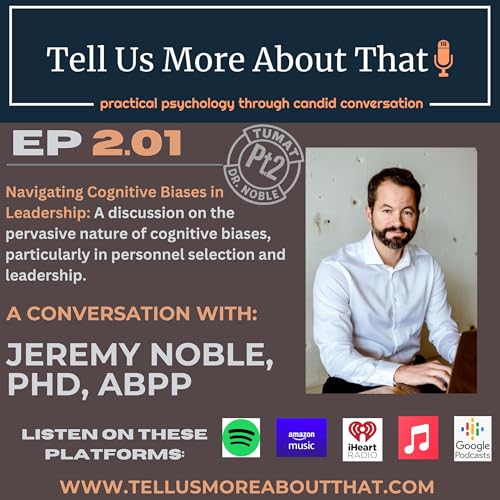
    • Dr. Noble, Pt. 2 - Navigating Cognitive Biases in Leadership: A discussion on the pervasive nature of cognitive biases, particularly in personnel selection and leadership.
      Aug 1 2025

      In this conversation, Dr. Noble discusses the pervasive nature of cognitive biases, particularly in personnel selection and leadership. He delves into the Dunning-Kruger effect, illustrating how individuals often overestimate their knowledge and competence. The discussion also touches on personal career journeys, the challenges of self-awareness in leadership, and the evolving landscape of consulting in psychology, emphasizing the importance of emotional intelligence and the need for reliable data in decision-making.

      TUMAT Takeaways:

      • Cognitive biases are prevalent in decision-making processes.
      • Awareness of biases can help individuals make better decisions.
      • The Dunning-Kruger effect illustrates how confidence does not equal competence.
      • Imposter syndrome is common among high achievers, contrasting with the overconfidence of less knowledgeable individuals.
      • Self-awareness tends to decrease as leaders rise in rank due to fewer honest feedback sources.
      • Narcissistic leaders can sometimes protect their teams but may harm the organization overall.
      • Therapy and coaching can provide valuable support for personal and professional growth.
      • Manipulation and bias are significant factors in how individuals present themselves in leadership roles.


      For more information on Dr. Noble and to learn more about the services offered by Noble Organizational Consulting, visit his website, here.


      Afficher plus Afficher moins
      43 min
    • Operational Psychology: Dr. Noble discusses the mission of Op Psych, what it takes to become one, and shares unique firsthand accounts from working in the field.
      Jun 27 2025

      In this conversation, Dr. Jeremy Noble shares his compelling journey as an operational psychologist within the U.S. Army's elite Ranger Regiment. Drawing from first-hand experience, he offers rare insight into the unique role operational psychologists play in selecting, supporting, and safeguarding the mental readiness of our nation’s most capable warfighters.

      Dr. Noble delves into the nuances of operational psychology, emphasizing the importance of sound hiring practices, the ethical challenges of confidentiality in military settings, and the impact of toxic leadership on team performance. He also explores the value of psychometric assessments in personnel selection and how these tools can enhance organizational effectiveness across high-stakes environments.


      TUMAT Takeaways:

      • Operational psychology focuses on enhancing performance in national security contexts.
      • Crisis intervention is a critical aspect of a psychologist's role in the military.
      • Confidentiality in military psychology has specific nuances compared to civilian practices.
      • Proper hiring practices can significantly impact organizational effectiveness and morale.
      • Toxic leadership traits, particularly narcissism, can have detrimental effects on teams.
      • Peer evaluations are valuable for identifying potential toxic leaders.
      • Psychometric assessments provide insights into personality traits relevant to job performance.
      • The military's approach to psychology allows for more flexibility in interventions than the civilian sector.
      • Effective leadership is crucial for employee engagement and organizational success.


      To learn more about Dr. Noble, check him out, here

      Afficher plus Afficher moins
      59 min
    Aucun commentaire pour le moment