Couverture de Take 2 Theology

Take 2 Theology

Take 2 Theology

De : Michael Mott and Zach Hale
Écouter gratuitement

À propos de ce contenu audio

Take 2 Theology is a twice-weekly podcast hosted by Michael Mott and Zachary Hale, elders at Charleston Bible Church. Each episode explores Scripture, theology, and Christian living through thoughtful conversations, interviews, and the occasional friendly debate. Whether we’re walking through a book of the Bible, tackling a tough doctrinal topic, or drafting our favorite children’s Bible songs March Madness-style, our aim is the same: to think deeply about God’s truth and invite others to do the same.Michael Mott and Zach Hale Christianisme Ministère et évangélisme Spiritualité
Épisodes
  • Cults | Is Christian Science Christian? Mind, Matter, and the Meaning of Salvation
    Mar 5 2026

    Episode 2.88


    [Note: We accidentally reference Jehovah's Witness at the beginning, but this episode covers Christian Science.]


    In this episode, Michael and Zach examine Christian Science using the same framework applied in previous discussions on Mormonism and Jehovah’s Witnesses. The question is not about sincerity, charitable work, or moral intent. The question is theological: Does Christian Science fall within historic, creedal Christianity—or does it depart from it at a foundational level?


    The discussion begins with the origins of the movement under Mary Baker Eddy in the late nineteenth century. Eddy’s book Science and Health with Key to the Scriptures functions alongside the Bible as the interpretive authority of the movement, providing the metaphysical framework through which Scripture is understood.


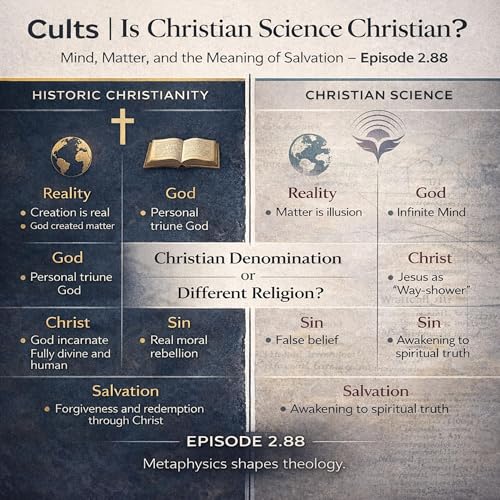
    From there, the episode explores the system’s central philosophical claim: reality is purely spiritual. God is defined as infinite Mind, while matter, disease, evil, and even death are ultimately illusions of mistaken perception. This metaphysical idealism reshapes every major Christian doctrine.


    We examine how Christian Science redefines key theological categories—including God, Christ, sin, atonement, creation, resurrection, and salvation. Jesus is treated not as God incarnate but as the supreme “Way-shower,” demonstrating humanity’s true spiritual nature. Sin is understood as a false belief rather than a moral rupture with God, and salvation becomes an awakening to spiritual truth rather than redemption from real guilt. The resurrection is likewise interpreted spiritually rather than bodily.


    Along the way, we briefly compare Christian Science with non-dual philosophical traditions found in certain strands of Hinduism and Buddhism. While the systems are not identical, they share a common rejection of material reality that sharply contrasts with historic Christianity’s affirmation of real creation, the incarnation of Christ, and the bodily resurrection.


    The episode concludes that Christian Science differs from Christianity not merely in practice but in metaphysics. By redefining the nature of reality itself, the movement departs from the doctrinal framework that has historically defined the Christian faith.


    Find our videocast here: https://youtu.be/Zj3BZM6RjM0


    Merch here: https://take-2-podcast.printify.me/


    Music from #Uppbeat (free for Creators!):

    ⁠https://uppbeat.io/t/reakt-music/deep-stone⁠

    License code: 2QZOZ2YHZ5UTE7C8


    Find more Take 2 Theology content at http://www.take2theology.com

    Afficher plus Afficher moins
    37 min
  • Narrative Juxtaposition: How the Bible Speaks Through Story Placement | Part 1
    Mar 3 2026

    Episode 2.87


    Matthew: A Jewish Gospel That Won’t Stop Talking About Gentiles


    In this opening episode of our new series Narrative Juxtaposition: How the Bible Speaks Through Story Placement, Michael and Zach explore a provocative question: If Matthew is the most Jewish of the four Gospels, why do Gentiles keep stealing the spotlight?


    Matthew is structured to emphasize Jesus as the fulfillment of Israel’s story—Abraham’s seed, David’s son, the new Moses. The Gospel is saturated with fulfillment formulas, Torah echoes, and covenant themes. Yet at key narrative moments, Gentiles are the ones who recognize, worship, and confess Jesus rightly—while Israel’s leaders hesitate, misunderstand, or resist.


    We trace these narrative placements carefully: the Gentile women in the genealogy, the Magi contrasted with Jerusalem’s indifference, the Roman centurion whose faith astonishes Jesus, the persistent Canaanite woman, and the Roman executioner who confesses Christ at the cross. These are not random anecdotes. They function as theological commentary embedded in the story itself.


    Along the way, we explore how Matthew uses Gentiles as narrative mirrors—exposing unbelief, redefining covenant membership around faith rather than ethnicity, and foreshadowing the global scope of the kingdom. The Gospel’s beginning and end are bookended by Gentile worship, culminating in the Great Commission to all nations.


    This episode models how careful attention to story placement can reveal theological depth often missed in isolated readings. In Matthew, placement preaches.


    Find our videocast here: https://youtu.be/nyxGoFn5-a0


    Merch here: https://take-2-podcast.printify.me/


    Music from #Uppbeat (free for Creators!):

    ⁠https://uppbeat.io/t/reakt-music/deep-stone⁠

    License code: 2QZOZ2YHZ5UTE7C8


    Find more Take 2 Theology content at http://www.take2theology.com

    Afficher plus Afficher moins
    34 min
  • Cults | Is Jehovah’s Witness a Christian Denomination? Examining God, Christ, and Salvation
    Feb 26 2026

    Episode 2.86


    In this episode, Michael and Zach apply the same standard used in the Mormonism discussion to another major movement: Jehovah’s Witnesses. The question is not about sincerity or moral seriousness. It is about theology. Does Jehovah’s Witness doctrine align with historic, creedal Christianity—or does it depart from it at a foundational level?


    We examine official Watchtower and JW.org sources on authority, the Trinity, the nature of the Holy Spirit, and the identity of Jesus Christ. Jehovah’s Witnesses explicitly reject Nicene Trinitarianism, deny the full deity of Christ, identify Jesus with Michael the Archangel, and describe the Holy Spirit as an impersonal force. Using their own New World Translation, we walk through key biblical texts—including Isaiah 42–48, John 1, John 17, Philippians 2, and Hebrews 1—to evaluate whether these claims cohere with Scripture.


    We also address distinctive teachings on salvation, the 144,000, the new birth, organizational exclusivity, and the nature of the soul. The cumulative question becomes unavoidable: if the identity of God, the person of Christ, and the structure of salvation are redefined, does the movement remain within Christianity—or does it constitute a separate religion using Christian vocabulary?


    The episode concludes by clarifying that the issue is not tone or intention, but doctrinal definition. By classical Christian standards, the differences are structural, not secondary.


    Find our videocast here: https://youtu.be/qb61zxXnEpw


    Merch here: https://take-2-podcast.printify.me/


    Music from #Uppbeat (free for Creators!):

    ⁠https://uppbeat.io/t/reakt-music/deep-stone⁠

    License code: 2QZOZ2YHZ5UTE7C8


    Find more Take 2 Theology content at http://www.take2theology.com

    Afficher plus Afficher moins
    45 min
Aucun commentaire pour le moment