Épisodes

  • Turning Off the Kill Switch: How Mongolia Made Its Power Grid Safer for Raptors. With Dr Andrew Dixon
    Dec 23 2025

    Send us a text

    For years an unseen hazard hung over the steppe. Standard distribution poles were silently killing thousands of raptors each year, including Saker Falcons. In this episode, Dr Andrew Dixon explains how leadership from Abu Dhabi, later anchored by the Mohamed bin Zayed Raptor Conservation Fund, helped Mongolia confront the crisis and retrofit 27,000 power poles across the country. The result is one of the standout conservation wins of our time and a practical blueprint any nation can adopt.

    Andrew takes us inside the work from first grim counts to winter field trials, and into the coalition of utilities, engineers, regulators, herder communities, and researchers that made bird-safe design the norm. We look at outcomes that matter, from dramatic reductions in electrocution to procurement standards that lock in safer builds for the future.

    In this episode you’ll hear:
    • What makes a typical pole dangerous to perching raptors, in simple terms
    • Which retrofits proved most effective and affordable in real-world conditions
    • How teams scaled to 27,000 poles without losing momentum
    • The measurements that show success, including carcass searches, telemetry, and nest outcomes
    • How policy and procurement now require bird-safe construction
    • Why this pays for utilities through fewer outages, lower incident costs, and stronger public trust
    • A clear path for countries in Africa, Asia, and beyond that want to act now

    This is the second installment in our three-part Talons of Hope series with Dr Andrew Dixon and the final podcast of 2025.

    Guest
    Dr Andrew Dixon, Science and Conservation Director, MBZRCF, recipient of the Partners for Raptors Lifetime Achievement Award.

    Call to action
    Follow Talons of Hope, share this episode with colleagues in energy and conservation, and ask your utility to adopt bird-safe standards in procurement and maintenance plans.

    Afficher plus Afficher moins
    30 min
  • From Barrels to Broods with Dr Andrew Dixon: Abu Dhabi’s Vision and Mongolia’s Falcon Turnaround
    Nov 4 2025

    Send us a text

    What does it take to bring a national bird back from the brink? In this opening episode of our three-part Talons of Hope special on the Mohamed bin Zayed Raptor Conservation Fund's signature project in Mongolia, Dr. Andrew Dixon—the Partners for Raptors Lifetime Achievement Award honoree and MBZRCF’s Science & Conservation Director—tells the inside story of how an Abu Dhabi–driven vision became one of the most ambitious raptor conservation efforts of our time.

    Long before the Mohamed bin Zayed Raptor Conservation Fund (MBZRCF) had a name, Abu Dhabi’s leadership backed a bold, practical idea on the Mongolian steppe: build thousands of safe, well-sited artificial nests; partner with herder families and schools; and invest in young Mongolian scientists to lead the future. Five thousand “barrels on poles” later, those nests turned into broods—lifting fledglings, strengthening communities, and restoring pride in a bird that is both Mongolia’s national icon and deeply cherished in the UAE.

    Andrew takes us from his first day on the steppe to the data and decisions that scaled a handful of prototype nests into a country-level grid—proof that when science, community, and long-horizon support align, raptors recover.

    In this episode, you’ll hear about

    • How 5,000+ artificial nests went from concept to population-level impact
    • Why early Abu Dhabi leadership (pre-2018) and later MBZRCF backing were decisive
    • Partnerships with herder families as hands-on nest guardians
    • School links between Mongolia and the UAE that turned kids into young conservationists
    • The metrics that matter: occupancy, fledging rates, and the ripple effects on steppe ecology
    • The pipeline of Mongolian early-career scientists now leading field seasons and research
    “Hope sounds like fledglings calling from a barrel that didn’t exist five years ago.”

    Guest

    Dr. Andrew Dixon — Science & Conservation Director, MBZRCF; recipient of the Partners for Raptors Lifetime Achievement Award; two decades leading Mongolia’s Saker Falcon research and conservation.

    Call to action

    If this story moves you, follow Talons of Hope, rate the show, and share this episode. It’s the blueprint for scaling raptor conservation—one nest, one herder family, one young scientist at a time.

    Produced by Talons of Hope in collaboration with Vision Aquila. 🦅

    Afficher plus Afficher moins
    33 min
  • Islands on the Edge: Saving the World’s Most Endangered Raptors
    Oct 21 2025

    Send us a text

    Across the world’s scattered islands, from the volcanic ridges of the Philippines to the icy fjords of Tierra del Fuego, live some of the rarest and most extraordinary birds of prey on Earth. These are the island raptors—hawks, owls, eagles, and falcons that evolved in isolation, mastering ecosystems shaped by wind, salt, and solitude. But that same isolation now places them in peril.

    Science tells a stark truth: every known extinction of a raptor has occurred on an island. From the Guadalupe Caracara of Mexico to the Reunion Kestrel and owl of the Indian Ocean, island raptors have vanished—quietly, and often unnoticed—undone by invasive species, habitat loss, pollution, and the accelerating impacts of climate change. Their populations are small, their habitats fragmented, and their options vanishing.

    In this episode of Talons of Hope, host Dr. Munir Virani sits down with Dr. Ulises Balza, a leading Argentinian raptor biologist whose groundbreaking research has revealed the global scale of this crisis. Drawing on his studies from the windswept archipelagos of Tierra del Fuego to the subantarctic islands, Ulises explains why island raptors are the world’s most imperiled birds of prey—and why now is the time to act.

    Together, they explore:

    • How genetic isolation and small populations heighten extinction risk.
    • The surprising ways some raptors depend on marine food webs, feeding on seabirds, seals, and even whales.
    • The threat of heavy metal contamination and ecosystem collapse.
    • And the bold idea to create a global Island Raptor Conservation Network, linking scientists, communities, and governments in a unified effort to save these birds before it’s too late.

    Yet this is not just a story of loss—it’s a story of hope. The Mauritius Kestrel, once down to only four known birds, was brought back from the brink through determination, science, and collaboration. Its recovery stands as proof that extinction is not inevitable.

    As Ulises reminds us, island raptors are more than symbols of fragility—they are sentinels of resilience, teachers of adaptation, and guardians of the planet’s most vulnerable ecosystems.

    This episode is a call to raise the red flag, to unite for action, and to believe—like the kestrel that flew again—that hope still has wings.

    Afficher plus Afficher moins
    35 min
  • Wings to Fly: From Science to Stewardship in Raptor Conservation with Laurie Goodrich
    Sep 30 2025

    Send us a text

    In this inspiring episode of Talons of Hope, we sit down with Dr. Laurie Goodrich—Sarkis Acopian Director of Conservation Science at Hawk Mountain Sanctuary—and explore what it takes to build the next generation of true conservation leaders. Drawing on decades of raptor migration data, groundbreaking studies on kestrel declines and broad‑winged hawk wintering behavior, Laurie shares not only the science, but how she’s weaving training in communication, storytelling, fundraising, and community engagement into her mentorship.

    We talk about:

    • Lessons from 40 years of migration monitoring and what current trends reveal about raptor populations
    • How holistic leadership training allows emerging scientists (especially from under‑resourced regions) to tackle broader environmental issues — from grassland degradation to climate change
    • Stories of her trainees turning science into action: policy change, habitat protection, and community partnerships
    • How the Raptor Population Index and other tools are empowering conservationists globally
    • Laurie’s vision for fostering storytelling, systems thinking, and advocacy skills, so that tomorrow’s leaders are equipped for more than measurements — but change

    If you believe in the power of investing in people as much as protecting wildlife, this conversation will stir hope and clarity on how to make long‑term impact.

    Afficher plus Afficher moins
    28 min
  • Why Vultures Matter — and Why We Must Act Now (Special IVAD2025 Episode)
    Sep 5 2025

    Send us a text

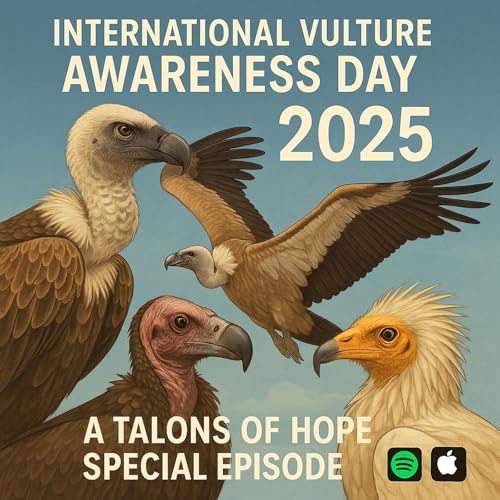
    Vultures prevent disease, recycle nutrients, and even reduce greenhouse gas emissions — yet they face extinction at an alarming rate. These birds are the silent guardians of our ecosystems, nature’s clean-up crew that protect both wildlife and human health. Beyond ecology, they are also woven into human culture and history — from ancient Egyptian deities to Indigenous traditions that see them as symbols of purification and renewal.

    In this special Talons of Hope episode for International Vulture Awareness Day, host Munir Virani speaks with André Botha — one of the world’s leading vulture conservationists and a longtime friend. From the savannas of Africa to the policy tables of international conventions, André has spent more than three decades fighting for vultures. Together, they share stories from the field, highlight groundbreaking solutions that are turning the tide, and celebrate the resilience of these remarkable birds.

    This is a conversation of hope and inspiration — and a reminder that every one of us can play a part in ensuring vultures continue to soar in our skies.

    Don't forget to follow us on Instagram @talons_ofhope_

    Afficher plus Afficher moins
    49 min
  • Dead Birds Flying — and the Science of Second Chances with Dr Christian Hagen
    Aug 19 2025

    Send us a text


    What happens when an injured hawk, eagle, falcon, or owl beats the odds, survives rehabilitation, and is released back into the wild? Do they truly make it? Do they matter?

    In this episode of Talons of Hope, host Munir Virani talks with Dr. Christian Hagen — Senior Research Scientist and Associate Professor at Oregon State University — about a groundbreaking study that combed through decades of data on more than two million raptors. The results challenge long-held skepticism and reveal that rehabilitated raptors, especially long-lived species, can play a real role in offsetting human-caused losses.

    From power lines to wind farms, the threats are daunting — but this conversation explores how science, policy, and even ancient falconry traditions can unite to give birds of prey a second shot at life. It’s a story of resilience, redemption, and hope on the wing.

    Afficher plus Afficher moins
    29 min
  • Cliffs, Toddlers, and Tracking Devices - The Megan Murgatroyd Story
    Aug 5 2025

    Send us a text

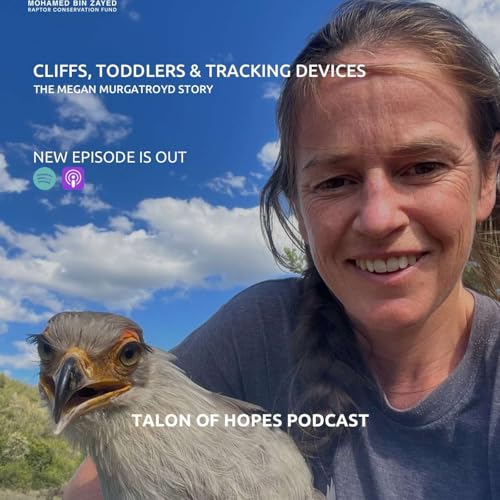
    In this compelling episode of Talons of Hope, Dr. Munir Virani sits down with one of the rising stars in global raptor conservation—Dr. Megan Murgatroyd, a field biologist, scientist, mother, and Director of International Programs at HawkWatch International.

    From the cliffs of South Africa to the jungles of Indonesia, Megan shares her bold and deeply personal journey tracking and protecting some of the world’s most elusive and endangered raptors. Listeners are taken behind the scenes of her fieldwork: wrestling Verreaux’s Eagles, developing wind energy collision models for large eagles, tagging Flores Hawk Eagles with a toddler strapped to her back, and investigating the illegal killing of Hen Harriers on UK grouse moors.

    Throughout the conversation, Megan reflects on:

    • The early spark that drew her to raptors
    • The resilience it takes to do fieldwork as a woman and a mother
    • The powerful role of GPS tracking in both conservation science and advocacy
    • How science can—and must—adapt to a changing climate
    • The vital importance of storytelling and mentorship in inspiring the next generation of conservation leaders

    What emerges is the portrait of a conservationist who brings equal parts grit, grace, and global thinking to the field of raptor biology. With humor, honesty, and depth, Megan shares lessons from the field—both scientific and human—that offer hope for the skies above and the communities below.

    Featured Themes:

    • Women in conservation science
    • GPS tracking and real-time conservation
    • Balancing motherhood with fieldwork
    • Renewable energy and wildlife coexistence
    • Illegal killing of raptors and policy implications
    • Mentorship and building the next generation of raptor biologists

    "Sometimes you have to climb a cliff with a telemetry unit in one hand and a baby carrier in the other—because the eagles aren’t going to wait." — Dr. Megan Murgatroyd

    Afficher plus Afficher moins
    24 min
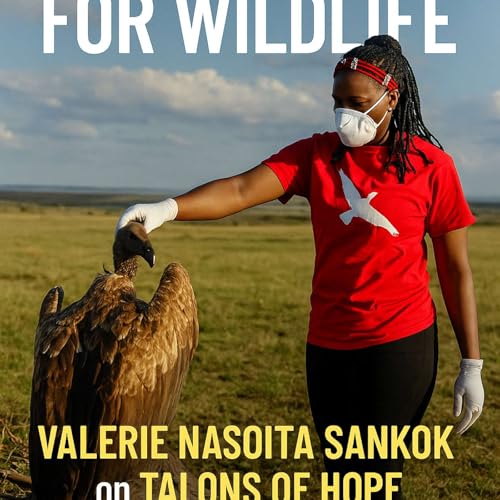
  • Valerie Sankok: A Warrior’s Mission to Save the Mara’s Vultures
    Jul 22 2025

    Send us a text

    Deep in the grasslands of Kenya’s legendary Maasai Mara, where lions roar and wildebeest thunder, a quieter crisis is unfolding. Vultures — nature’s essential clean-up crew — are dying in silence, poisoned by the very communities that once lived in harmony with them.

    But one woman is fighting back.

    Meet Valerie Nasoita Sankok, a proud Maasai woman and frontline conservationist. She’s not just saving birds. She’s saving ecosystems, cultural values, and future generations.

    As the Vulture Liaison Officer with The Peregrine Fund, Valerie responds to wildlife poisoning incidents — often being the first on the scene. She finds poisoned carcasses, collects forensic evidence, tends to any surviving vultures, and engages with pastoralist communities to stop the cycle of revenge poisoning that is decimating wildlife.

    It’s grim, dangerous, and emotional work.

    But Valerie is no stranger to adversity. Raised in a traditional Maasai community, she broke gender barriers to become one of Kenya’s most recognized voices for vultures. With training in crime scene management and wildlife poisoning response, and with deep cultural fluency, she is uniquely positioned to lead this fight from within.

    In this powerful episode of Talons of Hope, Valerie shares:

    • What it feels like to stand amid dozens of poisoned vultures — and what drives her to act.
    • How she works with Maasai herders to replace poison with peaceful coexistence.
    • The cultural and ecological importance of vultures in Kenya’s rangelands.
    • Her personal journey as a Maasai woman forging a path in conservation.
    • What gives her hope in the face of loss, and why the next generation matters more than ever.

    Why You Should Listen

    This isn’t just a conversation about birds. It’s about justice, environmental health, gender equality, and the power of one woman to reshape how communities think about wildlife.

    Vultures play a critical — and often invisible — role in our ecosystems. By cleaning up carcasses, they prevent the spread of diseases like anthrax and rabies. Without them, entire food webs begin to unravel. Yet in Africa, vulture populations have plummeted by over 90% due to poisoning and habitat loss.

    Valerie’s story reveals the hidden frontline of this crisis — and the quiet revolution being led by women, by communities, and by those who care enough to act.

    A Local Hero with a Global Message

    Valerie’s work has inspired not only her own community but also the wider conservation world. Her voice represents the intersection of science and tradition, action and empathy. She reminds us that real conservation starts with listening, with trust, and with those who live closest to the land.

    Her message is clear:
    “When vultures disappear, we all suffer. But when people rise to protect them — so does hope.”

    Listen Now If You Care About:

    • Wildlife conservation and raptor protection
    • Maasai culture and women’s leadership
    • Solving human-wildlife conflict
    • Poisoning response and ecological justice
    • Stories of resilience, courage, and change

    Join us for this unforgettable episode of Talons of Hope, and be inspired by Valerie Sankok — a warrior whose fight is for all of us.

    Because in her words, “Saving vultures is saving life.”


    Afficher plus Afficher moins
    21 min