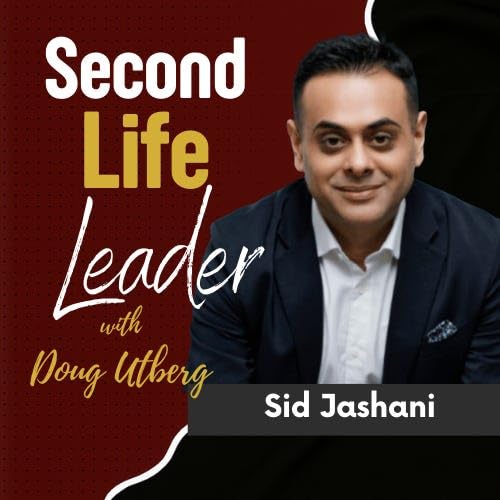
Couverture de Second Life Leader

Second Life Leader

Second Life Leader

De : Doug Utberg
Écouter gratuitement

À propos de ce contenu audio

From Setback to Sovereignty. This platform is for founders, executives, and rebuilders who’ve been knocked down by layoffs, burnout, betrayal, or failure—and refuse to stay down. I’m Doug Utberg. I rebuilt my career, my finances, and my identity from zero, and now I have raw conversations with leaders who’ve walked through fire and rebuilt stronger. Every episode cuts directly into the moments that forge a leader: Career reinvention and self-leadership Burnout recovery and nervous system restoration Ethical entrepreneurship in a post-growth world Systems thinking, AI, and automation for sovereign execution No hype. No guru scripts. Just clarity, truth, and the architecture required to rebuild a life—and a company—that cannot be taken from you. 🔧 CFO Operator Clinic If you lead a finance function, this is where we dismantle the chaos and build real structure: KPI trees Universal journals Transformation architecture Decision systems Semantic-layer design This is the tactical advantage most CFOs never get—and it’s where operators rise. 📍 Book your spot at SecondLifeLeader.com 📩 Go Deeper The show sparks the rebuild. But the newsletter is the operating system—your weekly cadence for clarity, structure, and execution. 👉 Subscribe at DougUtberg.com

www.dougutberg.comDoug Utberg
Economie Management Management et direction Réussite personnelle
Les membres Amazon Prime bénéficient automatiquement de 2 livres audio offerts chez Audible.

Vous êtes membre Amazon Prime ?

Bénéficiez automatiquement de 2 livres audio offerts.
Bonne écoute !
    Épisodes
    • The Struggle Never Ends — And That’s the Point
      Feb 20 2026

      Entrepreneur and EOS implementer Sid Joshnani joins me to unpack what really happens when a business grows fast, becomes dangerously dependent on one client, and nearly collapses under its own fragility.

      Most business stories skip the middle — the sleepless payroll nights, the rejected credit cards, the clients who stretch payments while you carry 35 salaries on your back. This episode doesn’t.

      Sid shares how his IT services company grew to $3 million in revenue — with one client representing 75% of it — and how that concentration nearly pushed him into bankruptcy. We walk through the tension of chasing late payments from large corporations, the anxiety of holding only $150 in the corporate checking account, and the uncomfortable realization that dependence kills leverage.

      From there, the conversation turns tactical.

      Sid explains how discovering EOS (Entrepreneurial Operating System) helped him move from firefighting to systems thinking. We break down pipeline discipline, activity-based metrics, hiring dedicated sales leadership, understanding unit economics, and why the ability to walk away from a deal only comes when you’ve architected your business not to need it.

      We also explore the emotional side: leaving Deloitte for entrepreneurship, briefly returning to consulting to survive, moonlighting to stay afloat, and the psychological weight of carrying other people’s livelihoods.

      This isn’t a glamorized founder story.

      It’s a candid conversation about de-risking your business before it de-risks you.

      The lesson isn’t avoiding struggle.

      It’s building a company that can survive it.

      TL;DR

      * Client concentration risk can destroy otherwise profitable businesses

      * Large companies use extended payables as a financing tool — small vendors absorb the pain

      * The best negotiation position is not needing the deal

      * Revenue diversification creates leverage

      * Activity-based metrics matter more than lagging financial indicators

      * Cash in the bank is stability — not vanity

      * Unit economics must work before operating systems can scale them

      * Discipline and consistency outperform bursts of motivation

      * Entrepreneurship isn’t freedom — it’s responsibility

      Memorable Lines

      * “The best way to negotiate a deal is to not need it.”

      * “When one client is 75% of your revenue, you don’t own a business — you own a risk.”

      * “Big companies use small vendors as a finance tool.”

      * “Discipline and consistency always win.”

      * “You can’t scale chaos — you have to systematize it first.”

      Guest

      Sid Joshnani — Entrepreneur, EOS implementer, and Founder & CEO of Recrudo

      Former MSP owner who rebuilt after near collapse and now helps companies implement EOS while also leading a staffing company connecting founders with offshore talent in the Philippines and Latin America.

      🔗 https://recrudo.net

      🔗 LinkedIn: Sid Joshnani

      Why This Matters

      Most businesses don’t fail because of lack of revenue.

      They fail because of structural fragility.

      Client concentration, weak pipeline discipline, poor cash visibility, and the inability to walk away from bad terms quietly erode leverage long before collapse becomes visible.

      For founders and operators navigating growth, this episode reframes struggle not as misfortune, but as information — revealing where systems are weak and where courage is required.

      Entrepreneurship doesn’t remove instability.

      It exposes it.

      The goal isn’t to eliminate struggle.

      It’s to build a company that survives it.


      This is a public episode. If you would like to discuss this with other subscribers or get access to bonus episodes, visit www.dougutberg.com
      Afficher plus Afficher moins
      29 min
    • Confessions of a Reformed Chemist, and Why IP Strategy Determines Who Gets Funded
      Feb 19 2026

      Patent attorney and former chemist Josh Goldberg joins me to unpack how intellectual property strategy determines whether innovation gets funded—or quietly dies.

      Most startup conversations focus on product, growth, and pitch decks. This episode focuses on what founders often ignore until it’s too late: protection. Josh shares why he left drug formulation chemistry to go to law school, and how he now helps innovators—particularly in green tech and scientific industries—turn inventions into defensible assets.

      We walk through the uncomfortable reality that patents don’t let you do anything. They let you stop others. That negative right, however, is often the very thing investors care about most.

      From first-to-file rules and accidental public disclosures to the difference between patents, trademarks, and copyrights, this episode breaks down how smart founders think about timing, leverage, and risk before litigation ever enters the picture.

      This isn’t a conversation about legal theory.It’s about strategic sequencing.

      Because innovation without protection doesn’t attract capital. It attracts competition.

      TL;DR

      * In green tech and scientific startups, patents often are the product

      * Investors evaluate risk before they evaluate brilliance

      * Publishing before filing can permanently destroy international patent rights

      * The U.S. has a one-year grace period; most other countries do not

      * Patents protect inventions; trademarks protect brands; copyrights protect creative works

      * Litigation is expensive—early strategy prevents most of it

      * Founders need business planning as much as scientific expertise

      * IP strategy should be integrated into the business plan from day one

      Memorable Lines

      * “Having a patent doesn’t let you do something—it lets you stop someone else.”

      * “It’s a race to the patent office.”

      * “If you don’t know where you’re going, wherever you wind up is going to be fine.”

      * “Innovation without protection makes funding harder, not easier.”

      * “The earlier I get involved, the fewer mistakes we have to untangle.”

      Guest

      Josh Goldberg — Patent attorney and former chemistIntellectual property strategist focused on green technology, scientific innovation, and helping startups build defensible patent portfolios before going to market.

      📍 Brooklyn, New York🔗 Email: jgoldberg@nathlaw.com

      Why This Matters

      The American economy rewards innovation—but only when it’s defensible.

      Founders often move fast, publish early, and chase funding without realizing they may be donating their invention to the public domain in the process.

      This episode reframes intellectual property not as legal overhead, but as strategic leverage. For technical founders, scientists, and operators building in complex industries, protection isn’t paperwork—it’s positioning.

      Capital flows toward lower risk.

      And risk is shaped long before anyone files a lawsuit.


      This is a public episode. If you would like to discuss this with other subscribers or get access to bonus episodes, visit www.dougutberg.com
      Afficher plus Afficher moins
      28 min
    • Jazz, Peace, and Raising Human Consciousness in a Fractured World
      Feb 18 2026

      Jazz musician and humanitarian Rick DellaRatta joins me for a different kind of conversation — one that steps outside traditional business failure narratives and into culture, conflict, and human consciousness.

      Rick is the founder of Jazz for Peace, a movement that began as a poem written on the morning of 9/11 while he watched the attacks unfold from less than a quarter mile away. That moment launched what he describes as his “second life” — blending music, philanthropy, and diplomacy in ways that eventually led to a United Nations concert featuring Israeli, Palestinian, and American musicians performing together for peace.

      This episode explores what art can do that politics can’t.

      We unpack:

      * The 25th anniversary of the UN Jazz for Peace concert

      * The disconnect between political narratives and lived human experience

      * Why labels like “pro-Israel” or “pro-Palestine” often obscure more than they clarify

      * The idea that jazz — America’s most original art form — is built from global influence and improvisation

      * Whether economic hyper-growth is eroding culture and authentic art

      * The tension between financial wealth and spiritual wealth

      * A “trickle-up economy” concept for philanthropy

      * The role of art in raising human consciousness

      Rick argues that culture moves consciousness — and consciousness determines the direction of civilization. If politics operates at the level of power, art operates at the level of perception.

      We also explore whether modern philanthropy has drifted into performative tax strategy rather than human connection, and whether meaningful change requires collapsing the layers of intermediation between people and the causes they claim to support.

      This conversation is less about solutions and more about perspective:Can creativity raise consciousness in a time of polarization?Can music bridge divides where policy fails?Can we hold material success and inner wealth in balance without collapsing into excess or decay?

      The goal isn’t naïveté.It’s alignment.

      TL;DR

      * Art can move consciousness in ways politics cannot.

      * Jazz is improvisation — and a metaphor for cultural integration.

      * Financial wealth without inner wealth creates imbalance.

      * Modern philanthropy often adds layers instead of impact.

      * Hyper-growth economics may undermine cultural sustainability.

      * Peace begins with raising awareness, not slogans.

      * Reinvention isn’t just financial — it’s existential.

      Memorable Lines

      * “It started as a poem on 9/11 — and became a second life.”

      * “Jazz may be America’s greatest gift to the world.”

      * “Financial wealth and inner wealth must stay in balance.”

      * “Peace operates at a higher level of human consciousness.”

      * “Change without consciousness just reshuffles power.”

      Guest

      Rick DeLaRotta — Founder of Jazz for PeaceJazz musician, humanitarian, and organizer of benefit concerts supporting over 850 global causes, including a historic United Nations performance bringing together Israeli, Palestinian, and American artists.

      🔗 https://jazzforpeace.org🔗 LinkedIn: Rick DeLaRotta

      Why This Matters

      Second lives aren’t always built from financial collapse.

      Sometimes they’re born from cultural rupture.

      When institutions fracture and politics polarize, leadership requires more than strategy. It requires awareness. Art, culture, and authenticity shape that awareness long before legislation ever catches up.

      For founders and executives accustomed to thinking in metrics and markets, this episode is a reminder: systems don’t just run on capital — they run on consciousness.

      If we want durable change, we have to elevate the level at which we’re operating.

      Peace isn’t negotiated only in boardrooms or treaties.It begins in perception — and sometimes, in a song.


      This is a public episode. If you would like to discuss this with other subscribers or get access to bonus episodes, visit www.dougutberg.com
      Afficher plus Afficher moins
      44 min
    Aucun commentaire pour le moment