Couverture de Scale Her Up: Female business stories and expert tips for business growth and success

Scale Her Up: Female business stories and expert tips for business growth and success

Scale Her Up: Female business stories and expert tips for business growth and success

De : Brenda Hector
Écouter gratuitement

À propos de ce contenu audio

If you are a female business owner, self-employed freelancer, or girl boss who wants to build a successful business i.e. work less hours, make more money, and get better results from your staff, then this is the podcast for you. Hosted by Dr Brenda Hector MBA from ActionCOACH UK, this podcast provides relatable and accessible business advice and inspiration from successful businesswomen who have been there and done it before you. This podcast is where you can • hear female business stories • share business success • learn how to overcome business challenges • get advice for businesswomen aspiring to success • find out what needs to change • discover how we can bring about that business revolution Only 1 in 3 UK entrepreneurs are female. UK men are 5 times more likely than women to build a business of over £1million turnover If UK women matched UK men in starting and scaling businesses, it would add £250 billion to the UK economy (Alison Rose, The Rose Review of Female Entrepreneurship 2018) As a woman in business, a business coach, and a business growth expert, Brenda’s mission is to help business owners grow their companies, achieve their goals and live the lifestyle of their dreams. She's the help you need to grow your business.Copyright 2026 Brenda Hector Direction Economie Finances privées Management Management et direction
Épisodes
  • The Money Conversation | Pricing, Burnout and Self-Belief with Linda Hunt
    Mar 6 2026
    In this episode of Scale HER Up – The Female Entrepreneur Show, I’m joined by Linda Hunt, founder of Some Solutions, corporate “dropout” and one of the early pioneers of remote accounting services. Linda left a demanding, travel-heavy corporate role in 1998 and built a business that started with outsourced accounting and evolved into two core arms: a done-for-you accounting services division and an educational arm helping service-based business owners fix their relationship with money, pricing and capacity.Linda works with bookkeepers, accountants and a wide range of service businesses – from online providers to bricks-and-mortar locations like medical spas. She sees the same pattern again and again: smart, capable people who know their craft, but are undervaluing themselves, undercharging and burning out. Much of her work now focuses on pricing, offers, service delivery and nervous-system-safe ways to talk about money.Linda shares her concept of MAP – the Minimum Aligned Price: a simple formula that starts with your desired salary and business expenses, then divides by your true delivery capacity, including holidays, sick days and time to work on the business. She explains why charging below that number means you’re effectively paying your client to work for them – and why “charge your worth” rhetoric is unhelpful and confusing.We dive into the emotional side of pricing: fear of what people will think, imposter syndrome (“who am I to charge that?”), people-pleasing, discounting before anyone asks and filling the silence after stating your price. Linda talks about money stories from childhood, the pressure many women feel to make everyone comfortable, and why pricing is “not about math – it’s about what your nervous system can safely hold.” She shares practical ways to build a clear process, simple scripts and body-based tools so you can talk about money with more neutrality and confidence.Linda also opens up about her own burnout story. On the outside, she looked like a successful accountant with a growing team. On the inside, her bank balance was unpredictable, she was overextended and exhausted. A breaking-point conversation with a friend led to a mini sabbatical, scaling the business back to bare bones and working half-time for several months while she rebuilt her pricing, capacity and boundaries. The MAP formula and much of her current work came directly out of that period.We cover how she has since rebuilt Some Solutions with a small team model (a senior controller plus support for each client), moved herself into more of a systems architect and educator role, and written her upcoming book “The Money Conversation”, along with her Pricing Essentials workshop series. Both are designed to help service providers speak about money clearly, set standards for the value their services deliver and get paid without apology.This is a grounding, reassuring conversation for anyone who feels shaky when they say their prices, worries about being “too expensive”, or is scared to slow down even when their body is screaming for a break.In this episode, we cover:How Linda went from corporate road warrior to founding Some Solutions in 1998Building one of the first remote accounting services businesses long before remote work was normalEvolving from pure accounting into two arms: done-for-you accounting services and an educational/pricing armWhy so many service-based business owners – especially women – undervalue and underprice themselvesHow “charge your worth” can be damaging, and why it’s better to focus on the transformation and result you deliverLinda’s MAP concept – Minimum Aligned Price – and how it helps you stop paying to work for your clientsWhy pricing is not just math: nervous system regulation, safety, and the ability to be seenPractical ways to talk about price: simple processes, broad-strokes explanations of how you work and clear language like “your investment is…”The pull to over-explain, over-deliver and discount – and how to resist filling the silence after quoting a feeFeminine and masculine energy in business: structure, process and container alongside intuition, alignment and discernmentLinda’s burnout story: hitting the wall, taking a week off, scaling back the business and rebuilding in a more sustainable wayCreating healthier capacity: building holidays, sick time and strategy time into your model instead of hustling 24/7Why traditional “hustle for three years” advice often doesn’t work for women juggling caring responsibilities and complex livesThe importance of mentors and supporters who are further ahead in business, not just peers at the same stageLinda’s advice to her 18-year-old self: trust your intuition, your body knows the truth, and combine logic with a gut check before making big decisions
    Afficher plus Afficher moins
    36 min
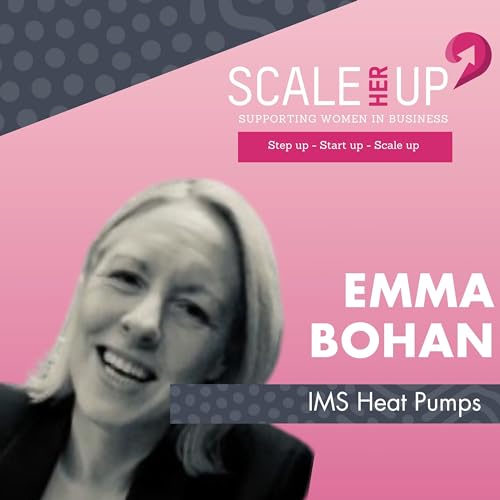
  • From Hospitality to Heat Pumps | Emma Bohan of IMS Heat Pumps
    Mar 4 2026
    In this episode of Scale HER Up – The Female Entrepreneur Show, I’m joined by Emma Bohan, Managing Director of IMS Heat Pumps, a specialist renewable heating company installing air source, ground source and water source heat pumps, plus solar PV and batteries, from bases in Scotland and Sheffield. Emma and her team help homeowners and small commercial clients move away from gas boilers towards low-carbon, electricity-based systems that can be powered by renewables.Emma explains, in plain English, how heat pumps work, who they’re right for and why combining a heat pump with solar panels and a battery – the “holy trinity” – can both cut carbon and reduce fuel bills. She shares examples from self-builds, major renovations and “grand designs” style projects, as well as small commercial jobs like tractor showrooms and warehouses.We then dive into her unexpected career journey. Emma started out in hotel and catering management, working her way up to operations in a hotel group before realising that never seeing her family over Christmas and New Year wasn’t the life she wanted. After a stint in the civil service, she joined a business development consultancy, helping manufacturing companies and early renewables innovators tackle bottlenecks, explore new markets and commercialise technology. That’s where she first encountered heat pumps and the founder of a pioneering UK heat pump company.Years later, that same founder brought several installers together with a big vision: to grow a national heat pump business and develop “heat as a service” – a mobile-phone-style model where customers would pay a monthly fee that covered both their heat and the equipment. Emma joined as operations manager, using her hospitality-honed process and people skills to run the installation business day to day. But the company over-invested in the new service model, funding ran out and the business went into administration.At that point, Emma could have walked away. Instead, she stayed up crunching numbers and pitched a bold plan to the Scottish and Sheffield installation teams: buy the viable installation part back from the administrators and rebuild. In 2019 they relaunched together as the current IMS Heat Pumps. Since then, they’ve grown year on year in revenue, profit and headcount, focusing on quality installations, tight geographic areas and a strong service ethos: sell it right, design it right, install it right, support it well – and make life easier for everyone.Emma also talks about the practical realities of running an installer business: limiting the operating radius so they can look after customers properly, the joys and pains of vans and engineer logistics, and why their internal mantra is “have an easy life” – not in the sense of coasting, but in doing things properly first time so Christmas shutdowns really can be a shutdown, with only the occasional emergency call-out.We also explore what it’s like to be a woman leading in a male-dominated sector. Emma shares how she has found the renewables and heat pump world welcoming and supportive, with several male mentors championing her, and a growing number of women running the “back office” and, increasingly, leading businesses. She talks about how regulation and admin have created real opportunities for women who are strong on organisation, compliance and customer communication, and how women in the sector tend to gravitate towards and support each other.Finally, Emma offers grounded advice for anyone thinking about starting or scaling a business in a technical sector: stay curious, learn the technology, track what’s happening in your industry and policy environment, build a strong “frenemies” network of other installers, and don’t be afraid to be corrected. For her, every day is a school day – and thick skin, hospitality-grade work ethic and a willingness to learn have been key ingredients in her success.This is a fast-paced, story-packed conversation about renewables, resilience, restarting after failure and designing a business that works for customers and the people who run it.In this episode, we cover:What IMS Heat Pumps does and the technologies they install: air source, ground source, water source heat pumps plus solar PV and batteriesThe benefits of the “holy trinity” – heat pump, solar and battery working togetherDomestic vs small commercial projects, from self-builds and major renovations to tractor showrooms and warehousesEmma’s early career in hotel and catering management and what hospitality taught her about process, logistics and customer serviceMoving into business development consulting and working with early renewable energy and energy efficiency innovatorsThe “heat as a service” concept and why the original business failed despite a strong ideaHow Emma, the Scottish and Sheffield teams bought the viable installation side out of administration and relaunched as IMS Heat Pumps in 2019Growing...
    Afficher plus Afficher moins
    34 min
  • From Burnout to Employee Ownership | Susie Cresswell of Whitewall Marketing
    Mar 2 2026
    In this episode of Scale HER Up – The Female Entrepreneur Show, I’m joined by Susie Cresswell, founder of White Wall Marketing, a Glasgow-based marketing and comms agency specialising in the built environment – think shopping centres, retail parks, office blocks and high-end residential.Susie shares how she went from a demanding, male-dominated corporate role in property to launching her own agency after realising there was “more to life” than never having time to post a birthday card to her niece. With no savings, a loan from her parents to cover the mortgage and a determination to do great work rather than chase titles, she started freelancing from her spare room and grew from there.We talk about the power of a niche – how her specialist experience in property and the built environment led to a client base that has stayed loyal for 20 years – and why she spent years trying to “get away” from that niche before fully embracing it. She explains how White Wall started with associate collaborations, then shifted to building an in-house team, at one point reaching 22 people before right-sizing to a core team supported by long-term freelancers.Susie also shares how her view of marketing channels has evolved: digital and “traditional” are all just tools in the same toolbox. What matters is the research, the planning and understanding where your audience actually is – whether that’s TikTok and Instagram for younger customers, or websites, search and even handwritten notes and direct mail for others.A big part of the conversation focuses on team, culture and flexibility. White Wall now runs with a blend of employees and freelance specialists, some of whom have worked with Susie since day one and even sit in the office as part of the team. She talks about adapting to changed expectations around work, creating a culture where people are encouraged not to work late by default, and recognising that different working patterns suit different people and life stages.We then dive into a huge milestone: moving White Wall Marketing into an Employee Ownership Trust (EOT) and appointing a new Managing Director. Susie explains why she chose employee ownership instead of a trade sale or management buy-out, why she transferred 100% of her shares, and how she now sees herself in a founder role supporting the new leadership team through an earn-out period.Throughout, Susie is very honest about imposter syndrome, burnout and learning to be calmer. She talks about making pricing mistakes, managing redundancies after losing a major contract and during COVID, and how HR has gone from “I’ll just handle it” to bringing in external support to protect both the company and the team. She has learned what she is good at – and not good at – and is unapologetic about building a business that reflects that.This is a relatable, down-to-earth conversation about building an agency over 20 years, embracing niche expertise, looking after your team and planning succession so the business can thrive without you.In this episode, we cover:What White Wall Marketing does, and why it focuses on the built environmentHow Susie’s career in property and managing agents led naturally into that nicheStarting the business with no savings, a loan from her parents and a year of working from homeHer early “associate model” and why she eventually moved to building an in-house teamGrowing to 22 people at the company’s height and then right-sizing to a smaller team with trusted freelancersWhy digital vs “traditional” is a false divide – it all starts with research, planning and understanding where your audience isExamples of standout tactics, including handwritten notes and direct mail in a digital-heavy worldThe realities of HR in a small agency: pricing, tough conversations, hiring, retention and the emotional weight of redundanciesBlending employees and freelancers, including long-term freelance team members who sit in the officeHow expectations around work have changed since “we never had lunch and worked every hour”Moving to an Employee Ownership Trust and appointing a new MD to lead the next phaseWhy she believes she’s not necessarily the right person to lead the next digital chapter – and why that’s okayWhat she’s learned about herself: being calmer, solution-focused and recognising that different perspectives make the work betterHer message to other founders: there is always a solution, you only get one life, and you don’t want to look back and regret not going for it
    Afficher plus Afficher moins
    33 min
Aucun commentaire pour le moment