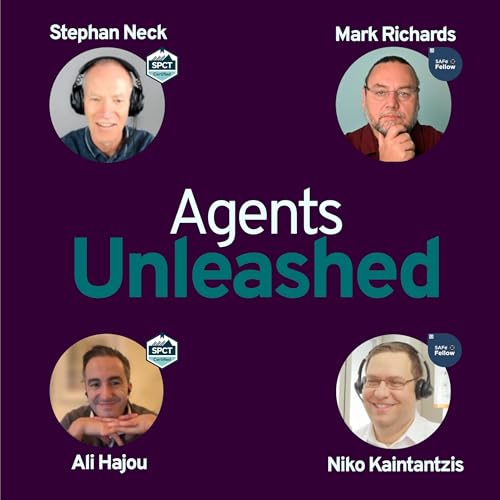
Couverture de Agents Unleashed

Agents Unleashed

Agents Unleashed

De : Stephan Neck Niko Kaintantzis Ali Hajou Mark Richards
Écouter gratuitement

3 mois pour 0,99 €/mois

Après 3 mois, 9.95 €/mois. Offre soumise à conditions.

À propos de ce contenu audio

Agents Unleashed is a podcast for curious change agents building the next generation of adaptive organizations — where people and AI learn, work, and evolve together.

Hosted by Mark Richards, Ali Hajou, Stephan Neck, and Nikolaos Kaintantzis, the show blends stories from the field with experiments in agility, leadership, and technology. We explore how work is changing — from agile teams to agentic ecosystems — through honest conversation, a dash of mischief, and the occasional metaphor that gets away from us.

We’re not selling frameworks or chasing hype. We’re practitioners figuring it out in real time — curious, hopeful, and sometimes hilariously wrong.
Join us as we unpack what it really means to be adaptive in a world where intelligent agents (human and otherwise) are rewriting the rules of change.

© 2025 Shaping Agility
Développement personnel Réussite personnelle
Les membres Amazon Prime bénéficient automatiquement de 2 livres audio offerts chez Audible.

Vous êtes membre Amazon Prime ?

Bénéficiez automatiquement de 2 livres audio offerts.
Bonne écoute !
    Épisodes
    • Value Streams - The Tool AI Experts Don't Know They Need
      Jan 12 2026

      "I have never heard a single AI thought leader stand on a stage and say the words value stream." Mark's observation cuts to the heart of a strange disconnect: while AI dominates every conversation, the people building AI futures don't seem to know about one of Lean's most powerful tools—and the people who do know aren't connecting their expertise to AI possibilities.

      Mark anchors this exploration with Stephan and Niko, asking why value stream thinking might be more relevant in an AI-disrupted world, not less. Niko identifies a split in the AI conversation: personal productivity (prompting, tools, typing faster) versus end-to-end thinking. The former dominates; the latter is where organizational impact actually lives. "By the end, it's AI. It's a tool, and if I use it as my personal tool, I will not help my teammates and my value stream."

      Mark's epiphany came working through Anthropic's delegation model—mission, sequence of steps, how AI helps each step. "And then I went, well, actually, this is just a Value Stream Map." AI thought leaders are reinventing tools that already exist. Stephan imagines AI-powered real-time mapping—systems that show how work actually flows rather than how people think it flows. The traditional two-day war room with all functional leaders? "I've never managed to get that collection of leadership together for two days," Mark admits. AI might finally bridge gut feeling and reality.

      Niko pushes toward bigger ambitions: don't just use AI to optimize individual steps—use it to see the whole picture. "We call this transformational thinking—think about how you change the whole process or parts of the value stream, and not optimizing it." His takeaway is blunt: "AI without value stream thinking is just a hype."

      Niko's jiggle asks what Disney movie captures AI meets value streams. Mark goes straight to The Sorcerer's Apprentice—powerful tools that go catastrophically wrong when wielded without understanding. Stephan sketches a Wall-E-inspired tale about a burned-out process engineer and an AI named Flow. Niko's creation features a hero whose power is connecting specialists to see the whole picture.

      The episode surfaces a gap hiding in plain sight: AI experts optimizing algorithms while missing systems thinking, Lean practitioners holding powerful tools they're not connecting to AI. Whether you're building AI solutions or wondering how AI fits your value streams, this conversation asks the question few others are asking.

      Afficher plus Afficher moins
      1 h et 2 min
    • Coaching in the Age of AI: Trust, Tools, and What Remains Human
      Jan 5 2026

      "Coaching in the age of AI" sounds straightforward—until you ask what it actually means. Niko asked AI and got 20 different interpretations. Are we coaching leaders to use AI? Coaching AI systems themselves? Being replaced by AI coaches? Leveraging AI to become better coaches? The answer is yes to all of them—and therein lies the problem.

      Niko anchors a conversation that refuses to pretend coaching will stay the same. Joining him are Mark, who's discovered his 15 years of coaching skills are more valuable in the AI world, not less, and Ali, bringing his characteristic skepticism about what "coach" even means anymore. With AI tools now capable of asking great questions, maintaining perfect consistency, and never forgetting a conversation, the hosts confront what remains uniquely human about the coaching relationship.

      Ali frames the stakes bluntly: "Either you gonna become a good question asker in the moment... or you're an expert in something which leans more towards the teacher profile... or you're going to be irrelevant." AI can already ask triggering questions that help people think and contextualize. But can it interject at the right moment? Can it read the room when someone's arms are crossed—and know whether that means they're closing off or focusing deeply?

      Mark cuts to what he considers foundational: "The instant that you are not treated as a vault, your ability to coach effectively is gone." When AI enters a coaching conversation—transcribing, analyzing, mining for insights—what happens to the psychological safety that makes coaching work? Niko's response is visceral: "It was the first time in my life I said no to a technology innovation."

      Yet Mark also grounds the theoretical in reality: use AI to summarize past coaching conversations, identify patterns across sessions, prepare better for calls. "Really practical, really down to earth. No science fiction required."

      The episode doesn't declare coaching dead or triumphant—it maps the territory where trust, technology, and human connection collide. For coaches wondering what to invest in and what to release, this conversation offers something rarer than answers: honest uncertainty from practitioners navigating the same questions.

      Afficher plus Afficher moins
      58 min
    • Will AI Replace the Trainer—Or Just the PowerPoint?
      Dec 29 2025

      Three trainers who've collectively spent thousands of days in the room—physical and virtual—sit with a question that's been nagging at them: what happens to training when AI shows up?

      Mark opens with a scenario. Your trainee texts you at 11pm, panicking before their first PI Planning. You're asleep. They muddle through. But imagine they had an AI buddy from the course—one that knew the context and answered instantly. Relief that they got help? Or quiet terror that you just became optional?

      The conversation moves through what AI might extend and what it might erode. Stephan shares how his AI agent reframed his role: stop being a "knowledge dispenser" and become a "wisdom cultivator." The content isn't the hard part anymore. The hard part is helping people navigate what they don't know when they're in the thick of it. Ali picks up the thread but surfaces what's missing: AI can't interject. It can't say "whoa, stop—we need to zoom in right here." Chatbots are polite companions. Trainers sometimes need to be challengers.

      They explore practice and simulation—if someone rehearses a retrospective 50 times with an AI before trying it for real, do they arrive with justified confidence or false confidence? AI is infinitely patient in ways humans aren't. And Ali raises his "doomsday" scenario: if everyone privately asks ChatGPT instead of raising their hand, do we lose the brave question? The one that cracks things open for the whole room?

      The James Bond jiggle—courtesy of absent Niko—produces unexpected depth. Stephan casts Q as the on-the-job AI (efficient, tool-focused, never teaches why) and M as the classroom trainer. Mark chooses Blofeld for AI—omnipresent, enabling, but creating dependency—and Daniel Craig's scarred Bond for the human trainer who learned everything the hard way.

      The episode lands on two complementary edges: Ali's conviction that AI extends the trainer rather than replaces them, and Mark's sharper take—"If you think your job is to teach people what's on the PowerPoint slides, AI is going to replace you." Stephan's closing haiku captures it: "AI gives answers fast, but struggle builds the muscle—mirror, not rescue."

      Afficher plus Afficher moins
      1 h et 1 min
    Aucun commentaire pour le moment