Couverture de Precision Signals

Precision Signals

Precision Signals

De : Sean Khozin MD MPH
Écouter gratuitement

Offres de saison | 0,99 € par mois pendant les 3 premiers mois

5,99 €/mois par la suite. Des conditions s’appliquent. Annulation mensuelle possible.
Precision Signals is a podcast from the CEO Roundtable on Cancer about decoding biomedical progress: what’s real, what matters, and what’s next. We talk with scientists, regulators, investors, and builders operating across the messy interface of research, healthcare, and policy. Some are moving the system from within; others are reshaping it from the outside. All of them bring signal in a world crowded with noise.CC BY 4.0 – You may share and adapt with credit to “Precision Signals” and a link to precisionsignals.ai. Economie Finances privées Hygiène et vie saine Maladie et pathologies physiques Science
Épisodes
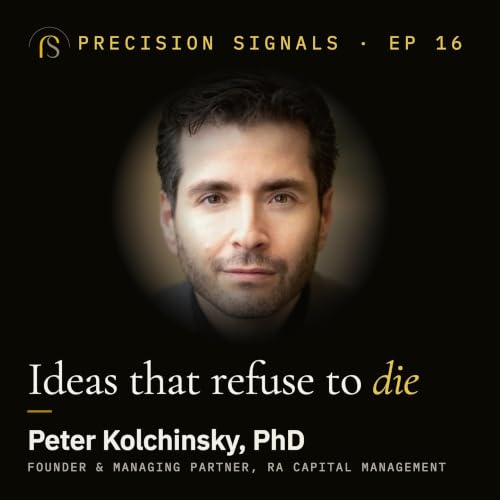
  • Peter Kolchinsky, PhD: Ideas That Refuse to Die
    Aug 27 2026

    In the latest episode of Precision Signals, Sean Khozin speaks with Peter Kolchinsky, founder and managing partner of RA Capital Management.

    Peter’s perspective is shaped in part by his experience as the child of Soviet Jewish immigrants. His parents brought him a deep appreciation for education, hard work, entrepreneurship, and the opportunity to improve the systems around us.

    That mindset has guided his journey from scientist and virologist to biotech investor and institution builder.

    In this wide-ranging conversation, Sean and Peter discuss:

    • How Peter moved from studying biology to helping scientists translate discoveries into medicines

    • Why the biotech industry needs stronger institutional memory, including a willingness to learn from failed experiments

    • The limitations of AI in drug development, where generating a promising molecule is only the beginning of a years-long clinical learning process

    • Why China’s expanding clinical trial infrastructure may have a greater near-term impact on the pace of R&D than AI

    • How the FDA can be understood as a community of people working within a complex institution, rather than as an opaque gatekeeper

    • Why CEOs must define their role by what it takes to advance the mission, including advocacy for patients, innovation, and better policy

    A substantive discussion about immigration, science, entrepreneurship, AI, clinical trials, regulation, and what it means to build organizations that keep learning.

    Afficher plus Afficher moins
    1 h et 41 min
  • Thomas Clozel, MD on Building Intelligence that Reads Life
    Jul 21 2026

    There is a sentence most physicians are trained never to say. Three words: I don't know. Thomas Clozel learned early — from Valentin Fuster at Mount Sinai — that those three words are not a confession of failure, but the beginning of discovery.

    Thomas is an oncologist, co-founder, and CEO of Owkin. He trained in Strasbourg, then crossed the Atlantic to work under Fuster in cardiology and alongside Olivier Elemento and Ari Melnick at Weill Cornell in computational biology. Ten years ago, he left clinical medicine to build a new kind of superhuman intelligence for biology — on a contrarian bet that chemistry was the confined, solvable problem, and that biology, the messy, causal, unsolved one, was where the real discovery lived.

    In this conversation, we trace that arc: from federated learning across the world's hospitals, to a mesothelioma study that surfaced categories of disease no human had ever named, to Owkin Pro — an AI scientist that, in Thomas's words, is beginning to have ideas of its own. We discuss why big pharma keeps missing the AI wave, why he thinks Anthropic could be the biggest pharma in five years, why the treatment for Alzheimer's might one day come from a fifteen-year-old in a garage, and what it will actually take for him to say, someday, that he has succeeded.

    Afficher plus Afficher moins
    56 min
  • Everything is a Signal: Sahir Ali on Connecting AI, Biology, and Venture Capital
    Jul 6 2026

    Sahir Ali’s career defies conventional paths. Trained as an engineer, he worked in quantitative finance, contributed to cancer research, built software companies, and ultimately founded Modi Ventures, where he developed the BioStack investment framework for technology-driven life sciences.

    In this conversation with Sean Khozin, Sahir explains how systems thinking, mathematics, and first-principles reasoning shaped his approach to investing. They discuss the evolution of artificial intelligence in medicine, the realities of drug discovery, founder psychology, venture capital, and why enduring innovation often comes from connecting ideas across disciplines rather than following trends.

    Afficher plus Afficher moins
    1 h et 24 min
adbl_web_anon_alc_button_suppression_t1
Aucun commentaire pour le moment