Couverture de Power Plays

Power Plays

Power Plays

De : Human Rights Foundation
Écouter gratuitement

Behind your favorite sport, there is always something else at play. Power Plays is a new investigative podcast from the Human Rights Foundation hosted by sports journalist and HRF Sports and Dictators Program Lead Karim Zidan, exposing how authoritarian regimes weaponize sports for political influence. Season 1 explores the regimes that have exploited the FIFA World Cup over the last century, from Italy’s fascists in 1934, to Argentina’s military junta in 1978, to Russia’s kleptocratic police state in 2018, to Qatar’s monarchy built on the backs of exploited migrant workers in 2022. We also look ahead to the 2030 and 2034 World Cups in Morocco and Saudi Arabia. Whether you like football or geopolitics — whether you plan to watch the World Cup or turn it off in protest — these stories matter far beyond the game. This podcast was produced by Elie Bleier, Robert Scaramuccia, and HRF’s multimedia team.Copyright 2026 Human Rights Foundation Sciences sociales
Épisodes
  • 5. The Power of Football
    Jun 11 2026

    With the World Cup now underway in North America, this season finale of Power Plays explores what comes next for football and FIFA. From the politics surrounding this year's tournament to future World Cups in Morocco and Saudi Arabia, we examine how the game continues to shape—and be shaped—by power.

    Over the course of Season 1, we’ve traveled from Mussolini’s Italy to Argentina's military junta, Putin’s Russia, and Qatar's controversial World Cup. Along the way, we’ve seen how football has been used to project global influence and advance political ambitions. Now, we end with a simple question—what should we do with all that we’ve learned?

    We don’t pretend to have all the answers, but perhaps it starts here: When you love something, you should want to make it better… because the next chapter of the beautiful game is still being written.

    In this episode, you’ll learn:

    • Football’s role in Egypt's 2011 uprising
    • How Infantino has reshaped FIFA's relationship with world leaders
    • Why Morocco's youth are pushing back
    • The hidden costs of hosting the World Cup
    • Saudi Arabia's Vision 2030 and football
    • Should fans boycott the World Cup?
    • What it means to love football without ignoring its political realities

    Connect:

    • Website: hrf.org
    • Instagram: @hrf
    • YouTube: @humanrightsfdn
    • Facebook: humanrightsfoundation
    • X: @HRF

    We’ve partnered with La Media Inglesa to bring you the full episode on YouTube, out now.

    Created by Karim Zidan and Elie Bleier.

    Produced by Elie Bleier and Robert Scaramuccia.

    Media strategy by Guillermo Purchese and Marielle Marlys.

    Afficher plus Afficher moins
    28 min
  • 4. The Story of Qatar's World Cup Whistleblower
    Jun 4 2026

    On the eve of the 2022 World Cup, FIFA president Gianni Infantino took the stage in Doha and delivered a speech that stunned the football world—declaring “today I feel gay… today I feel like a migrant worker," while pushing back on criticism of Qatar. as he defended Qatar against mounting criticism over its hosting of the tournament.

    In this episode, we travel to Qatar, where the World Cup’s “success” was built on the labor of millions of migrant workers—many facing stolen wages, extreme heat, and dangerous conditions. We trace how Qatar won the tournament, how FIFA’s leadership protected it, and how criticism was managed or silenced, told through the story of Abdullah Ibhais, who witnessed the atrocities firsthand.

    In this episode, you’ll learn:

    • Why Qatar wanted to host the World Cup in the first place
    • How Qatar won the World Cup, despite major concerns
    • How the kafala system controls migrant workers
    • What Abdullah saw when he spoke to workers
    • How protesting workers were treated
    • Why worker abuse was treated as a PR problem
    • What happened after Abdullah refused to comply
    • How the World Cup played out as a human rights crisis

    Connect:

    • Website: hrf.org
    • Instagram: @hrf
    • YouTube: @humanrightsfdn
    • Facebook: humanrightsfoundation
    • X: @HRF

    Coming soon! We’ve partnered with La Media Inglesa to bring you the full episode on YouTube, premiering in June 2026.

    Created by Karim Zidan and Elie Bleier.

    Produced by Elie Bleier and Robert Scaramuccia.

    Media strategy by Guillermo Purchese and Marielle Marlys.

    Afficher plus Afficher moins
    45 min
  • 3. Pussy Riot and Putin’s World Cup
    May 28 2026

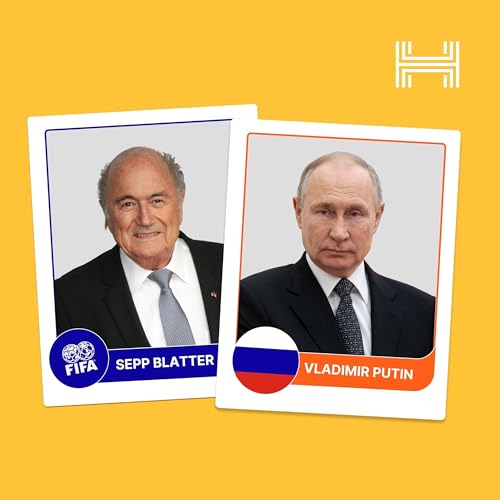
    In 2015, Swiss authorities—working with the FBI—raided a luxury hotel in Zurich and arrested top FIFA officials in a corruption scandal tied to how World Cups were awarded.

    Three years later, Russia hosted the tournament anyway.

    In Putin’s Russia, repression was not hidden. Journalists were silenced. Political opponents were imprisoned. And yet, as millions of fans arrived and billions watched, the country projected an image of openness, efficiency, and national pride.

    In this episode, we trace how Russia secured the World Cup amid FIFA corruption—and how that image was challenged during the final, when Pussy Riot stormed the pitch, revealing the risks of dissent.

    In this episode, you’ll learn:

    • How FBI agents arrested FIFA officials
    • Why Russia kept the 2018 World Cup despite the scandal
    • How Putin spent $50 billion on the Sochi Olympics
    • How FIFA’s voting system made corruption possible
    • Why Russia’s human rights abuses were already widely known
    • What Pussy Riot risked by storming the World Cup final
    • What their protest revealed about power in Putin’s Russia

    Connect:

    • Website: hrf.org
    • Instagram: @hrf
    • YouTube: @humanrightsfdn
    • Facebook: humanrightsfoundation
    • X: @HRF

    Coming soon! We’ve partnered with La Media Inglesa to bring you the full episode on YouTube, premiering in June 2026.

    Created by Karim Zidan and Elie Bleier.

    Produced by Elie Bleier and Robert Scaramuccia.

    Media strategy by Guillermo Purchese and Marielle Marlys.

    Afficher plus Afficher moins
    46 min
adbl_web_anon_alc_button_suppression_t1
Aucun commentaire pour le moment