Épisodes

  • Ep. 184 Is Poverty a Choice? What Federal Stats Tell Us About Who's Poor in America
    Oct 1 2026

    Each September, the U.S. Census Bureau releases new data revealing how many people in the country are living in poverty. But what does that number really tell us, and how should it shape the choices we make as a nation? Lisa Gennetian, the Pritzker Professor of Early Learning Policy Studies at Duke University's Sanford School of Public Policy, follows the data closely each year. She joins host Anna Gassman-Pines to explore how poverty is measured, what the latest figures reveal about American life, and how evidence can inform better public policy.

    Watch this conversation on video.

    Afficher plus Afficher moins
    38 min
  • Ep. 183 Insights About Climate, Energy and the Future of Public Policy Education
    Sep 15 2026

    Public policy shapes how societies work. As climate change, AI, and other challenges transform the world, policymakers and other leaders must understand complex issues and develop innovative solutions. JR DeShazo, dean of Duke's Sanford School of Public Policy, joins host Anna Gassman-Pines to discuss climate policy, policy innovation, and how public policy schools can better prepare the next generation of leaders. Among other roles, DeShazo previously led a UCLA center focused on innovation and sustainability.

    Watch this conversation on video.

    Afficher plus Afficher moins
    26 min
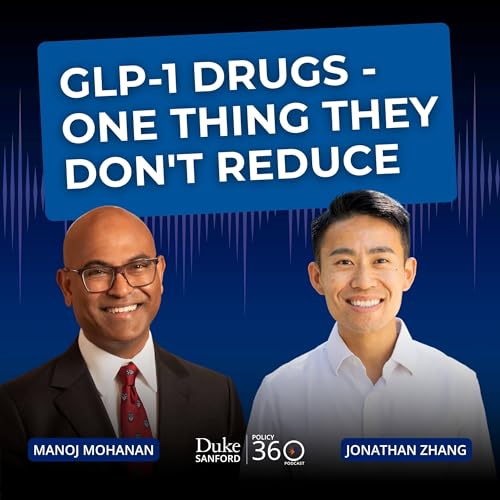
  • Ep. 182 GLP-1 Drugs - One Thing They Don't Reduce
    Apr 25 2026

    GLP-1 drugs like Ozempic and Wegovy have revolutionized the management of diabetes and obesity. Millions of Americans are experimenting with them. Celebrities like Oprah are sharing their experiences. Duke Sanford School of Public Policy faculty member Jonathan Zhang is an economist who works on health policy, health economics and public finance. His research shows that GLP-1 drugs live up to their promise in everyday medical care. But the study also finds that, at least in the short run, they do not reduce overall health care spending.

    Afficher plus Afficher moins
    29 min
  • Ep. 181 What Jamaican Sprinters Can Teach Us About Upward Mobility
    Apr 11 2026

    Duke Sanford School of Public Policy Professor Anirudh Krishna has been studying a seemingly simple question: why do people in certain countries just seem better at some things than others? Think of the large number of world-class runners from Jamaica like Usain Bolt and Shelly-Ann Fraser-Pryce, or the long list of top female golfers from South Korea. Why are people in tiny Estonia keep hatching software companies worth billions? Krishna's research shows that these examples are due in large part to structures that are specifically designed to support the rise of talent. By giving a fair chance to everyone these "ladders of opportunity" both produce champions and serve as avenues of upward mobility, supporting community development. Krishna's TED Talk, The 7 Pillars of Unlocking Potential, has garnered half a million views. His latest book is The Broken Ladder: The Paradox and Potential of India's One-Billion.

    Afficher plus Afficher moins
    25 min
  • Ep. 180 Trust & Leadership: A Conversation with CQ Brown, Jr. Former Chairman of the Joint Chiefs of Staff
    Mar 25 2026

    As 21st Chairman of the Joint Chiefs of Staff General CQ Brown, Jr. advised the President, the Secretary of Defense, and the National Security Council. He now serves as an executive in residence at Duke with appointments in the Sanford School of Public Policy and the Pratt School of Engineering. Over his career, General Brown has held many different roles. As a pilot with the U.S. Air Force, he has logged more than 3,100 flying hours. He also served as the first African American chief of a U.S. military service, the Air Force, and was unanimously confirmed for that role by the Senate in 2020.

    Afficher plus Afficher moins
    32 min
  • Ep. 179 Power to the Renters: Tenant's Rights in a Landlord's World
    Mar 6 2026

    Every year, 250 million Americans face issues that land them in the civil justice system; think eviction, debt collection and poor housing. And here's a shocking number: more than 90% of people with low incomes either get no legal help or inadequate legal assistance. Today's guest, Mallory SoRelle, is a public policy faculty member at Duke. She's co-written a book called Uncivil Democracy: How Access to Justice Shapes Political Power. The book is filled with true stories and analysis about how to harness power, politics, and justice to create effective public policy for everyone.

    Afficher plus Afficher moins
    31 min
  • Ep. 178 The Hidden Everyday Successes of Government - And How That Can Help Democracy
    Jan 15 2026

    Danny Werfel recently served as the 50th Commissioner of the Internal Revenue Service. He led the U.S. tax system twice, and in his most recent stint he was in charge of a dramatic transformation, launching more digital solutions in a two-year period than in the previous two decades combined. Werfel joins us to talk about leadership, organizational change, and how a broader understanding of what the government does – and gets right – could have a profound impact on political polarization and democracy itself.

    Danny Werfel earned a Master of Public Policy degree at Duke, and is now serving as a distinguished fellow with Polis, Duke's Center for Politics.

    Afficher plus Afficher moins
    41 min
  • Ep. 177 Workers: a non-compete clause should give you pause
    Dec 19 2025

    What if a single clause in your job contract could quietly shape how much you are able to get paid -- after you leave that job? And what if that same contract clause ends up limiting the places you can move for a job? Today, the hidden power of the non-compete clause. New research from Matt Johnson, professor at the Sanford School of Public Policy at Duke University and co-authors gives insight into what the practice actually costs workers.

    Afficher plus Afficher moins
    33 min