Épisodes

  • S02E40 - Judge and Restorer: Justice That Leads to Renewal
    Feb 16 2026

    Podcast Episode Description

    Welcome to Perspective Shift: Unveiling paradigms in perceptions, where we examine deeply held beliefs in the light of Scripture and the truth of God’s Word.

    In today’s episode, “Judge and Restorer: Justice That Leads to Renewal,” we confront one of the most misunderstood aspects of God’s character: His role as Judge.

    Modern culture prefers a God defined by tolerance, affirmation, and indulgence. No one enjoys being judged, especially by imperfect people. Accountability feels uncomfortable. Holiness can seem restrictive. And when we compare ourselves to a perfectly holy God, judgment may feel like an automatic guilty verdict.

    Yet Scripture consistently presents God as both righteous Judge and merciful Redeemer.

    This episode explores why judgment is necessary from God’s perspective. Because God is just, evil cannot be ignored. Because He is righteous, wrongdoing cannot be excused. Because He is holy, injustice cannot be allowed to remain unchecked. Judgment is not cruelty. It is moral coherence. A judge who refuses to judge is not compassionate, but incompetent.

    At the same time, God’s compassion provided an escape. Knowing humanity could never live sinless like Christ, He made provision through the cross. There, justice and mercy converge. In Christ, judgment is not dismissed but borne. God remains just while justifying those who trust in Him.

    We also examine the Genesis account of the ram provided in place of Isaac. While often described as a prototype of Jesus, it is more accurately understood as proof of concept. The ram did not volunteer, did not choose the altar, and did not rise again. Jesus did. Judgment fell on the ram so Isaac could walk away. Judgment fell on Christ so mercy could fall on us.

    The episode culminates in a prophetic vision of restoration:

    Revelation 21:5 (NKJV) “Then He who sat on the throne said, ‘Behold, I make all things new.’”

    Isaiah 11:9 (NKJV) “They shall not hurt nor destroy in all My holy mountain, For the earth shall be full of the knowledge of the LORD As the waters cover the sea.”

    Peace, we discover, is not the absence of justice but its fruit. Where accountability is absent, chaos is inevitable. Where God’s righteous order is established, restoration follows.

    This message invites listeners to see that God’s judgment flows from holiness and His mercy flows from love. They do not contradict each other. They complete each other.

    If you have wrestled with the idea of God as Judge, this episode offers clarity, hope, and an invitation to experience the mercy made available through Christ.

    Share this episode with someone seeking a deeper understanding of God’s character.

    And remember, Jesus Christ is Lord of all.

    Afficher plus Afficher moins
    19 min
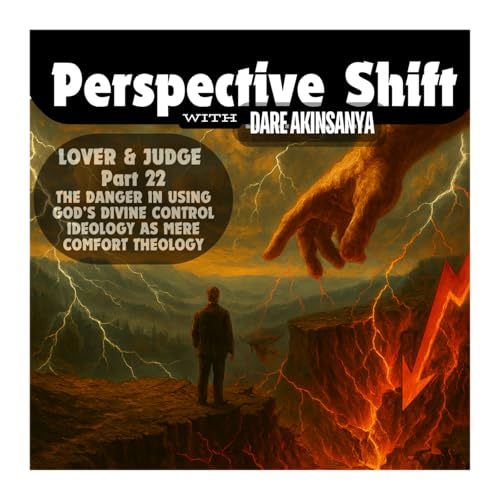
  • S02E39 - The Danger in Using God's Divine Control as mere Comfort Theology
    Feb 9 2026

    Welcome to Perspective Shift: Unveiling paradigms in perceptions, the podcast where deeply held beliefs are examined through the lens of Scripture, truth, and lived experience.

    In today’s episode, “The Danger in Using God’s Divine Control as Mere Comfort Theology,” we confront a popular yet often misunderstood phrase: “God had a plan.” While frequently offered as comfort in times of pain, this statement can unintentionally misrepresent God’s nature, distort accountability, and silence honest faith.

    This episode challenges listeners to discern the difference between God’s sovereignty and ownership, and to recognize that divine control does not mean God authors every tragedy. Through Scripture, personal testimony, and biblical case studies, we explore when God truly intervenes directly, and when suffering is the result of human free will, a fallen world, or spiritual opposition.

    Key discussions include:

    • Why God’s sovereignty does not mean He causes pain
    • Biblical examples of rare, intentional divine intervention
    • Leadership disappointment, integrity, and God’s redemptive signature in loss
    • The difference between faith-based confessions and religious language
    • How free will, knowledge, and spiritual guidance shape our outcomes

    The episode culminates in a heartfelt invitation to surrender fully to Jesus Christ, including a guided prayer of repentance and salvation. Listeners are encouraged to begin a new journey of being led by the Holy Spirit, not by comfort theology, fear, or religious clichés.

    If this message blesses you, share it with someone who needs clarity, healing, and truth today.

    Remember that Jesus is Lord!

    Afficher plus Afficher moins
    20 min
  • S02E38 - God's Non-Intervention Is Not Determinism
    Feb 2 2026

    In this episode of Perspective Shift: Unveiling Paradigms in Perceptions, we confront one of the most damaging theological misconceptions in modern Christianity: the belief that God’s omnipotence means He determines every outcome.

    Building on last week’s discussion about God’s foreknowledge versus causation, this episode addresses the claim that if God does not intervene in a situation, it must be because He needs it for a greater good. While Scripture affirms that God can redeem any situation, it does not teach that He requires evil in order to accomplish good.

    We examine common Christian phrases such as “Nothing catches God by surprise” and “If God didn’t stop it, He must have wanted it,” and expose how these ideas subtly misrepresent God’s character and assign Him responsibility for destruction He never authored.

    Through biblical reasoning, practical illustration, and a compelling FDA guideline analogy, this episode explains why omnipotence does not equal micromanagement, why free will does not cancel moral law, and how careless living can remove spiritual defense without removing God’s love.

    We also address frequently misused Scriptures on predestination and Romans 8:28, restoring their proper biblical context, and reaffirm that God is sovereign without being manipulative, powerful without being coercive, and redemptive without being the author of evil.

    The episode concludes with a clear exhortation, an invitation to salvation, and encouragement to align daily living with the guidance of the Holy Spirit, our Helper, Advocate, and Defense Attorney.

    Afficher plus Afficher moins
    31 min
  • S02E37 - God Is in Control: When Truth Is Misunderstood and Misapplied
    Jan 26 2026

    What does it really mean when we say, “God is in control”?

    In this episode of Perspective Shift: Unveiling paradigms in perceptions, we begin a three-part series that confronts one of the most frequently used, yet most misunderstood phrases in Christian culture. While the statement is biblically sound, it is often overstretched in ways that unintentionally remove human responsibility, misrepresent God’s character, and create confusion around suffering, sin, and spiritual accountability.

    In Part One, Dare Akinsanya shares a deeply personal journey that began with a season of prayer, fasting, and divine consecration that unexpectedly became a “spiritual school.” Through that process, God began to dismantle long-held assumptions and reframe truths that had been taught, heard, and even defended for years. This journey ultimately gave birth to the book Yes and Amen and a renewed mandate to represent God accurately.

    This episode explores the first major misconception: the belief that because God is in control, He must be responsible for everything that happens on earth. Drawing from Scripture, lived experience, and biblical examples such as Job and Joseph, Dare explains the critical difference between God’s permission and God’s approval, and why confusing the two distorts both theology and faith practice.

    You will also learn:

    • Why allowing something does not mean God caused it
    • How spiritual accusations operate and why Christ’s intercession matters
    • How God’s sovereignty works alongside free will, not in opposition to it
    • Why misrepresenting God’s character deeply displeases Him

    The episode concludes with a clear invitation to alignment through salvation, a guided prayer of repentance, and an opportunity to connect and receive a complimentary audiobook of Yes and Amen.

    Remember that Jesus Christ is Lord of all.

    Afficher plus Afficher moins
    23 min
  • S02E36 - Can God Be Overruled By Human Prayer?
    Jan 19 2026

    Can prayer change God’s mind, and if so, does that mean God is no longer sovereign?

    In this episode of Perspective Shift: Unveiling Paradigms in Perceptions, we confront the 10th common argument used to suggest that God is not truly in control:

    “If God can be overruled, then He is not really sovereign.”

    At first glance, this claim sounds reasonable. But does it hold up under biblical scrutiny?

    Using two often-misunderstood passages of Scripture, we take a closer look at:

    • Hezekiah’s prayer for extended life (Isaiah 38)
    • Moses’ intercession for Israel after the golden calf (Exodus 32)

    Were these moments examples of humans overriding God’s will, or something far deeper?

    In this episode, you’ll discover:

    • The difference between appeal and authority in prayer
    • Why prayer does not coerce God, but functions within His sovereignty
    • How divine mercy expresses sovereignty rather than diminishes it
    • Why God responds to intercession without ever surrendering control

    We also examine Moses’ later plea to enter Canaan (Deuteronomy 3) to show that God cannot be manipulated, even by His most faithful servants.

    The episode concludes with a call to repentance and salvation, an invitation to surrender fully to God, and a prayer for those seeking restoration and truth.

    If you’ve ever wondered whether prayer weakens God’s authority or strengthens your relationship with Him, this episode will bring clarity, balance, and biblical grounding.

    🎧 Listen, reflect, and share with someone who needs this perspective shift.

    Remember that Jesus Christ is Lord of all.

    Afficher plus Afficher moins
    18 min
  • S02E35 - Why God Is Truly In Control
    Jan 12 2026

    Welcome to another thought-provoking episode of Perspective Shift: Unveiling Paradigms in Perceptions. In this installment, host Dare Akinsanya continues the ongoing exploration of God’s sovereignty, building on the foundation laid in the previous two episodes.

    Today’s discussion engages a long-standing theological tension. On one side are those who argue that God is not truly in control. On the other are those who affirm God’s control but interpret it in ways that push the concept to unhealthy extremes. Rather than dismissing either camp, this episode carefully examines the valid concerns raised by both and reframes them through a biblically grounded perspective.

    The focus centers on the concept of God’s self-limitation. Does the fact that there are things God “cannot” do mean He lacks control, or does it reveal something deeper about His nature, integrity, and governance? Drawing from key passages in Psalms, Isaiah, the Gospels, and the Epistles, this episode demonstrates that God’s restraint is voluntary, principled, and rooted in His commitment to His word and character.

    You will explore commonly cited statements such as “God cannot lie,” “God cannot deny Himself,” and “God cannot be tempted by evil,” not as signs of weakness, but as evidence of moral perfection and sovereign consistency. The episode also addresses passages where Jesus did not perform many miracles due to unbelief and contrasts them with moments where He healed, provided, or raised the dead apart from any demonstrated faith, emphasizing the role of authority, compassion, and divine purpose.

    Through clear biblical examples, leadership insights, and theological clarity, this episode reframes restraint not as absence, but as one of the highest expressions of integrity in governance.

    The key takeaway is this: most objections to God’s control are not objections to His sovereignty, but to a narrow and coercive definition of control. Scripture reveals a God who delegates authority without losing sovereignty, allows freedom without forfeiting power, operates through covenant without being bound by it, and restrains Himself without compromising justice.

    God is in control, but His control is not coercive. It is sovereign.

    Afficher plus Afficher moins
    31 min
  • S02E34 - How Natural Disasters Are Man-Made
    Jan 5 2026

    In this episode of Perspective Shift: Unveiling Paradigms in Perceptions, host Dare Akinsanya continues the foundational conversation on the sovereignty of God. After establishing key truths in the previous two episodes, we now examine the opposing perspectives, including those who argue that God is not in control, and those who affirm God’s control but push it into unhealthy extremes.

    This episode is designed to bring balance and biblical clarity by confronting the most common arguments people raise against divine governance, including:

    • The existence of evil and suffering
    • Human free will and the question of delegated authority
    • Delayed or unanswered prayers and the misunderstanding of prayer as manipulation
    • Natural disasters, tragedy, and the overlooked laws and layers through which God governs
    • Passages that seem to suggest God changes His mind or makes mistakes
    • The prosperity of the wicked and the myth that God is partial
    • Scientific discovery being mistaken for replacement of God rather than evidence of Him
    • The misuse of God’s name to justify atrocities and the difference between permission and endorsement

    With supporting Scriptures such as Isaiah 45:7, Jeremiah 9:12–13, 2 Chronicles 7:13–14, Psalm 62:11, Deuteronomy 32:4, Matthew 5:45, and Psalm 90:2, this episode challenges listeners to rethink how God exercises authority, how covenant and timing function, and why sovereignty does not mean constant interference.

    This is not an argument for fatalism. It is a call to mature understanding. God’s rule is not tyrannical control but relational governance, expressed through law, covenant, delegated authority, and divine timing.

    As always, the episode closes with an invitation to salvation and restoration for anyone who is ready to return to Jesus, followed by partner acknowledgments and an invitation to connect at akinsd.com/connect to receive additional resources and a complimentary audiobook offer.

    Afficher plus Afficher moins
    43 min
  • S02E33 - Is God Truly In Control?
    Dec 29 2025

    Perspective Shift: Unveiling Paradigms in Perceptions Episode Title: “God Is in Control” vs. Human Responsibility: The Oversights We Keep Missing (Part 1)

    Is God truly in control, or does human responsibility contradict divine sovereignty? In this deeply needed and often heated conversation, Dare Akinsanya confronts one of the most emotionally charged debates in the body of Christ, not through doctrinal sparring, but through the lens of Scripture and the guidance of the Holy Spirit.

    Many believers find comfort in the phrase “God is in control,” while others struggle with it because of evil, suffering, tragedy, unanswered prayer, and the reality of human free will. But what if the conflict is not about whether God is sovereign, but about what we mean when we say “control”?

    In this episode, Dare re-centers the conversation on the purpose of creation and reveals a crucial truth many overlook: everything God created exists primarily for His pleasure. Drawing from Revelation 4:11 and unpacking the parable of the wheat and tares (Matthew 13:24–30, NKJV), he highlights a sobering insight Jesus made clear: “while men slept.” This was not physical sleep, but spiritual negligence and abandoned responsibility. The tares did not prove the farmer lost ownership of the field. They revealed what happens when delegated authority is not exercised.

    You will learn why sovereignty is not micromanagement, why God sometimes restrains Himself even when He has the power to intervene instantly, and how premature attempts to uproot evil can destroy what God is trying to preserve.

    This is Part 1 of a series. Next week, we will examine the major arguments people use to claim God is not in control and expose the assumptions behind them.

    And if your faith has been shaped by pain, disappointment, or confusion, this episode ends with an invitation to return to Christ through repentance and restoration, followed by a guided salvation prayer.

    Connect with Dare and access a complimentary audiobook offer at: akinsd.com/connect

    Remember: The tares exist, but the harvest is coming. The enemy is active, but the King is still on the throne.

    Remember that Jesus is Lord!

    Afficher plus Afficher moins
    24 min