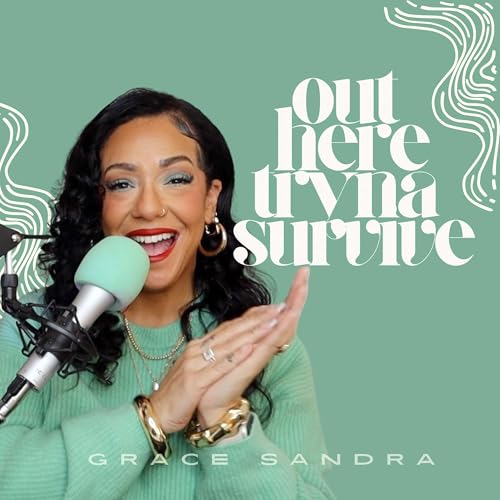
Couverture de Out Here Tryna Survive

Out Here Tryna Survive

Out Here Tryna Survive

De : Grace Sandra
Écouter gratuitement

À propos de ce contenu audio

Out Here Tryna Survive is a trauma-informed, reflective podcast centering the emotional lives, resilience, and humanity of Black women — especially those of us navigating midlife, healing, motherhood, and healing after survival.


Hosted by Grace Sandra — Mama, storyteller, advocate, and lifelong student of survival — this podcast explores what it feels like to live in a world that constantly demands our strength while offering little protection.


Through personal storytelling, cultural reflection, and nervous-system-aware conversations, each episode holds space for truth, grief, joy, rage, softness, and repair.


This is not a place for perfection or performance. It’s a place for us as Black women to exhale, feel seen, and remember ourselves.


We are braver than we believe ✨


© 2026 Out Here Tryna Survive
Développement personnel Hygiène et vie saine Psychologie Psychologie et psychiatrie Réussite personnelle
Les membres Amazon Prime bénéficient automatiquement de 2 livres audio offerts chez Audible.

Vous êtes membre Amazon Prime ?

Bénéficiez automatiquement de 2 livres audio offerts.
Bonne écoute !
    Épisodes
    • Ep 40: When AmeriKKKa has Narcissistic Personality Disorder, go NO CONTACT
      Jan 29 2026

      Send us a text

      Your eyes told the truth, and then the headlines told you they didn’t. That whiplash has a name—DARVO—and once you see how deny, attack, and reverse victim and offender operate, it becomes impossible to unsee the pattern in both intimate relationships and public life. We connect the dots between personal narcissistic abuse and national narrative control, exploring how gaslighting erodes trust in your senses, scrambles your nervous system, and turns outrage into exhaustion.

      I share hard-earned survivor tools to navigate this moment with clarity and care. We unpack the Minneapolis case as a live example of how stories get spun within hours, then zoom out to the larger system that punishes truth tellers, manages its image, and conditions the public to accept the unacceptable. Instead of feeding the doom machine, we build a plan: set an information diet, refuse trauma loops, block freely, and pick one role—caller, donor, organizer, caregiver, or witness—so your energy touches real people. We talk about why sleep is resistance, how a regulated body is harder to manipulate, and we practice a simple grounding reset you can use today: feet on the floor, long exhale, and the affirmation “We are here and safe enough in this moment.”

      This conversation is a warm hug of solidarity for Black and brown women carrying too much for too long, and an invitation to stay awake without burning out. If this spoke to you, share it with a friend who’s been doom scrolling into despair, subscribe for more hope-oriented storytelling, and leave a review so others can find their way here. What boundary will you set this week to stay engaged without being consumed?

      Support the show

      Afficher plus Afficher moins
      25 min
    • When The State Spins A Story: Renee Good, Media Power, And Black Women’s Clarity
      Jan 23 2026

      Send us a text

      The camera rolls, a woman dies, and then the story tries to kill her again. We talk about Renee Good’s killing and the speed with which power moves to rename a victim a threat, turning language into a shield for violence. As Black women, we know this pattern by heart. The harm happens, then the management of the harm—press briefings, headlines, talking points—asks us to doubt our eyes. We refuse that bargain. We grieve without confusion, and we get practical about what comes next.

      I share why the DOJ’s non-action reads as posture, not neutrality, and how labels like domestic terrorism blur law on purpose. We look at the long history of “law and order” as a tool to justify surveillance, force, and public fear, and we name the cost of that blur: fewer checks on state power and more room for abuse. For white listeners, this is a mirror as much as a map. Organizing is not a slogan; it’s sustained work—roles, logistics, fundraising, safety teams, and local pressure where you actually live. Study what Black organizers have built for generations and put your numbers to use.

      We also draw a hard line around energy and care. Doom scrolling is wrecking our nervous systems, so we set simple rules: choose two reliable sources, read once, log off. We talk through roles beyond protests—mutual aid, childcare, food banks, mental health support, and raising children who refuse dehumanization. If you do march, plan like it matters: buddies, meeting points, charged phones, shared locations, exits. If you don’t, support those who do. Most of all, we hold memory. They will try to erase what we saw and who Renee was. Don’t let them.

      If this lands heavy on your chest, you’re not broken—you’re human. Stay informed but not consumed. Stay connected so fear can’t isolate you. And if a Black woman you love is carrying too much, send this her way. Subscribe, share with a friend who needs clarity and care today, and leave a review with the role you’re choosing this week.

      Support the show

      Afficher plus Afficher moins
      19 min
    • Desmond & Kristy. Parasocial Grief, Religion & Choice. How I Messed up Too.
      Jan 15 2026

      Send us a text

      Headlines love a simple story, but real relationships rarely fit clean plots. When Christy filed for divorce and Desmond responded publicly, the internet crowned a villain overnight. We slow down the scroll and ask harder questions: why does a stranger’s breakup cut so deep, what myths about beauty and “being enough” do we keep swallowing, and how do religious rules shape the way people stay, confess, and finally leave?

      We talk candidly about parasocial grief—how attachment to public couples becomes a mirror for our own hopes—and the dangerous idea that fidelity can be earned through perfection. From there, we examine high-control faith cultures where divorce is framed as failure, endurance is praised over safety, and agency gets outsourced to pastors and communities. Grace shares her personal story of trying to exit under pressure, the costs of “confession” without accountability, and the quiet ways institutions protect themselves while individuals lose themselves.

      Then we go further. What if monogamy isn’t a moral default but one valid option among many? We explore how ethical non-monogamy, temporary separation with boundaries, and consent-forward renegotiations could reduce harm by normalizing honest conversations about desire and change. The goal isn’t to prescribe a model—it’s to champion clarity, boundaries, and the courage to tell the truth before the internet tells it for you.

      If the Christy–Desmond news or the Philip Yancey revelation stirred something in you, consider this your invitation to reflect without shame and reclaim your agency. Listen, share with a friend who needs nuance today, and if the conversation resonates, subscribe and leave a review so more people can find their way here. Your stories and questions help shape what we explore next.

      Support the show

      Afficher plus Afficher moins
      42 min
    Aucun commentaire pour le moment