Épisodes

  • CNN, The New York Times, Reuters, and Hacks/Hackers on AI in the Newsroom: In Conversation with Arlyn Gajilan, Burt Herman, Ryan Struyk and Rubina Madan Fillion
    Mar 2 2026

    AI is settling in as infrastructure within newsrooms, a layer quietly reshaping how journalists discover information, how stories move through production, and how audiences increasingly expect news to reach them.


    In this episode of Newsroom Robots, recorded live in New York City at TV News Check’s News Tech Forum, host Nikita Roy brings together four industry leaders to examine the tangible ways AI is transforming newsroom operations. The conversation features Ryan Struyk, Director of AI Initiatives at CNN; Rubina Madan Fillion, Associate Editorial Director of AI Initiatives at The New York Times; Arlyn Gajilan, Global Editor of AI Development and Integration at Reuters; and Burt Herman, Co-Founder and Principal of Hacks/Hackers.


    The discussion focuses on defining questions for the news industry: Where is AI already delivering real operational impact? How should newsrooms adapt to a world of “liquid content” and AI-mediated distribution? Is human-in-the-loop governance sustainable, or is it already breaking down? As trust in news declines and trust in AI interfaces rises, what becomes journalism’s true competitive advantage?


    In this episode, they cover:


    03:10 — Where AI is already embedded inside CNN’s newsroom workflows

    04:25 — How The New York Times uses AI to power investigative reporting and the “Manosphere Report”

    07:30 — How Reuters compressed story production from minutes to seconds and feature development from three months to three weeks

    11:44 — Why Hacks/Hackers is urging small newsrooms to think from first principles before adopting AI

    15:15 — The rise of liquid content and what it means when audiences reshape journalism into their preferred formats

    23:24 — Why local news holds a unique advantage in an AI-mediated information landscape

    29:12 — Five years from now: What newsrooms hope they get right

    Hosted on Acast. See acast.com/privacy for more information.

    Afficher plus Afficher moins
    43 min
  • Uli Köppen: How Bavarian Broadcasting is preparing for an AI-mediated future where trusted content wins
    Mar 2 2026

    Most major newsrooms have now moved beyond early experimentation with AI. The main challenge now is determining how to govern effectively, scale consistently, and strategically position AI across the entire organization—while maintaining public trust as a central priority.


    This week on Newsroom Robots, host Nikita Roy sits down with Uli Köppen, Chief AI Officer at Bavarian Broadcasting (BR), to talk about what it really looks like to lead AI strategy inside one of Europe’s largest public broadcasting networks.


    Uli makes a compelling case for why every newsroom should establish a dedicated AI leadership function, backed by an interdisciplinary governance structure. They also dig into a question defining the next phase of AI strategy for many newsrooms: in a world of AI overviews, zero-click search, and agent-driven information retrieval, how do you maintain your brand as a recognizable, trustworthy source? Uli shares why BR opted out of AI crawling and what they are building instead, including a vision for a verified content data pool that could power new products across multiple media organizations.


    In this episode, they cover:


    02:09 — What it means to be Chief AI Officer at a public broadcaster

    06:30 — Why every newsroom needs an interdisciplinary AI board, not just a single AI leader

    09:06 — The skills newsrooms need to build for an AI-driven environment

    11:00 — Why reinventing workflows starts before adding any technology

    16:28 — Inside the Oktoberfest Chatbot and the collaborative content pool powering it

    23:40 — Using AI for smarter community engagement and real-time moderation

    26:30 — The personalized audio news briefing that users love and where it’s headed

    36:00 — How BR’s AI guidelines evolved from broad guardrails to clear, example-based rules

    41:40 — The strategic question: be part of AI platforms, or build recognizable products of your own?


    Hosted on Acast. See acast.com/privacy for more information.

    Afficher plus Afficher moins
    47 min
  • Melissa Bell, Aron Pilhofer, Mark Chonofsky & David Chivers: Chicago Public Media on Building AI Tools That Serve the Audience
    Jan 27 2026

    Chicago Public Media operates two distinct news brands: WBEZ, the public radio station, and the Chicago Sun-Times, the legacy newspaper. With audio and print journalism, both membership and advertising revenue, and decades of archives in multiple formats, they're a unique case study for AI in local news.


    When CEO Melissa Bell joined the organization, there was interest in AI but no dedicated resources for experimentation. Through the Lenfest AI Collaborative, they brought in their first AI engineer. A year later, Spanish translations that used to take days are now published the same day. Forty years of WBEZ audio, previously unsearchable, are being transcribed and made searchable for journalists.


    In this week's episode, host Nikita Roy speaks with Chicago Public Media leaders Melissa Bell (CEO) and Aron Pilhofer (Chief Product and Membership Officer), along with Mark Chonowsky (AI Fellow) and David Chivers (lead AI advisor for the Lenfest AI Collaborative).


    A note on this week's episode

    David Chivers, who listeners will hear in this episode, passed away on January 1, 2026. He was the lead advisor for the Lenfest AI Collaborative and this episode was recorded the previous month. David was deeply committed to building capability in newsrooms. He was generous with his time, sharp in his insights, and always had one of those big smiles that would light up a room. He will be missed.


    The conversation covers how Chicago Public Media is thinking about AI as part of a larger membership strategy, how they decide what to build versus buy with limited resources, and what it looks like to lead through a public AI failure.


    In this episode:

    02:55 — Where Chicago Public Media started with AI a year ago

    08:08 — What AI use looks like inside the newsroom

    15:42 — How product development is evolving with AI tools

    27:28 — Collaboration with OpenAI and Microsoft

    28:26 — How AI fits into Chicago Public Media's membership strategy

    36:05 — Build vs. buy with limited resources

    37:44 — The Chicago Sun-Times AI-generated book list incident

    42:18 — Advice for leaders navigating AI mistakes publicly


    This episode of Newsroom Robots is supported by the Lenfest Institute for Journalism.


    Sign up for the Newsroom Robots newsletter for episode summaries and insights from host Nikita Roy.

    Hosted on Acast. See acast.com/privacy for more information.

    Afficher plus Afficher moins
    48 min
  • Alessandro Alviani & Fabian Heckenberger: How Germany’s Süddeutsche Zeitung is building AI products that audience can trust
    Jan 10 2026

    By 2026, most leading newsrooms have moved past the question of whether AI belongs in their organization. Now the key question is: what does a sustainable AI product strategy look like when you’re building for a subscription-based business and a high-trust brand?


    This week on Newsroom Robots, host, Nikita Roy sits down with Alessandro Alviani, Lead for Generative AI, and Fabian Heckenberger, Managing Editor for AI, at Germany’s Süddeutsche Zeitung to discuss how they’re using AI to build the next generation of news products.

    This conversation looks at what happens when AI becomes a permanent layer in a newsroom’s product stack.


    Alessandro and Fabian walk through how they’re designing AI experiences that fit naturally with reader behavior and how they’re developing new distribution and accessibility formats that would have been impossible to sustain manually.


    This episode also goes deep on a topic that’s becoming a defining competency which is operational trust. What do you monitor once an AI product is live? How do you categorize failures? And how do you respond quickly when something goes wrong, without panic and without eroding your brand?


    This episode, we cover:


    02:52 — How editorial and product roles complement each other in AI strategy


    13:13 — Addressing skepticism and fear around AI in the newsroom


    25:17 — Inside building the German election chatbot


    31:10 — The design framework that signals AI content without eroding trust


    35:30 — Real-time risk management and monitoring for live AI tools


    48:50 — The two questions every newsroom should ask before greenlighting an AI project


    54:55 — Closing reflections and personal AI use


    Sign up for the Newsroom Robots newsletter for episode summaries and insights from host Nikita Roy.

    Hosted on Acast. See acast.com/privacy for more information.

    Afficher plus Afficher moins
    1 h
  • Francesco Marconi & Scott Austin: 2025 Year in Review, What Actually Changed in AI and Media
    Jan 1 2026

    2025 wasn’t just another year of AI experimentation in the media industry. It forced the industry to confront a bigger question: what happens when AI stops being just a newsroom tool and becomes the layer audiences experience journalism through? That is the core question heading into 2026.


    This week on Newsroom Robots, host Nikita Roy sits down with Francesco Marconi and Scott Austin for an end of year recap roundtable on what actually changed in AI and media in 2025 and what newsroom leaders need to prepare for heading into 2026.


    Francesco is the co-founder and CEO of AppliedXL. He previously led R&D at The Wall Street Journal and built some of the earliest AI and newsroom automation systems at The Associated Press.


    Scott leads business development at Symbolic.ai, an AI assisted publishing tool. He is also a journalist and digital media veteran who spent years at The Wall Street Journal as a reporter and award winning editor, and later led content partnerships at Dow Jones across major platforms.


    This episode covers:


    03:10 — Why 2025 was journalism’s operational reckoning year


    08:55 — The shift from search to answers and why it breaks old business models


    14:40 — Proactive AI and what ChatGPT Pulse reveals about the next distribution layer


    20:30 — Journalism’s hidden work and why persistence, source building, and human judgment still matter


    23:30 — Why news orgs must move upstream from content to structured knowledge


    36:10 — AI agents: what they actually are, what they are not, and why transparency matters


    41:20 — The overlooked shift: Model Context Protocol (MCP) and why it is a major newsroom disruption


    51:05 — Predictions for 2026


    Sign up for the Newsroom Robots newsletter for episode summaries and insights from host Nikita Roy.

    Hosted on Acast. See acast.com/privacy for more information.

    Afficher plus Afficher moins
    1 h et 12 min
  • Jim Friedlich, David Chivers & Matt Boggie: How the Lenfest AI Collaborative placed AI engineers in 10 newsrooms
    Dec 19 2025


    The Philadelphia Inquirer never had an AI engineer on staff until the Lenfest AI Collaborative & Fellowship program changed that.


    The collaborative is a $5 million partnership between the Lenfest Institute, OpenAI, and Microsoft that placed 10 AI fellows in American newsrooms for two years. These engineers work within the organizations, building tools that solve real newsroom problems.


    This week on Newsroom Robots, host Nikita Roy sits down with Jim Friedlich, CEO and Executive Director of the Lenfest Institute, David Chivers, lead advisor to the Lenfest AI Collaborative and Matt Boggie, CTO of The Philadelphia Inquirer, to walk through how the program works and what the Inquirer has built as a result.


    The Inquirer came to the collaborative with an idea to build a full-archive search tool that would let reporters query decades of journalism. They expected it to take 24 months. Within two weeks of a Microsoft hackathon, they had working code. The tool, now called Dewey, searches everything the Inquirer has published since 1978.


    This episode covers:


    03:02 — How the Lenfest AI Collaborative got started


    05:34 — Can newsrooms trust big tech partners?


    08:33 — How the fellowship works day to day


    14:52– Inside the Microsoft hackathon that built Dewey in two weeks


    21:37 — Training journalists to understand LLM limitations


    24:07 — How AI literacy has changed newsroom culture


    29:45 – How small newsrooms can get started with AI


    35:14 — AI answers, search decline, and the future of audience traffic


    38:15 — Rethinking journalism’s role in an AI-mediated world


    41:23 — Closing reflections and personal AI use


    This episode of Newsroom Robots is supported by the Lenfest Institute for Journalism.


    Sign up for the Newsroom Robots newsletter for episode summaries and insights from host Nikita Roy.

    Hosted on Acast. See acast.com/privacy for more information.

    Afficher plus Afficher moins
    47 min
  • Tav Klitgaard: How Zetland turned a newsroom problem into a global AI business
    Dec 15 2025

    This week on Newsroom Robots, host Nikita Roy is joined by Tav Klitgaard, the CEO of the Danish newsroom Zetland, to unpack the origin story of GoodTape — an AI transcription tool that began as an internal newsroom solution and evolved into a profitable, global product used far beyond journalism.


    Zetland is an audio-first newsroom in Denmark. But GoodTape wasn’t born from an AI strategy or a product roadmap. It emerged from a familiar newsroom pain point of journalists spending hours transcribing interviews, with existing tools falling short, especially in non-English languages like Danish.


    In this conversation, Tav breaks down how GoodTape went from an internal experiment to a standalone, subscription-based product that quickly became profitable, generated millions in revenue and was eventually divested. He also shares what building GoodTape taught Zetland about AI adoption, organizational learning, and where newsrooms should, and shouldn’t, use generative AI.


    This episode covers:


    05:50 – How a prototype using OpenAI’s Whisper sparked GoodTape


    08:36 – The moment Zetland realized GoodTape could be a real product


    12:34 – How journalism’s trust and privacy standards became a product advantage


    13:59 – What actually improves transcription quality beyond the model itself


    15:27 – How GoodTape became profitable and contributed to Zetland’s revenue


    16:29 – Why Zetland eventually divested GoodTape instead of scaling it internally


    17:36 – What building an AI product taught Zetland about newsroom AI adoption


    19:08 – Why Zetland uses AI for productivity, not editorial output


    28:14 – A real-world example of AI use that forced Zetland to rethink its own guidelines


    30:34 – Why principles matter more than rigid AI rules in newsrooms


    Sign up for the Newsroom Robots newsletter for episode summaries and insights from host Nikita Roy.

    Hosted on Acast. See acast.com/privacy for more information.

    Afficher plus Afficher moins
    38 min
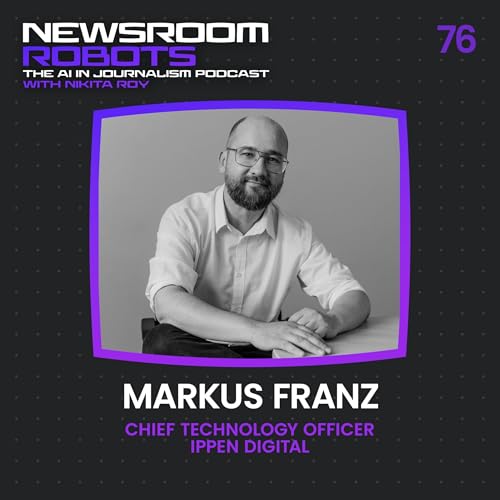
  • Markus Franz: How Germany's Ippen Digital Is Prototyping the AI-Powered Newsroom of the Future
    Nov 26 2025

    How do you redesign a newsroom’s entire workflow when AI is no longer a single tool, but a collection of agents, voice interfaces, and ambient intelligence changing how journalism gets produced?


    This week on Newsroom Robots, host Nikita Roy is joined by Markus Franz, Chief Technology Officer at Ippen Digital, one of Germany’s largest digital media networks with more than 80 online news and media portals. This episode was recorded live at the Digital Growth Summit in Stuttgart, where Markus shared how his team is building some of the most forward-looking AI experiments in European media.


    Markus leads Ippen Digital’s Incubator Lab, an innovation unit focused on reimagining how publishing and AI-driven experiences will evolve. With 16 years inside the company, Markus has been central to Ippen’s digital transformation and now leads efforts around multi-agent architectures and building adaptive workflows for the newsroom.


    In this conversation, Markus breaks down how his lab is experimenting with multi-agent “virtual teams,” voice-first newsroom interfaces, multimodal content production and an ambient AI-powered newsroom where intelligent systems support journalists in real time. He shares what his team has learned from early prototypes, why the biggest challenges are cultural rather than technical, and how news organizations should think about guardrails, platform dependency, and the rise of self-evolving models.


    This episode covers:


    02:22 – Why Ippen Digital built an Incubator Lab and how it’s structured as a future-focused R&D unit


    04:49 – What multi-agent systems look like inside a newsroom


    9:42 – The case for voice as the next major interface for both journalists and audiences


    14:41 – The shift from human-in-the-loop to human-on-the-loop workflows


    17:40 – Guardrails for agent systems: grounding, bounding, editorial policies


    19:33 – The vision for an ambient newsroom powered by AI companions and real-time intelligence


    27:31 – Why vendor lock-in and self-evolving LLMs pose new strategic risks


    30:08 – Multimodal personalization and rethinking how news is experienced


    34:27 – Why most AI pilots fail and what experimentation looks like in practice


    49:19 – Markus’s personal AI stack and how he uses these tools day-to-day


    Sign up for the Newsroom Robots newsletter for episode summaries and insights from host Nikita Roy.

    Hosted on Acast. See acast.com/privacy for more information.

    Afficher plus Afficher moins
    52 min