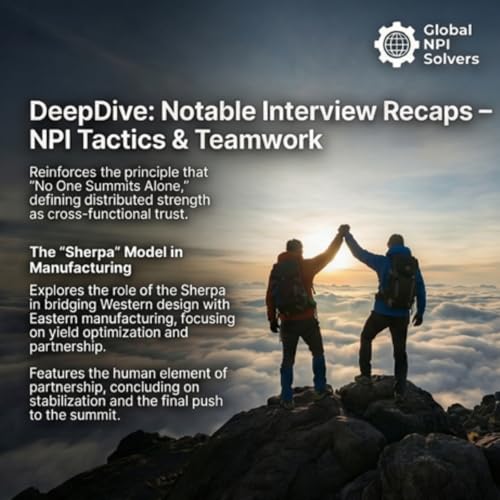
• DeepDive: Notable Interview Recaps - NPI TACTICS & TEAMWORK (19m35s)
    Feb 17 2026

    Executive Summary In this "Interview Recap" episode, the hosts analyze Rob Carl’s methodology, moving past the "motivational poster" cliché of mountain climbing to reveal a brutal survival manual for New Product Introduction (NPI). The core takeaway is that the biological and strategic demands of summiting Kilimanjaro are identical to surviving the "Valley of Death"—the fatal gap between a fun prototype and profitable mass production.

    1. Empty Your Backpack (The Gear Check) The most "sticky" metaphor for listeners is the "Backpack of Rocks." In hiking, carrying rocks is insanity; in business, companies do it daily by launching with unscalable tolerances.

    The Insight: A design demanding 5-micron precision works in a lab but fails in a 20-micron factory. These "rocks" are invisible at the start but become dead weight that kills the project halfway up the mountain.

    Action: Perform a ruthless Design for Manufacturability (DFM) review to strip out risks before boarding the plane.

    2. The Courage to Pivot (The Barranco Wall) The narrative peak is the Barranco Wall, where Rob had to fold up his trekking poles—his "safety net"—to survive a cliff climb.

    The Business Parallel: "What got you here won't get you there." Tools that served a startup (e.g., gut-check management, local mom-and-pop vendors) become liabilities at scale. High performers must abandon legacy tools to survive the ascent.

    3. Yield Loss is "Creating Garbage" The hosts demystify Yield Loss as the silent killer in the Valley of Death. If 400 out of 1,000 watches fail, you have paid for materials and labor to create garbage. Success requires "Distributed Strength"—treating factory workers as partners (Ubuntu) rather than black-box vendors to ensure quality.

    4. The Summit is Stabilization Finally, the episode redefines success. The launch party is a trap; it is only the halfway point. The true summit is Stabilization—ensuring unit #10,000 is as perfect as unit #1. Hiring a "Solver" is framed not as a consulting expense, but as an insurance policy against the fatal descent of product recalls.

    Final Thought: "You don't have to be fearless; you just have to begin".

    This episode was produced by Global NPI Solvers with the assistance of AI voice technology—including a digital twin of my voice—to bring you these insights faster. While the delivery is automated to scale and speed our knowledge sharing, the expertise, strategies, and 'Sherpa' methodology are 100% real.

    Afficher plus Afficher moins
    20 min
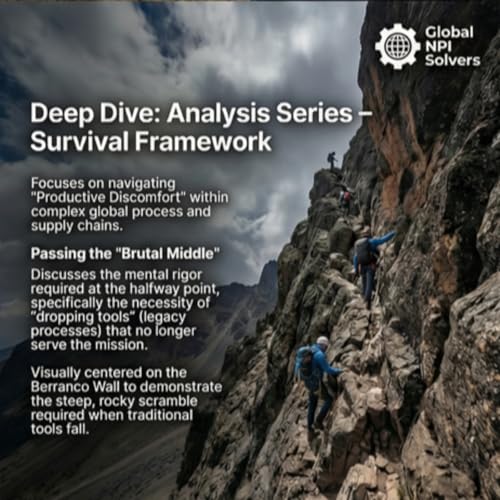
  • DeepDive: Analysis Series: SURVIVAL FRAMEWORK - NPI Survival using Kilimanjaro Takeaways (17m29s)
    Feb 10 2026

    The NPI Sherpa: A Framework for Survival (Analysis Series)

    Executive Summary In this "Analysis Series" deep dive, the hosts deconstruct the philosophy of Rob Carl, CEO of Global NPI Solvers, moving beyond the "motivational poster" view of mountain climbing to reveal a technical survival manual for New Product Introduction (NPI). The core takeaway is that the "Brutal Middle" of summiting a 19,300-foot volcano is structurally identical to the "Valley of Death" in manufacturing—the gap where most products die between prototype and profitability,,.

    1. The Gear Check: Empty Your Backpack The most actionable metaphor is the "Backpack of Rocks." In hiking, carrying useless rocks ensures fatigue; in business, companies do this by launching with unscalable tolerances.

    The Insight: A design demanding microscopic precision works in a California lab but fails in a mass-production factory in Vietnam. These "rocks" are invisible at the start but become dead weight that kills the project halfway up the mountain,.

    Action: Perform a ruthless Design for Manufacturability (DFM) review to strip out weak suppliers and impossible specs before the climb begins.

    2. The Courage to Pivot (The Barranco Wall) The narrative peak is the Barranco Wall, a 900-foot cliff where Rob had to fold up his trekking poles—his "safety net"—to climb a sheer face.

    The Business Parallel: "What got you here won't get you there." Tools that served a startup (e.g., gut-instinct management, mom-and-pop vendors) become liabilities at scale. High performers must abandon legacy tools to survive the ascent,.

    3. The Translator & The Summit Success requires a "Translator" to bridge Western design intent with Eastern manufacturing reality, preventing factories from making fatal assumptions (like swapping glues). Finally, the episode redefines success: The launch party is a trap. The true summit is Stabilization—ensuring unit #10,000 is as perfect as unit #1. Hiring a "Solver" is an insurance policy against the fatal descent of product recalls,.

    Final Thought: "You don't have to be fearless; you just have to begin"

    This episode was produced by Global NPI Solvers with the assistance of AI voice technology—including a digital twin of my voice—to bring you these insights faster. While the delivery is automated to scale and speed our knowledge sharing, the expertise, strategies, and 'Sherpa' methodology are 100% real.

    Afficher plus Afficher moins
    17 min
  • DeepDive: 1-on-1 Series: THE METAPHOR - Interview with Rob Carl, Founder & CEO of Global NPI Solvers
    Feb 3 2026

    Executive Summary This "DeepDive 1-on-1" episode features Rob Carl, CEO of Global NPI Solvers where he and our host discuss his framework for business leadership by mapping the biological and strategic demands of summiting Mount Kilimanjaro to the chaos of New Product Introduction (NPI). Drawing on 40 years of experience guiding 500+ new products to market, Carl shares how the "Brutal Middle" of a climb is structurally identical to the "Valley of Death" in manufacturing,,.

    The core takeaway is that success is not defined by the initial excitement or the launch party, but by the ability to survive hostile landscapes through radical self-awareness, the courage to drop legacy tools, and the humility to trust a guide.

    Executive Summary: The Kilimanjaro Framework

    Rob Carl, CEO of Global NPI Solvers, parallels summiting Mount Kilimanjaro with the "Valley of Death" in New Product Introduction (NPI). Success requires surviving hostile landscapes through radical self-awareness and shedding legacy tools.

    1. Concept to Commitment

    The journey starts when alignment shifts to action. Real leadership begins when the "landscape turns hostile" and the finish line is no longer visible.

    2. DFM: Stripping the "Rocks"

    In NPI, unscalable tolerances are "rocks" in your pack. A part with 0.01mm precision may work in a lab but fail in mass production. You must strip these risks before scaling; unscalable designs are dead weight.

    3. The Body as a Dashboard

    Rob reframes burnout as biological data. Just as you cannot "spin" low oxygen on a mountain, leaders cannot ignore cognitive fatigue. Treating exhaustion as noise is a fatal operational error; self-regulation is a prerequisite for leadership.

    4. The Courage to Pivot

    At the Barranco Wall, Rob had to abandon his trekking poles—the very tools that provided stability for 22 miles—to climb with his hands. Similarly, gut-instinct management that builds a startup becomes a bottleneck for an enterprise. You must drop the tools that got you here to get there.

    5. Distributed Strength

    No one summits alone. Success requires a "Sherpa" who knows the supply chain's "ending." Following the Ubuntu philosophy—"I am because we are"—means treating factory operators as essential partners.

    6. The Summit

    The struggle is "fuel for progress." When the middle gets brutal, focus only on the next foothold.

    Final Thought: Check your gear, drop the rocks, trust the guide, and begin.

    This episode was produced by Global NPI Solvers with the assistance of AI voice technology—including a digital twin of my voice—to bring you these insights faster. While the delivery is automated to scale and speed our knowledge sharing, the expertise, strategies, and 'Sherpa' methodology are 100% real.

    Afficher plus Afficher moins
    15 min