Couverture de MSU Today with Russ White

MSU Today with Russ White

MSU Today with Russ White

De : Russ White
Écouter gratuitement

À propos de ce contenu audio

MSU Today is a lively look at Michigan State University-related people, places, events and attitudes put into focus by Russ White. The show airs Saturdays at 5 P.M. and Sundays at 5 A.M. on 102.3 FM and AM 870 WKAR.© 2026 Russ White Sciences sociales
Épisodes
  • Higher Education, Civil Discourse and Democracy
    Mar 18 2026
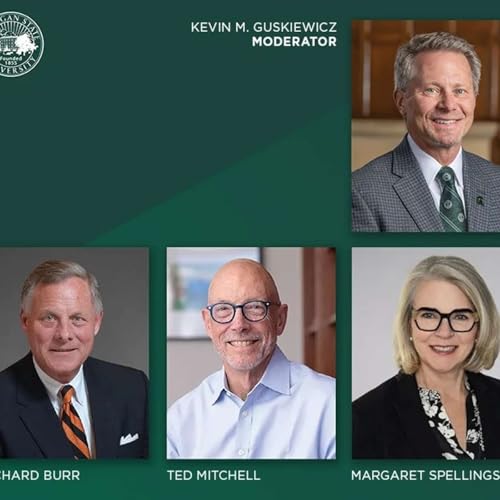
    Special Presidential Speaker Series – Michigan State UniversityMichigan State University launched its Presidential Speaker Series with a wide‑ranging and candid conversation on the role of higher education in sustaining democracy and civil discourse. Held at the Wharton Center and moderated by MSU President Kevin M. Guskiewicz, the event brought together bipartisan leaders from government and higher education to examine how universities can help prepare students to navigate disagreement, practice democratic engagement, and contribute meaningfully to the public good.The evening opened with framing from Ann Austin, University Distinguished Professor in the College of Education, who emphasized the importance of universities as spaces where diverse perspectives meet—and where disagreement, when approached constructively, becomes a powerful tool for learning. President Guskiewicz underscored that today’s college campuses are often the first places where students encounter people with markedly different backgrounds, beliefs, and lived experiences, making higher education a microcosm of American democracy itself.The panel featured three nationally recognized leaders: Richard Burr, former U.S. senator and principal policy advisor at DLA Piper; Ted Mitchell, president of the American Council on Education and former U.S. under secretary of education; and Margaret Spellings, president and CEO of the Bipartisan Policy Center and former U.S. secretary of education. Former Michigan governors Jim Blanchard and John Engler also joined the program, highlighting bipartisan efforts to strengthen trust in democratic institutions.Across the conversation, panelists explored growing public skepticism toward higher education, driven by concerns about affordability, job outcomes, transparency, and perceived political bias. While acknowledging these challenges, speakers emphasized that most students report feeling free to express their views—and that universities remain among the few institutions designed specifically to foster open inquiry and debate.A recurring theme was balance: between higher education’s public mission and individual return on investment; between academic autonomy and accountability; and between preparing students for employment and preparing them for citizenship. Panelists stressed that employability and civic education are not competing goals, but mutually reinforcing ones—arguing that student success, transparency in admissions and financial aid, and relevance of research to community needs are essential to restoring public trust.The discussion also addressed emerging pressures, including rapid technological change, artificial intelligence, national security concerns tied to research and data, and the influence of social media on public discourse. Speakers called on universities to communicate their value more clearly, form stronger public‑ and private‑sector partnerships, and recommit to their role as places where difficult conversations can happen with rigor, respect, and honesty.Audience questions steered the conversation toward practical action: how to design classrooms and campus experiences that encourage belonging and respectful dissent; how faculty can be supported in navigating charged discussions; and how leaders can remain grounded in core educational values amid political and social pressures.As the inaugural event in the series concluded, President Guskiewicz reflected on the enduring responsibility of universities to educate not only skilled graduates, but engaged citizens. The evening affirmed the purpose of the Presidential Speaker Series: to model civil discourse, elevate thoughtful disagreement, and strengthen the democratic mission at the heart of higher education.Transcript:Speaker 1 (00:00:00):Good evening. Hello, and thank you so much for joining us tonight. I'm Ann Austin, and I'm a university distinguished professor in the College of Education. I'm very pleased to be here this evening to introduce the Special Presidential Speaker Series and its participants to you. Before we get started, I want to mention a few housekeeping items. First, and in particular to the topic that we're examining this evening, we ask that you please be respectful to those who are joining in the conversation. We also ask that you avoid flash photography or personal recording devices as they may be distracting to those who are on the stage. And we all very much appreciate your cooperation with those requests. Tonight, we're going to be discussing a topic that's quite important to me, and I think to all of us, it's important to me because I've held leadership roles in higher education, as well as being a researcher who studies major issues in higher education.(00:01:05):And in fact, with my colleague, Brendan Cantwell, who I think is here this evening also, we've been hosting a series of public webinars discussing the future of public research universities. And tonight's topic on higher ...
    Afficher plus Afficher moins
    1 h et 43 min
  • MSU leads talent development for an innovation economy with Green and White Council
    Jan 21 2026
    Michigan State University has unveiled the signature initiatives of its specially appointed Green and White Council. The Council was convened by MSU President Kevin Guskiewicz and tasked with bringing forward ideas to strengthen the state’s workforce, connect students to high-quality careers, and accelerate innovation across Michigan’s industries. Launched by Guskiewicz in April, and co-chaired by Matt Elliott and Sanjay Gupta, the Green and White Council comprises more than a dozen prominent leaders, including representatives from Dart Container, Bedrock Detroit, Blue Cross Blue Shield of Michigan, ITC Holdings and Carhartt, representing a cross-section of industry and innovation that drive the economy. Conversation Highlights:(1:37) - Before we discuss the signature initiatives, remind us why you thought it was important to pull this group together and what you charged them to do.(2:57) - Why did you select Matt and Sanjay to co-chair the council? And talk about the membership of the council and the variety of backgrounds you wanted to get input from.(4:16) - Why was it important to you to co-chair council and lead this initiative? And talk about the process and collaboration of the council. How did you do your work and go about selecting these three initiatives?(7:15) - Enhancing MSU’s current work to connect education and industry, the members of the Green and White Council used their experience, knowledge and effort, to shape three transformative initiatives: AI-Ready Spartans Career-Connected Spartans Spartan Catalyst Elaborate on the initiatives, and why did you settle on these three?(8:34) – What do you mean by AI-Ready Spartans?(12:00) – What are Career-Connected Spartans?(16:20) – What is a Spartan Catalyst?(21:33) – What are your thoughts on what Matt and Sanjay have been discussing?(23:23) - How do you envision the initiatives being implemented across campus over the coming weeks, months and even years?(27:36) - Will the council disband or will you keep working?(28:34) – Closing thoughts from the group.Listen to “MSU Today with Russ White” on the radio and through Spotify, Apple Podcasts, and wherever you get your shows. Conversation Transcript:Russ White (00:00):Michigan State University has unveiled the signature initiatives of the specially appointed green and white council. The council was convened by MSU President Kevin Guskiewicz and tasked with bringing forward ideas to strengthen the state's workforce, connect students to high quality careers and accelerate innovation across Michigan's industries. Launched by President Guskiewicz in April and co-chaired by Matt Elliot and Sanjay Gupta. The Green and White Council comprises more than a dozen prominent leaders, including representatives from Dart Container, from Bedrock Detroit, Blue Cross Blue Shield of Michigan, ITC Holdings and Carhartt representing a cross section of industry and innovation that drive the economy. And President Guskiewicz it’s always great to have you back on the program. Good to see you again.Kevin Guskiewicz (00:51):Good to see you, Russ. Thanks for having me.Russ White (00:52):Sanjay Gupta is the Dean Emeritus, and Eli and Edythe L. Broad endowed professor in MSU's. Eli Broad College of Business. Sanjay, great to have you on again.Sanjay Gupta (01:02):Always good to be with you, Russ. Thank you.Russ White (01:03):And Matt, you’ve got your hands into so many things. I know Bank of America, just tell us how you'd like our audience to know about your background.Matt Elliott (01:10):Well, I'm the former president of Bank of America, Michigan, and now I lead a group of people under the banner of Blue Lake Ideas. And what we do is we consult with companies, boards, and institutions to help them lead through a world of accelerating change.Russ White (01:24):Excellent.Kevin Guskiewicz (01:25):And he's a proud Spartan alum. Russ White (01:26):Kevin, before we discuss the signature initiatives, remind us why you thought it was important to pull this group together and what you charge them to do.Kevin Guskiewicz (01:38):Well, Russ, I've said since I got here about 22 months ago now, that I wanted to be sure that Michigan State was always leading, that we were viewed as the leaders in research, education, service to the state, but also to the nation and the world. And we're going to lead in how we redefine the way in which we can better prepare our graduates for the workforce demands of today and tomorrow, jobs and careers that don't even exist today, that our graduates will be needing to be prepared for over the next three, four decades. So we charged them with gaining a better understanding from industry leaders in about five or six different sectors as to where higher ed is not delivering, it's going to be needed for the future, and I couldn't be happier with where we are. That's sort of one of the initiatives and others really around how we can better connect our graduates t...
    Afficher plus Afficher moins
    33 min
  • Renovated MSU Museum part of a “vital social infrastructure on campus”
    Jan 7 2026
    Devon Akmon is the director of the renovated and revitalized MSU Museum.Conversation Highlights:(0:20) – What’s been happening at the renovation and revitalization of the venerable MSU Museum?(1:03) – Was the remodeling something you knew was necessary when you became director in 2021?(1:49) – You found a way to stay open during the renovation.(2:52) – What are you excited about in the renovated MSU Museum?(4:06) – What are some current or future exhibits you’d like to highlight?(5:38) – What are the MSU Museum’s priorities in the Uncommon Will Far Better World campaign?(6:34) – What do you want us to know about the revitalized MSU Museum?(7:14) – What are challenges and opportunities ahead for the MSU Museum and the entire arts industry?Listen to “MSU Today with Russ White” on the radio and through Spotify, Apple Podcasts, and wherever you get your shows. Conversation Transcript:Russ White (00:00):Well, it's great to welcome Devon Akmon back to MSU Today. Devon is the director of the Michigan State University Museum. Devon, welcome back. Thanks for having me on the show. So Devon, the museum has been closed for a while. I'm not sure if you're saying refurbished, modernized. What are you saying has happened to the museum?Devon Akmon (00:21):Certainly a lot has been happening. I would like to call it a renovation.Speaker 1 (00:24):Renovation, I like it.Speaker 2 (00:26):The museum has never been in a building that was purposely built for museums. So where we are today on the Circle was previously the library. So we've been in, the museum has been in that building for about 75 years. And this is the first infrastructural upgrade to the building, meaning heating, cooling, windows, all the things that make a museum flourish and make us excellent at stewardship of the collection.Speaker 1 (00:52):And Devon, did you kind of know when you took over in 2021, we need to renovate? Or was that part of even why you took the job knowing we would renovate? Speaker 2 (01:04):Certainly it was a priority from day one. So we are really proud that the Michigan State University Museum is accredited and less than 5% of museums are. There are 35,000 museums in the nation. Less than 5% are accredited. However, because of the accreditation standards, we were very concerned would we be able to continue with that designation given we didn't have heating and cooling. So from day one at that time, it was Provost Woodruff and Vice Provost Stoddard and I, we discussed this and made it a priority. And with the collective leadership, were able to get that vital support from our board of trustees who agreed this is an investment we need to make here at MSU.Speaker 1 (01:41):But you didn't really close completely, right? You stayed alive in the new MSU Credit Union building. You were there. Talk about how you stayed open and alive.Speaker 2 (01:49):So we've been really working to revitalize the museum. I don't think that most people recognize that the MSU Museum was founded in 1857 with the first incoming class of students here. And I always tell people MSU had two great visions. One, this notion of a land grant, and two, a museum that would help with teaching, learning, public engagement, research. So as we've been rethinking what a museum could be in the 21st century post pandemic, we were making great inroads and we knew that by shutting down for 18 months, we would be at a disadvantage. We wouldn't be able to serve our students and faculty in the community. So with the gracious support of our friends at MSU FCU, they provided us with a space where we had exhibitions and programming and a host of activity happening for about 18 months. We just closed down that gallery last week and now we're eagerly anticipating the reopening of the museum.Speaker 1 (02:40):So Devon, it's renovated. Tell us about what the renovation looks like. What are you excited about? What are some of the changes? Obviously some of the infrastructure, but what are you excited about in the renovated museum?Speaker 2 (02:52):Well, certainly the upgrades, new windows, all these things that will make it a comfortable and stable environment and enable us to do more forward-looking collection stewardship. However, we were able to renovate and upgrade some of the spaces in the museum as well. So the Forest Acres Trust has been phenomenal and they granted us $2 million to reenvision our lower level. So now we have a new immersive lab for faculty and students to engage more closely with our one million objects and specimens in our collection. We have more experiential learning galleries now because of this where we can collaborate with our students and faculty to build exhibitions. It doesn't have to just be the professional staff, but we also have other spaces in the museum for teaching, learning. We've included two new community, what we're calling lounges for students so that they can just drop in and hang out.(
    Afficher plus Afficher moins
    8 min
Aucun commentaire pour le moment