Épisodes

  • Powerful, Smart Choices After Diagnosis at Age 38
    Oct 22 2026
    Send us Fan MailTreatment ends, the calendar clears, and somehow that’s when the real questions surface: Who am I now? What do I actually want my life to look like? In this episode of Love Letters 2 Our Bodies, Gwendolyn Mitchell sits down with Kia Lee, a stage three breast cancer survivor, author, speaker, and patient advocate who knows this terrain intimately, both as someone who has lived it and someone who now walks alongside other women finding their way through it. Kia shares the story of being diagnosed at 38, the shock of facing cancer after doing many of the “right” things, and why survivorship is not about returning to who you were before. She reflects on how chronic stress, survival mode, and hypervigilance affect the body, especially for Black women and women of color navigating a world that often requires them to stay strong and keep pushing through. The conversation then turns to identity shifts, grief for the person you were before diagnosis, and the deeper questions that shape life after treatment. Kia also talks about self-advocacy, researching treatment options, fighting for proton radiation, and making choices that protected her body. This conversation offers an honest look at healing, alignment, and what it means to move forward with presence and purpose after diagnosis.Key Points From This Episode:• A warm welcome to today’s guest, Kia Lee.• Kia’s stage three breast cancer diagnosis at 38.• The shock of facing cancer after doing many of the “right” things.• Why survivorship is not about returning to who you were before.• How chronic stress and living in survival mode can affect the body.• Why hypervigilance is especially relevant for Black women and women of color.• The identity shifts many women face after cancer treatment.• Navigating grief for the person you were before diagnosis.• How Kia helps women recognize when they are running on empty.• The reflection guide Kia created to support deeper healing work.• Why you are not behind in your healing or your life.• How self-advocacy shaped Kia’s treatment and recovery choices.• The role of scalp cooling, compression boots, and personal research.• Why the emotional side of survivorship is not linear.• Choosing breath, alignment, and self-care after treatment ends.• Kia’s reflections on purpose, healing, and becoming a lighthouse. Quotes: “You're not the same person the moment you get the news that you were two hours before. And then as you move through the treatment, you're not the same person spiritually, physically, energetically, emotionally.” — Kia Lee [0:07:02]“You have to decide: is chemo right for me? Is radiation right for me? Is immunotherapy right for me? You're being bombarded with all of these questions, all while facing your own mortality.” — Kia Lee [0:07:29]“Grief is the hardest part, and for a while you don't even realize that that's what that emotion is. And it's hard because you are grasping and holding on to her, trying to get her back, trying to not let her go through the chemo, not let her go through all of the changes.” — Kia Lee [0:16:50]“I am exactly where I am meant to be. All of my choices have brought me to this moment. So I'm not behind; I’m right where I’m supposed to be.” — Kia Lee [0:27:44]“If anyone is in that fight [for proton treatment], keep appealing. And the proton centers are pretty great at it. So, as long as you're okay with the delay, which I was, I say keep fighting for it. But, research it for yourself and get second opinions.” — Kia Lee [0:31:45] “It’s not my way, it’s not about me. It’s just guiding people along their way. I'm not a lifeboat. — I don't have the answers. I just ask you to ask the right questions to get you on your way.” — Kia Lee [0:49:11]Links Mentioned in Today’s Episode:Kia LeeKia Lee on SubstackLighthouse: The Path Through CancerLighthouse: Surviving Narcissistic AbuseLife After Breast Cancer with Kia Lee: Free Reflection GuideGwendolyn Mitchell on LinkedInMOYO Institute, IncLove Letters 2 Our Bodies is sponsored by Moyo Institute, Inc and the Lloyd Symington FoundationGwendolyn Mitchell on LinkedInMOYO Institute, Incinstagram.com/moyoinstitute
    Afficher plus Afficher moins
    52 min
  • Discomfort During Breastfeeding was Breast Cancer
    Oct 8 2026

    Send us Fan Mail

    In this episode, Gwendolyn sits down with Brittany Mullins, a young Black woman who turned her stage four breast cancer diagnosis into a movement. Brittany shares her journey from discovering a lump while nursing her daughter, to being dismissed by doctors for six months, to finally receiving a diagnosis — and how the loneliness of that experience inspired her to create Black Girls Cancer Club, a community for young Black women navigating cancer.

    Topics Covered:

    • Brittany's diagnosis story: feeling a lump during breastfeeding and being told it was just clogged ducts for six months
    • The isolation of being a young Black woman with cancer during COVID
    • How being rejected from her dream medical program led to founding Black Girls Cancer Club
    • The highest gap in Black women's breast cancer care: lack of medical coverage and late detection
    • Barriers young Black women face — being taught to stay silent and not trust their intuition
    • The mental and emotional toll after treatment: the rumination, rebuilding your life, and the need for post-survivorship resources
    • Normalizing that it's okay to not always be strong
    • Brittany's restorative practices: journaling, morning sermons, therapy, and breathing
    • The resilience of the body and viewing it as a wise teacher

    Upcoming Event: Pilates and Prosecco — October 24th, presented by Black Girls Cancer Club in collaboration with 510 Society. A wellness event for Black women (21 and up) in Oakland, CA, celebrating breast cancer survivors and raising awareness. Over 200 women expected.

    Links Mentioned in Today’s Episode:

    • Black Girls Cancer Club website: blackgirlscancerclub.com
    • Contact BGCC: bgcc.club@bgcc.club (put "event" in subject line to volunteer, sponsor, or donate)
    • Moyo Institute: moyoinstitute.org
    • 510 Society (event collaborator)

    Quotes:

    "Because when you feel things, you have to listen to your intuition. You have to listen to your body... "I was sent home for six months and was told, You didn't have anything. It's all in your head." 00:13:04

    "My best advice is listen to no one's advice. Do what feels good in your heart and trust your intuition." 00:24:07

    Love Letters 2 Our Bodies is sponsored by Moyo Institute, Inc and the Lloyd Symington Foundation
    Gwendolyn Mitchell on LinkedIn
    MOYO Institute, Inc
    instagram.com/moyoinstitute

    Afficher plus Afficher moins
    26 min
  • Decoding the Diagnosis: What Every Family Needs to Know
    Sep 24 2026

    Send us Fan Mail

    Black men are more likely to be diagnosed with prostate cancer and more than twice as likely to die from it. In today’s episode of Love Letters 2 Our Bodies, Gwendolyn Mitchell is turning our focus to men’s health, because their health is our health too! She is joined by Dr. Nynikka Palmer, DrPH, MPH, an associate professor at UCSF Department of Medicine who has dedicated her career to addressing disparities in prostate cancer care for Black men. Together, they discuss the disproportionate impact of prostate cancer on Black men and their families. Dr. Palmer also is the Director of the Office of Community Engagement for the UCSF Helen Diller Family Comprehensive Cancer Center and is Vice President of Research for the Academy of Communication in Healthcare. Tuning in, you’ll hear all about the different variations of prostate cancer, why differentiation is essential, what a PSA (Prostate-Specific Antigen) test is, how it differs from a Gleason score, and more. We delve into how slow-growing prostate cancer is and why time is on a prostate cancer patient’s side before discussing when to get screened for prostate cancer and what to do when the result is elevated. Dr. Palmer also tells us all about her career history and how she got started in this work. We touch on the importance of having open conversations about your health within your family and community and how women can support the men in their lives when it comes to their health. Finally, our guest tells us about her prostate cancer support group and the peer navigation work she’s doing. To hear all this and even be inspired to encourage a man in your life to focus on their prostate health, be sure to press play now!

    Key Points From This Episode:

    • Welcoming Dr. Nynikka Palmer to the show.

    • A breakdown of the different types of prostate cancer.

    • All about PSA (Prostate-Specific Antigen) tests and how they work.

    • What a Gleason score is and how it differs from a PSA score.

    • Why there is no rush when considering treatment for prostate cancer.

    • How Dr. Palmer got started in this work, with a focus on Black men.

    • When men should start getting screened for prostate cancer.

    • The next steps for a man with an elevated PSA result.

    • How women can support men in their lives to get screened.

    • Dr. Palmer’s support group for Black men with prostate cancer.

    • Today’s action step: what to say to a man in your life about prostate health.

    Quotes:

    “There are a lot of treatment options [for prostate cancer]; there’s not just one way to treat it.” — Dr. Nynikka Palmer [0:03:57]

    “Prostate cancer, in general, is a very slow-growing disease.” — Dr. Nynikka Palmer [0:14:40]

    “Prostate cancer typically does not have symptoms when it’s still very early on.” — Dr. Nynikka Palmer [0:15:03]

    “I went into cancer for the strict purpose of changing how we provide care for our patients, particularly in the Black community.” — Dr. Nynikka Palmer [0:21:02]

    “The problem I have seen the most is that we’re not getting men into the doctor early enough for anything.” — Dr. Nynikka Palmer [0:33:51]

    Links Mentioned in Today’s Episode:

    Dr. Nynikka Palmer on LinkedIn

    NCCN Prostate Cancer Guidelines

    Gwendolyn Mitchell on LinkedIn

    MOYO Institute, Inc

    Love Letters 2 Our Bodies is sponsored by Moyo Institute, Inc and the Lloyd Symington Foundation
    Gwendolyn Mitchell on LinkedIn
    MOYO Institute, Inc
    instagram.com/moyoinstitute

    Afficher plus Afficher moins
    44 min
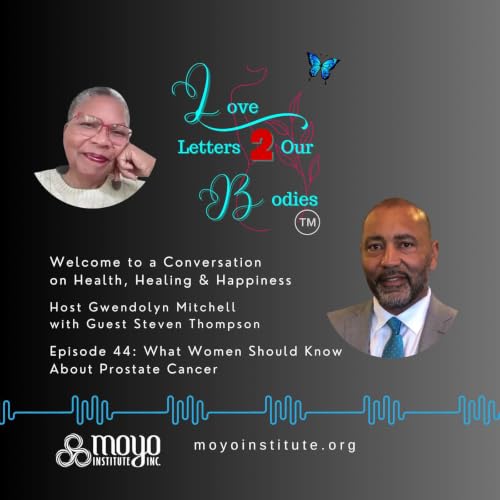
  • What Women Should Know About Prostate Cancer
    Sep 10 2026

    Send us Fan Mail

    Prostate cancer affects far more than the man who receives the diagnosis; it can reshape the emotional and practical life of an entire family. In this episode of Love Letters 2 Our Bodies, Gwendolyn Mitchell speaks with Steven Thompson, Co-Chair of the UCSF Black Men's Health Committee and a prostate cancer survivor and advocate, about what women should understand about screening, diagnosis, treatment, and survivorship. Steven reflects on his own journey and the support that helped him move through fear, weigh his options, advocate for his care, and help other Black men do the same. They also explore emotional openness, peer navigation, informed decision-making, and the meaningful role loved ones can play throughout the cancer journey. Tune in to learn how knowledge and trusted support can help men face prostate cancer with greater confidence and care.

    Key Points From This Episode:

    • Meet Steven and hear how his advocacy grew from his own prostate cancer journey.

    • Learn how bringing a trusted person to appointments can provide emotional support.

    • Understand how joining a support group changed Steven's experience of prostate cancer.

    • Steven shares what he wishes he had known before his prostate cancer journey began.

    • Hear about Steven's treatment path and how inequities can shape care for Black men.

    • Understand why an elevated prostate-specific antigen (PSA) does not always indicate cancer.

    • Find out how UCSF's peer-navigation program helps newly diagnosed men.

    • Hear what motivated him to join the UCSF Black Men's Health Committee.

    • Uncover what Steven most wants women to know about prostate cancer.

    • Appreciate how support groups can help men with relationships and navigating the process.

    • Advice for supporting a man who is avoiding the topic or living with prostate cancer.

    • Final takeaways and Steven's love letter to his body.

    Quotes:

    “Each treatment type has its side effects.” — Steven Thompson [0:13:46]

    “You’re going to come out different on the other side than when you walked in.” — Steven Thompson [0:14:04]

    “I think I am a far stronger individual now that I am able to express my feelings.” — Steven Thompson [0:20:18]

    “You’ve got to take care of yourself, and in order to take care of yourself you have to learn about yourself.” — Steven Thompson [0:48:54]

    Links Mentioned in Today’s Episode:

    UCSF Helen Diller Family Comprehensive Cancer Center

    UCSF Men's Health Committee and Prostate Cancer Support Group

    Prostate Health Education Network (PHEN)

    Gwendolyn Mitchell on LinkedIn

    MOYO Institute, Inc

    Love Letters 2 Our Bodies is sponsored by Moyo Institute, Inc and the Lloyd Symington Foundation
    Gwendolyn Mitchell on LinkedIn
    MOYO Institute, Inc
    instagram.com/moyoinstitute

    Afficher plus Afficher moins
    51 min
  • Reversing Prostate Cancer Naturally by Detoxing Everything
    Sep 3 2026

    Send us Fan Mail

    Supporting a loved one through prostate cancer can change the way an entire family approaches health. Today, Gwendolyn Mitchell is joined by Tiara Willis, clinical herbalist and holistic wellness educator, to discuss how Tiara supported her father following his prostate cancer diagnosis. Tiara shares how living across Africa sparked her interest in herbal medicine and why her work centers food, lifestyle, stress, environmental exposures, and the root causes of illness. She recounts the changes her family made to her father’s diet, home, movement, and daily routine before he was later declared cancer-free. The conversation also explores how Tiara tailors protocols to each person’s body and circumstances, why caregivers must care for themselves, and how to begin detoxing without becoming overwhelmed. Tiara also discusses nutrient testing, alkaline eating, restorative herbs, trauma, faith, supportive community, and finding healthcare practitioners who respect your choices. Listen in to hear Tiara’s practical advice for making sustainable changes and responding to what your body truly needs.

    Key Points From This Episode:

    • Introducing Tiara Willis and her father’s prostate cancer diagnosis.

    • Tiara’s food-first, root-cause approach to nutrition and clinical herbalism.

    • How living across Africa sparked Tiara’s interest in herbal medicine.

    • Why Tiara adapts healing plans to each person’s body and circumstances.

    • Diet, stress, environment, and movement as parts of a root-cause approach.

    • Reducing potential exposures in household and personal-care products.

    • Her father’s exercise routine, follow-up visits, and cancer-free result.

    • Caregiver self-care and the importance of family support.

    • Starting a home detox with one manageable, consistent change.

    • How travel and Islam have shaped Tiara’s spiritual grounding.

    • Supporting organ health through testing, food choices, and personalized care.

    • Healing advice: nutrient testing, restorative herbs, and consulting a healthcare provider.

    • Moving through fear with support, self-expression, prayer, and aligned care.

    • Tiara’s love letter to her body and her promise to keep listening.

    Quotes:

    “The thing about [clinical herbalism] is that everybody's body is different and requires something different. So I'm not bound to one system.” — Tiara Willis [0:09:05]

    “We will agree on a particular protocol based on what their bodies need, what they have access to.” — Tiara Willis [0:16:19]

    “Do not feel overwhelmed [when starting a home detox] because perfection is not the goal. There is not one single person on this planet who has a perfect toxin-free home. Not one person. It's just inevitable.” — Tiara Willis [0:23:39]

    “You're not meant to get through this alone. You're absolutely not.” — Tiara Willis [0:45:00]

    “Thank you [to my body] for communicating when you need nutrients. Thank you for communicating when you need love. Thank you for communicating when you don't like something. Please continue to do so. I promise to listen.” — Tiara Willis [0:47:48]

    Links Mentioned in Today’s Episode:

    Heal with Tiara

    Tiara Willis on Instagram

    Tiara Willis on LinkedIn

    Tiara Willis | Nourish Through Cancer Community

    Think Dirty

    Yuka

    Clearya

    iHerb

    Love Letters 2 Our Bodies is sponsored by Moyo Institute, Inc and the Lloyd Symington Foundation
    Gwendolyn Mitchell on LinkedIn
    MOYO Institute, Inc
    instagram.com/moyoinstitute

    Afficher plus Afficher moins
    51 min
  • Understanding Therapeutic Psychedelics and Their Role in Healing
    Aug 20 2026
    Send us Fan MailThe thought of pursuing alternative therapies can be intimidating, especially when they involve psychedelic medicines. Yet with the right support, they may help people work through trauma and emotional blocks that traditional talk therapy alone can’t always address. Today, Gwendolyn Mitchell is joined by Courtney Watson, LMFT, Founder and CEO of Doorway Therapeutics, to discuss the role therapeutic psychedelics can play in healing. Courtney shares how ancestral guidance led her to psychedelic-assisted therapy and why representation matters as these treatments enter mainstream mental health care. She demystifies ketamine-assisted psychotherapy, explaining the role of assessment, preparation, and integration while addressing safety, addiction concerns, stigma, and barriers to access. Courtney also explores culturally affirming care, the importance of ceremony, and how therapy can support people navigating trauma, cancer, body changes, sexuality, grief, and end-of-life anxiety. Listen in for a thoughtful conversation about creating healing spaces that make room for the whole person.Key Points From This Episode:• Introducing today’s guest, Courtney Watson, and her work with marginalized communities.• Why Courtney expanded her solo practice into a community-focused group practice.• How ancestral guidance led Courtney into psychedelic-assisted therapy.• The need for Black and queer providers as psychedelics enter mainstream care.• Doorway Therapeutics’ no-code-switching policy and the freedom to show up authentically.• How a postcolonial feminist lens shapes Courtney’s approach to therapy.• Why Courtney opened a legal ketamine clinic and how its therapeutic process works.• What ketamine-assisted therapy offers when talk therapy is not enough.• Ketamine safety, addiction concerns, and how it differs from ayahuasca.• The important role of ceremony and ancestral traditions in psychedelic healing.• Supporting people through cancer, body changes, sexuality, grief, and end of life.• Access to Doorways 501(c)(3) and its mission to subsidize psychedelic-assisted therapy.• How cost and stigma limit access to psychedelic therapy in Black communities.• Courtney’s love letter to her body as a physical archive of her ancestors.Quotes:“There needs to be queer and Black providers that are at the forefront with [these therapies] coming online to make sure that our people and our communities are also going to be able to receive all of the benefits that psychedelics have to offer.” — Courtney Watson [0:09:10]“No code-switching allows for us to be a real community. And when we are a real community, as providers, then we really deeply get to understand how to serve the community that is our clients.” — Courtney Watson [0:14:55]“A lot of the conversations, particularly in these times, that we're having around mental health, is that: ‘You are not the problem’. We are living on colonized land. We are living within colonized bodies and operating within colonized systems and structures, and that is hard.” — Courtney Watson [0:16:14]“When I get to the place that [talk] therapy can't reach anymore, a lot of times that's related to trauma. It could be intergenerational trauma. It could be sexual trauma. There's a deep, deep repression, a deep anxiety, some sort of block, a place where it's like ‘talking is not going to get you through this.’” — Courtney Watson [0:22:26]“The way that we hold the anxiety and the grief: that is what the therapeutic process is for. That's why we don't just give the medicine and leave you to it. You're held in a full container to be able to explore all of that before and/or after you are engaging with psychedelics.” — Courtney Watson [0:35:24]“I am so proud to be a physical manifestation of my ancestors.” — Courtney Watson [0:43:09]Links Mentioned in Today’s Episode:Courtney WatsonCourtney Watson on LinkedInDoorway TherapeuticsDoorway Therapeutics on InstagramDoorway Therapeutics: IG guided reflection on the Doorway to VisibilityAccess to Doorways 501(c)(3)Access to Doorways 501(c)(3) on InstagramDianne M. StewartDianne M. Stewart on LinkedInWords for the Dead: Part III — @‌rachel.grace.newman on InstagramLove Letters 2 Our Bodies is sponsored by Moyo Institute, Inc and the Lloyd Symington FoundationGwendolyn Mitchell on LinkedInMOYO Institute, Incinstagram.com/moyoinstitute
    Afficher plus Afficher moins
    47 min
  • Body Literacy and Body Sovereignty for Black Girls
    Jul 30 2026

    Send us Fan Mail

    Black women have the right to be understood, protected, and celebrated rather than dismissed, and the healthiest Black women begin as informed Black girls! Today, we welcome the founder of Aflo Health Foundation, Lisa Monroe, to discuss culturally responsive education and how she is empowering Black girls and women to advocate for their health through every stage of life.

    In this conversation, you’ll hear all about Lisa’s impressive 18-year career, when she became aware of the unique challenges Black women face in healthcare, what made her want to help Black girls grow into women who know and trust their bodies, and so much more! We delve into Aflo Health Foundation and how her daughters inspired its creation before discussing the concept of ‘body sovereignty’ and why it’s essential.

    Our guest touches on the exclusion of Black girls and women in mainstream healthcare, what culturally responsive health education looks like in practice, and how body confidence and understanding shift for Black women when they reclaim their lineage. She also talks us through her ‘empower, learn, and share’ model and tells us about her programs that support Black girls as they grow into women. Lisa even reminds us that healing begins with reconnecting to yourself and shares how she takes care of herself. Finally, she tells us what she hopes this work will achieve in the near future and reads us her own love letter to her body. Thanks for tuning in!

    Key Points From This Episode:

    • Welcoming Lisa Monroe to the show and a bit about her career.

    • When she became passionate about changing Black women’s health outcomes.

    • What inspired her to create Aflo Health Foundation and what ‘Aflo’ means.

    • A breakdown of what ‘body sovereignty’ means and why it’s so important.

    • Culturally responsive health education and how it includes Black women.

    • What shifts for Black women when they start to understand their lineage.

    • The three pillars of the Aflo model: Empower, learn, and share.

    • What Body Sovereignty Camp is and what the girls learn from the experience.

    • How the A Flow Code and Aflo XOXO programs meet girls in different seasons.

    • The kinds of questions Lisa is seeing girls ask and how she handles them.

    • What Lisa would say to a woman who wishes she had access to what she’s building.

    • Why healing the body begins with knowing it and how Lisa takes care of herself.

    • The world our guest is building towards with the work she is doing.

    • What a young Black girl’s love letter to her body should include.

    Quotes:

    “The real protection isn’t shielding – our girls from the world, that’s not realistic. It’s preparing them to move confidently through it.” — Lisa Monroe [0:06:05]

    “Our bodies deserve to be understood and celebrated and protected rather than feared and shamed.” — Lisa Monroe [0:07:51]

    “Our bodies aren’t problems to solve; they’re gifts we should understand and cherish, and I want every Black girl to grow up believing that.” — Lisa Monroe [0:08:10]

    “I believe something beautiful happens when a girl realizes [she’s] part of a much larger story.” — Lisa Monroe [0:13:38]

    “We can’t change what we weren’t taught, but we can choose what we reclaim and what we pass on from this moment forward.” — Lisa Monroe [0:21:36]

    “One of the biggest mistakes we’ve made is believing we have to wait until Black women become patients before investing in their health.” — Lisa Monroe [0:26:17]

    Links Mentioned in Today’s Episode:

    Lisa Monroe on LinkedIn

    Aflo Health Foundation
    Gwendolyn Mitchell on LinkedIn
    MOYO Institute, Inc


    Love Letters 2 Our Bodies is sponsored by Moyo Institute, Inc and the Lloyd Symington Foundation
    Gwendolyn Mitchell on LinkedIn
    MOYO Institute, Inc
    instagram.com/moyoinstitute

    Afficher plus Afficher moins
    31 min
  • A Million Thanks Are Not Enough
    Jul 24 2026
    Send us Fan MailIn this episode, host Gwendolyn Mitchell — founder and President of Moyo Institute — steps away from the usual guest format to reflect on gratitude, offering heartfelt thanks to the sponsors, partner organizations, donors, volunteers, and community members who made the Love Letters to Our Bodies Day of Renewal a resounding success. Gwendolyn also introduces the 2026 Dynamic Sisters honorees and previews upcoming Moyo Institute programs.Episode OverviewIn this episode, host Gwendolyn Mitchell — founder and President of Moyo Institute — steps away from the usual guest format to reflect on gratitude, offering heartfelt thanks to the sponsors, partner organizations, donors, volunteers, and community members who made the Love Letters to Our Bodies Day of Renewal a resounding success. Gwendolyn also introduces the 2026 Dynamic Sisters honorees and previews upcoming Moyo Institute programs.Sponsors• Lloyd Symington Foundation — five-year supporter of the Love Letters to Our Bodies project, funding visionary cancer programs. Thanks to board members Toby Symington, Marion Werner, and Katrina Mayo.• Red Oak Opportunity Foundation (ROOF) — funded by realtor commissions from Red Oak Realty, ROOF support made the expansion from workshops into the Day of Renewal possible. Special thanks to Vanessa Bergman (owner, Red Oak Realty) and Catherine Stern (realtor, Red Oak Realty) for advocating for the project.• Kaiser Permanente, Office of Public Affairs — financial support, encouragement, and event bags for participants.Partner Organizations• Charlotte Maxwell Clinic — five-year partner helping spread the word to clients. Thanks to former Executive Director Melbra Watts, current Director Ray Rieder, Medical Director Nishanga Bliss (ear seed treatments), and Sachi.• East Bay Healing House — provided Reiki treatments and a sound bath for participants. Founded by Adriana Parrish.• Black Ladies Advocating for Cancer Care (BLACC) — research partners with Stanford Medicine Office of Community Engagement on a Food as Medicine project. Thanks to Stanford representative Barakah and Food Indy founder Suzette Chaumette.Donors & In-Kind Gifts• Esencia Botanicals; Marina Bay Melville Farmers Market; Eris Picks; Salsa Yucatecas; Cand-Ginger Beer; Willis Dog Treats• All Health and Beauty (Chu Teng, founder) — micro-facial demonstrations featuring skincare products from Jeju Island, Korea• Lucky Stores — raffle gift certificate• Trader Joe's — raffle groceries• Berkeley Rep Theatre — raffle tickets• Jerome Brunet — coffee table book Into the Light, gifted to volunteer coordinator Dr. Cindy LeBlanc• DoubleTree by Hilton — two-night room stay with breakfast and parking for a 2026 Dynamic Sister• Marriott Oakland City Center — two-night room stay with breakfast for a 2026 Dynamic Sister• Claremont Resort and Club — $150 meal voucher for a 2026 Dynamic Sister, paired with a one-night DoubleTree stay• Cindy Howell (certified health coach) — two bioresonance scans• Jennifer Grobe — energy psychology tapping session• Kitava Kitchen — meal gift certificate• White Lotus Thai Cuisine (Albany) — meal gift certificate• Dr. Chiquita Tuttle (BLACC) — electronic blood pressure monitors for the raffle• Moyo Institute board members Ellen Goodman, Bill Pegg, Helen Eliades, and Dr. Lucretia Bolin — funded four $100 Amazon gift certificates for the raffleVolunteersEvent volunteers were coordinated by Dr. Cindy LeBlanc, with support from Miranda Mallard, Roshunda Collins, and Rosemary Ongpin. Pre-event support came from Patricia Hansen, Sandy at the Beach, Catherine Stern, and Chu Tang.2026 Dynamic Sisters• Reverend Jackie Mungo — Founder, The Healing Institute Global Network• Juanita Waugh — Co-Founder, Black Ladies Advocating for Cancer Care• Melody Johnson — Founder, Hart to Heart Food PantryCard Deck & Upcoming ProgramsEach woman who attended the Day of Renewal received an inspirational card deck spanning four categories: Loving My Body, Reclaiming My Power, Activating My Spirit, and Restoring My Joy.• Love Notes to Self: Every Cell Is Listening — a four-hour workshop exploring the relationship between emotions and the body's healing process. Next session: August 8 - https://buytickets.at/moyoinstituteinc/2219375• Love Letters to Our Bodies Workshop — a deeper, two-day healing experience. Next session: September.Links & ContactLearn more and stay connected: moyoinstitute.orgQuestions or topic suggestions for future episodes? Reach out to Moyo Institute at info@moyoinstitute.org or 510-904-4069.Love Letters 2 Our Bodies is sponsored by Moyo Institute, Inc and the Lloyd Symington FoundationGwendolyn Mitchell on LinkedInMOYO Institute, Incinstagram.com/...
    Afficher plus Afficher moins
    18 min