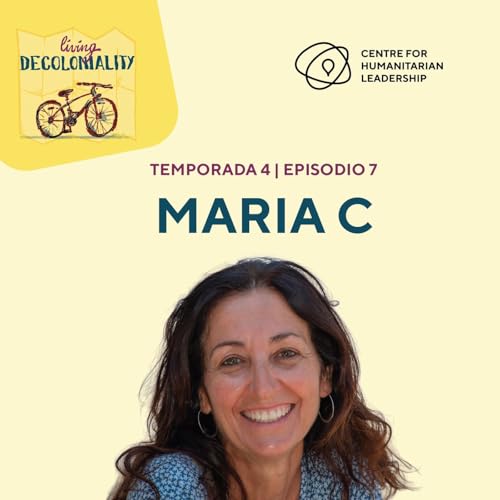
Couverture de Living decoloniality

Living decoloniality

Living decoloniality

De : Carla Vitantonio
Écouter gratuitement

À propos de ce contenu audio

Practical experiences of decolonial re-existence through the aid sector.
A podcast by Carla Vitantonio
With the support of the Center for Humanitarian LeadershipCarla Vitantonio

Philosophie Sciences sociales
Les membres Amazon Prime bénéficient automatiquement de 2 livres audio offerts chez Audible.

Vous êtes membre Amazon Prime ?

Bénéficiez automatiquement de 2 livres audio offerts.
Bonne écoute !
    Épisodes
    • S 04 Ep 07 Maria C
      Feb 19 2026
      En este episodio conversamos con Maria Chalaux, del equipo de Fundació Nous Cims en Barcelona, sobre impacto social, responsabilidad y el papel de las fundaciones en la transformación de las desigualdades estructurales.
      A partir de su experiencia en el ámbito de la filantropía y la innovación social, Maria reflexiona sobre cómo el poder, la financiación y la toma de decisiones condicionan lo que se considera impacto y lo que queda fuera de foco.Exploramos juntas las tensiones entre la medición del impacto y los procesos de cambio a largo plazo, la importancia de los enfoques ecosistémicos y la necesidad de ir más allá de soluciones tecnocráticas hacia prácticas relacionales, éticas y situadas.

      ***English*****

      In this episode, we speak with Maria Chalaux, who works at Fundació Nous Cims in Barcelona, about social impact, responsibility, and the role of foundations in addressing structural inequalities.
      Starting from her experience within philanthropy and social innovation ecosystems, Maria reflects on how power, funding, and decision-making shape what is possible, and what remains invisible in social and international cooperation.Together, we explore the tensions between impact measurement and long-term transformation, the importance of ecosystem approaches, and the need to move beyond technocratic solutions toward relational, ethical, and context-aware practices.

      Resursos// Resources

      Ebrahim, A. & Rangan, V. K. (2014). What Impact? A Framework for Measuring the Scale and Scope of Social Performance

      Nous Cims

      Biggs, R., Clements, H. S., Cumming, G. S., Cundill, G., de Vos, A., Hamann, M., … Reyers, B. (2022). Social-ecological change: insights from the Southern African Program on Ecosystem Change and Society.

      de Sousa Santos, B. (2014). Epistemologies of the South

      Moulaert, F. et al. (2013). The International Handbook on Social Innovation
      Afficher plus Afficher moins
      13 min
    • S 04 Ep 06 Kelly
      Feb 5 2026
      ¿Qué sucede cuando un sistema global como la cooperación internacional para el desarrollo, que se presenta como solidario y emancipador, en realidad reproduce las mismas lógicas de dominación que pretende superar?
      En este episodio conversamos con Kelly Saavedra Flores, investigadora peruana radicada entre Perú y España, sobre su trabajo en torno a la descolonización de la cooperación internacional.
      Kelly es autora de la Guía para la Descolonización de la Cooperación, desarrollada junto a Acápacá, una herramienta práctica y política que invita a repensar la cooperación como un acto de justicia, dignidad y reciprocidad.
      Reflexionamos juntas sobre cómo las perspectivas decoloniales pueden transformar las estructuras de poder del sistema, impulsando prácticas horizontales, equitativas y transformadoras, especialmente desde las organizaciones del Norte Global.

      *****

      What happens when a global system like international development cooperation, designed to promote solidarity and emancipation, ends up reproducing the same power hierarchies it seeks to dismantle?
      In this episode, we talk with Kelly Saavedra Flores, a Peruvian researcher and activist based between Peru and Spain, about her work on decolonizing international cooperation.
      Kelly is the author of the Guide to the Decolonization of Cooperation, developed with Acápacá, a practical and political tool to rethink how cooperation can become an act of justice, dignity, and reciprocity.
      Together, we explore how decolonial perspectives invite organizations in the Global North to move beyond rhetoric: towards horizontal, equitable, and transformative practices that truly center the voices and knowledge of the Global South.

      Recursos/ Reference list:
      • Decolonizando la Cooperación internacional. by Kelly Saavedra and Acápacá
      • Social Work Education’s Cultural Hegemony by Gurid Aga Askeland and Malcolm Payne.
      • Descolonización y despatriarcalización de y desde los feminismos de Abya Yala by ACSUR
      • The nine roles that intermediaries can play in international cooperation byPeace Direct
      Colonial Difference, Geopolitics of Knowledge, and Global Coloniality in the Modern/Colonial Capitalist World-System by Ramón Grosfoguel

      TRANSCRIPT
      Afficher plus Afficher moins
      17 min
    • S 04 Ep 05 Pluriversa
      Jan 22 2026
      En este episodio conversamos con Isabel García y Miguel Bello de Pluriversa, una comunidad de pensadoras y pensadores críticos que impulsan las transiciones ecosociales en el Sur Global a través del diseño y la tecnología.Inspirados por el pensamiento pluriversal de Arturo Escobar, Isabel y Miguel nos invitan a imaginar alternativas al desarrollo, basadas en la regeneración, la interdependencia y la autonomía.Juntas exploramos cómo el diseño decolonial puede desafiar los modelos extractivistas y lineales del desarrollo occidental, abriendo caminos hacia el bienestar colectivo, la diversidad y la reconexión con la Madre Tierra.Escucha este episodio para descubrir cómo el diseño puede convertirse en un acto político y relacional, capaz de cultivar nuevos mundos posibles.******In this episode, we talk with Isabel García and Miguel Bello from Pluriversa, a community of critical thinkers accelerating ecosocial transitions in the Global South through design and technology.From their work inspired by Arturo Escobar’s pluriversal thinking, Isabel and Miguel invite us to imagine alternatives to development. What are other ways of designing which are rooted in regeneration, interdependence, and autonomy?Together, we explore how decolonial design can challenge the extractivist, linear models of Western development and open paths toward collective well-being, diversity, and reconnection with Mother Earth. Tune in to discover how design can become a political and relational act — one that nurtures new worlds in the making.*****Recursos/ResourcesLibros y publicacionesArturo Escobar: Autonomía y DiseñoAnthony Dunne, Fiona Raby: Speculative Everything: Design, Fiction, and Social DreamingDonella Meadows: Thinking In SystemsFritjof Capra: The Systems View of Life MultimediaAnab Jain: TED Talk: Why We Need To Imagine Different FuturesTransition Design Institute: 10 years of transition designLos derechos de la Naturaleza. Un movimiento global: https://youtu.be/RupkZM8dV14?si=bgSJammuNFCoUqzSTerry Irwin: Designing for Systems-Level Change and Transitions Toward More Sustainable Futures Herramientas// ToolsPluriversa: Guía de pensamiento sistémico para la innovación públicaDesign Council: Systemic Design FrameworkUNDP: Foresight PlaybookUK Government Office for Science: Futures toolkit for policymakers and analystsTRANSCRIPT
      Afficher plus Afficher moins
      16 min
    Aucun commentaire pour le moment