A weekly magazine-style radio show featuring the voices and stories of Asians and Pacific Islanders from all corners of our community. The show is produced by a collective of media makers, deejays, and activists. Join Host Miko Lee as she introduces Dr. Robynn Rodriquez’s show “Spitting Fire.” Dr. Robynn speaks about Filipinx and colorism with Dr. Joanne Rondilla. LINKS Dr. Robynn, The People’s Professor SHOW TRANSCRIPT [00:00:00] Opening: Apex Express Asian Pacific expression. Community and cultural coverage, music and calendar, new visions and voices, coming to you with an Asian Pacific Islander point of view. It’s time to get on board the Apex Express. [00:00:35] Miko Lee: Welcome to Apex Express. I’m your host, Miko Lee, and tonight we get to hear the podcast from Dr. Robin Rodriguez called Spitting Fire, and I’m so excited for you to listen to it. Check it out, and if you wanna hear more, we’re gonna link in the show notes an earlier interview I did with Dr. Robin Rodriguez. So please listen to Spitting Fire with Dr. Robin [00:01:01] Dr. Robyn Rodriguez: I can’t actually remember a specific episode when my parents or my Lola, who helped raise me, explicitly said, “Don’t stay out in the sun.” But I always knew growing up that staying out in the sun was something I shouldn’t do because being dark was something to be avoided. I remember being embarrassed by my mom who would bust out an umbrella on a bright and shiny day. “Mom, it’s not even raining outside,” I remember complaining. I hated the big hats she would wear or insist I wear, or the comments of, “You’re getting darker,” also in a disapproving tone. I remember, too, the high praises anyone with lighter skin was heaped, even when I didn’t think they were that particularly attractive. Or how if my relatives knew someone was going to be marrying an American, basically a white person, they would exclaim, “Oh, they’re going to have beautiful children.” When I brought home a hapa, a dude who was Filipino and white, I was told that if we got married, I would be improving the race. I’ve always known, whether I can remember being told, “Don’t stay out in the sun,” that if there was a skin hue to aspire to, it was to be light. [00:02:49] To be called mestiza was to receive one of the best compliments. To be a mestiza is always already to be beautiful. Of course, if anyone said I was mestiza, it was always qualified as mestizang morena. That is, someone who exhibits certain types of physical traits that are associated with a mestiza, like having a more pointed nose or being slightly taller than the average Pinay, but not the lighter skin of a genuine mestiza. So that’s why I was sometimes called mestizang morena. Still meant as a compliment. After all, I could still enjoy the privilege of being associated with mestizaje, but only partially So many Filipinas in the diaspora, especially those of us who live in white settler colonial societies like what we now know as the United States as well as Canada, so many of us share experiences similar to the ones I’ve experienced. [00:03:58] My dear friend and colleague, a fellow sociologist, Dr. Connolly De Leon, who currently teaches at Ryerson University in Canada, made this shared experience a topic of study in her book chapter, “Mas Maputi Ako Sa’yo,” I’m Lighter Than You: The Spatial Politics of Intraracial Colorism Among Filipina-Filipino Youth in the Greater Toronto Area. It was a chapter that was part of the very historic anthology, Filipinos in Canada: Disturbing Invisibility, edited by Roland Coloma, Bonnie McElvaney, Ellen Ethel Dongohan, John Paul Katungol, and Lisa M. Davidson, and it was published in 2012. Now, I’ve taught, uh, Dr. De Leon’s chapter, Connolly’s chapter, in my Filipino American experience courses in the past, and it’s always, always deeply resonated with my Filipina students. In Dr. De Leon’s chapter, she starts off with a quote that so many of us are familiar with in some way. She writes, quote, “You’re so dark. Yuck.’ My cousin would say to me in disgust as she would place her forearm beside mine to compare her light skin to my dark skin.” End quote. Dr. De Leon continues, quote, “As early as the age of four, as early as the age of four, I was taught to feel ashamed of my complexion. I did not understand what was so shameful about being the particular shade of brown that I was.” End quote. The shaming that Dr. De Leon and so many of us experience comes from colorism, which scholars define as the discriminatory treatment of individuals falling within the same racial group on the basis of skin color. [00:06:01] On this episode of Spitting Fire, Dr.- Doctora Robyn Speaks, you’ll actually hear less from me and more from yet another friend and colleague, Dr. Joanne Rondilia, who I recently hosted as part of a lecture series jointly sponsored by the Bolosan Center for Filipinx ...
Afficher plus
Afficher moins


 Oct 15 20261 h
 Oct 14 2026Moins d'une minute
 1 h
1 h 1 h
1 h 1 h
1 h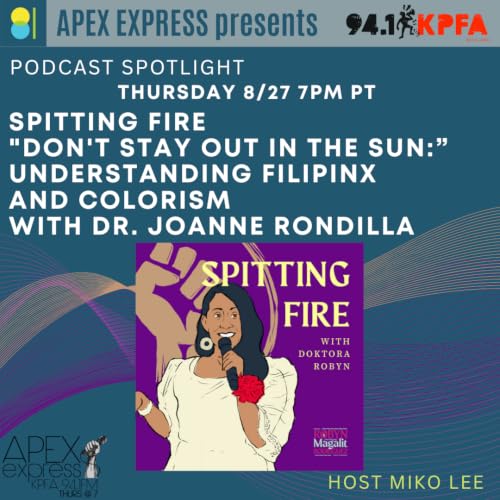 1 h
1 h