Épisodes

  • Humans of AI | Kai Jauslin (Webarchiving Display) - Exploring the Web of the Past
    Feb 3 2026

    🔍 In this episode of Humans of AI, Kai Jauslin, interaction designer and AI developer, discusses how his “Websites for Netherland” project turned web archives into interactive public experiences, evolving from a Swiss National Library installation into an open-source, Europe-wide initiative with Internet Archive Europe, using AI to extract metadata, translate content, and enable conversational search.

    He also addresses legal and data-access challenges in public institutions and envisions expanding the project internationally, improving metadata, and enhancing voice interaction. His key takeaway: explore and “play” with open data to create engaging, human-centered cultural experiences.

    📌 HoAI Highlights

    ⏲️[00:00] Intro

    ⏲️[00:35] The Spark

    ⏲️[06:11] The Impact

    ⏲️[10:05] The Challenge

    ⏲️[14:15] The Future

    ⏲️[18:36] The Takeaway

    The Spark

    🗣️“I like to work closely with institutions… it’s a joint process, and that’s what makes it special.”

    The Impact

    🗣️ “AI acted as a translator between archived images and user queries, creating a common ground that made search and exploration possible.”

    The Challenge

    🗣️ “Public institutions face legal and access challenges that limit how open data can be used, creating a gap between what corporations and small organizations can do with AI.”

    The Future

    🗣️“AI enables us to quickly build specific, playful applications with open data, merging coding and design in ways that were previously too costly or complex.”

    The Takeaway

    🗣️ “Go and play with the data—use open archives as a playground to explore, experiment, and build your own vision.”

    📌 About Our Guests

    Kai Jauslin | Webarchiving Display

    🌐 linkedin.com/in/kjauslin
    🌐 https://nextension.com/

    🌐 https://webarchiving.internetarchive.eu/

    The Webarchiving Display project turns archived websites into interactive, navigable visualizations, letting the public explore historical web content through AI-enhanced search and voice interaction.

    #AI #artificialintelligence #generativeAI

    Afficher plus Afficher moins
    20 min
  • Humans of AI | Daniel Erasmus (ClimateGPT) - When Cultural Memory Meets Planetary Memory
    Jan 27 2026


    🔍 In this episode, Daniel Erasmus discusses why climate change is one of humanity’s biggest challenges and how AI can help bridge the gap between knowledge and action. He explains the origins of ClimateGPT as an open, science-based model designed to support policy, risk assessment, and climate responses globally.

    Daniel emphasizes that the challenge isn’t solutions, but making decisions faster and more rationally. As AI shapes how we understand and respond to climate risks, transparent, human-centered models are key to accelerating a safe, carbon-neutral future.

    📌 HoAI Highlights

    ⏲️[00:00] Intro

    ⏲️[00:30] The Spark

    ⏲️[07:32] The Impact

    ⏲️[12:13] The Challenge

    ⏲️[15:36] The Future

    ⏲️[19:33] The Takeaway

    The Spark

    🗣️“By combining a decade of extreme weather data, SDGs, and scientific research, ClimateGPT gives humanity a clear, actionable view of climate impacts and interventions.”

    The Impact

    🗣️ “By building small, efficient, and open AI models grounded in scientific data, we can empower anyone to make informed, anticipatory decisions on climate risks at planetary scale.”

    The Challenge

    🗣️ “AI can help humanity access the best climate knowledge and make faster, smarter, and safer decisions for a carbon-neutral future.”

    The Future

    🗣️“Grounding AI in data and observations helps policymakers make transparent, rational decisions for a carbon-neutral future.”

    The Takeaway

    🗣️ “We often forget that, despite the challenges, we should focus on the hopeful future we want to create for ourselves, our children, and our children’s children.”

    📌 About Our Guests

    Daniel Erasmus | ClimateGPT

    🌐 linkedin.com/in/daniel-erasmus-94282

    🌐 https://climategpt.ai

    ClimateGPT is an open-source AI platform designed to support climate decision-making by turning complex climate science and data into clear, actionable insights. It is built specifically for climate use cases, helping researchers, policymakers, and organizations analyze risks, policies, and scenarios. The goal of ClimateGPT is to democratize access to trustworthy, science-based climate intelligence worldwide.

    #AI #artificialintelligence #generativeAI


    Afficher plus Afficher moins
    21 min
  • Humans of AI | Harry Verwayen (Europeana) - Connecting Culture Across Borders
    Jan 20 2026


    🔍 In this episode, Harry Verwayen from Europeana reflects on how Europe’s cultural heritage sector is responding to the rise of AI while staying rooted in the idea that culture belongs to everyone. He shares the origins of Europeana as a public alternative to private digitization efforts and explains how AI is being used to improve access to millions of cultural objects, guided by long-standing values like openness, authenticity, and provenance.

    Harry argues that the real challenge is not technology but adoption, governance, and public trust. As chatbots increasingly replace search engines as the main interface to knowledge, he warns that without sustained public investment and engagement, Europe’s cultural diversity risks becoming invisible in an AI-driven future.

    📌 HoAI Highlights

    ⏲️[00:00] Intro

    ⏲️[00:48] The Spark

    ⏲️[02:47] The Impact

    ⏲️[09:41] The Challenge

    ⏲️[14:56] The Future

    ⏲️[20:10] The Takeaway

    The Spark

    🗣️“Culture heritage belongs to all of us. Why would exclusive access to that only happen through a private entity?”

    The Impact

    🗣️ “The data really is like a garden, you need to keep nurturing it, because what is a derogative term today may change in the future.”

    The Challenge

    🗣️ “I don’t think it’s a technological challenge.Tthe technology is there. The question is how do we implement that more widely.”

    The Future

    🗣️“Library and archival data are the original datasets, and with them comes a value system of authenticity and provenance that AI should inherit.”

    The Takeaway

    🗣️ “AI chatbot interfaces will be how people interface with knowledge—and if we don’t engage with them, our culture risks becoming invisible."

    📌 About Our Guests

    Harry Verwayen | Europeana

    🌐 linkedin.com/in/harryverwayen

    🌐 https://www.europeana.eu/en

    Europeana is a digital platform that provides access to millions of cultural heritage items from museums, galleries, libraries, and archives across Europe. It promotes the sharing and reuse of Europe’s cultural collections for education, research, and creativity.

    #AI #artificialintelligence #generativeAI

    Afficher plus Afficher moins
    23 min
  • Humans of AI | Claire Warwick (Museum Goggles) - Augmented Exploration
    Jan 13 2026


    🔍 In this episode of Humans of AI, we explore a research project at the Bowes Museum in County Durham that uses AI-powered eye-tracking glasses to study how visitors engage with artworks. A multidisciplinary team combines digital humanities, psychology, art history, and computer science to understand where people look, how long they spend with paintings, and the impact of exhibition labels.

    The episode highlights key findings—such as how briefly most visitors view artworks—and reflects on the ethical limits of AI, the difference between observing behavior and understanding motivation, and the importance of using AI thoughtfully in cultural heritage and beyond.

    📌 HoAI Highlights

    ⏲️[00:00] Intro

    ⏲️[00:15] The Spark

    ⏲️[04:32] The Impact

    ⏲️[07:49] The Challenge

    ⏲️[13:42] The Future

    ⏲️[18:51] The Takeaway

    The Spark

    🗣️“The management at the Bowes were concerned that perhaps this is overwhelming for visitors… do we know that visitors are actually enjoying themselves?”

    The Impact

    🗣️ “It was horrifying to me how very quickly most people look at things in museums… it’s like 10 seconds, 15 seconds sometimes per painting.”

    The Challenge

    🗣️ “It is very, very important this is done ethically… because people know they’re being observed, it may change their behavior.”

    The Future

    🗣️“If we can’t compete in AI, we have no role in regulating what is going on in those organizations.”

    The Takeaway

    🗣️ “AI is not a terrible thing or a wonderful thing—we need to think about how we use it, where we use it, and where it’s most appropriate.”

    📌 About Our Guests

    Claire Warwick | Museum Goggles

    🌐 linkedin.com/in/claire-warwick-1951272b6

    The Bowes Museum “goggles” project used AI-powered eye-tracking glasses to study how visitors view paintings and labels. The research showed that most people look at artworks very quickly, but engaging with labels increases viewing time and enjoyment. The project highlights how AI can analyze behavior at scale while also raising ethical questions and showing its limits in understanding why people do what they do.

    #AI #ArtificialIntelligence #GenerativeAI

    Afficher plus Afficher moins
    21 min
  • Humans of AI | Anna Pappa (Litte_Bot) - Conversing with Collections
    Dec 9 2025

    🔍 In this episode of Humans of AI, the creators of Litte_bot explain how an idea to celebrate Molière’s 400th anniversary became an innovative project that lets audiences converse with literary characters through AI.

    Anna discusses training models to reproduce Molière’s alexandrines, extending the work to Brecht, and the challenges of capturing each writer’s distinct voice. The conversation highlights how AI can revive cultural memory, engage young people with theatre, and support human-centered artistic research.

    📌 HoAI Highlights

    ⏲️[00:00] Intro

    ⏲️[00:33] The Spark

    ⏲️[04:08] The Impact

    ⏲️[07:59] The Challenge

    ⏲️[12:17] The Future

    ⏲️[16:39] The Takeaway

    The Spark

    🗣️“We wanted to use AI not just as a tool, but as a mediator — a way to bring humans into a new dialogue with the past, almost like speaking with a literary ghost made alive again.”

    The Impact

    🗣️ “It wasn’t just a tool — AI became a bridge to the past.”

    The Challenge

    🗣️ “Artistic research struggles because we lack access to large computing resources.”

    The Future

    🗣️“For me, fine-tuning was a way to test how far AI can go in producing not just a writer’s style, but a writer’s way of thinking.”

    The Takeaway

    🗣️ “We should share these experiences widely — even with philosophers — because they can bring theatre, literature, and philosophy closer to young people.”

    Litte_bot is an artistic research project that uses AI to bring classical theatre to life by enabling audiences to interact directly with literary characters. Originally created to celebrate Molière’s 400th anniversary, the team trained generative models on his plays so the chatbot could respond in authentic alexandrines, making cultural memory feel alive and accessible—especially for young people.

    #AI #ArtificialIntelligence #GenerativeAI

    Afficher plus Afficher moins
    18 min
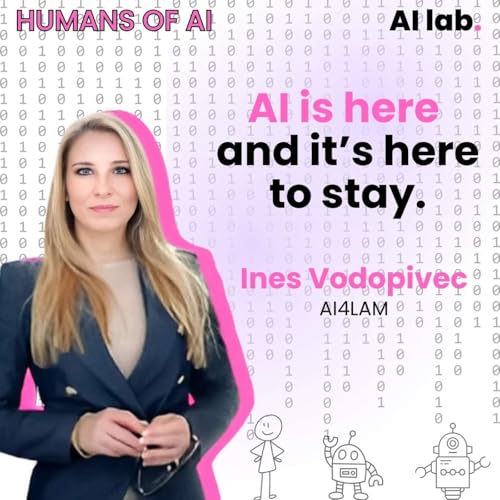
  • Humans of AI | Dr. Ines Vodopivec (AI4LAM) - The Power of Community
    Dec 2 2025

    🔍 In this episode of Humans of AI, we talk with Dr. Ines Vodopivec from AI4LAM about how libraries, archives, and museums can embrace AI to improve access to cultural heritage. They discuss the sector’s biggest challenges, from fear of new technology to outdated workflows, and share how AI can streamline metadata, enhance user services, and strengthen multilingual access.

    📌 HoAI Highlights

    ⏲️[00:00] Intro

    ⏲️[00:54] The Spark

    ⏲️[03:28] The Impact

    ⏲️[08:58] The Challenge

    ⏲️[12:58] The Future

    ⏲️[18:37] The Takeaway

    The Spark

    🗣️“Cultural heritage institutions now have the opportunity to jump on the train of AI and stay in the game.”

    The Impact

    🗣️ “The shift from manual work to the intellectual power of people is the biggest change AI can help us achieve.”

    The Challenge

    🗣️ “AI is evolving so fast that nobody can really adapt to it — and institutions are left without a roadmap for how to implement it.”

    The Future

    🗣️“The new language is happening online, not in published books — and we need to treat that digital space as cultural heritage.”

    The Takeaway

    🗣️ ““AI is here and it’s going to stay — it’s better that we use it, adapt it, and see it as a tool that helps us work.”

    📌 About Our Guests

    Dr. Ines Vodopivec | AI4LAM

    🌐 linkedin.com/in/ines-vodopivec

    🌐https://sites.google.com/view/ai4lam

    AI4LAM is a global community of libraries, archives, and museums working together to responsibly integrate AI into cultural heritage. They promote collaboration, develop practical tools and workflows, support multilingual access, and help institutions use AI to improve discovery, preservation, and public engagement.

    #AI #ArtificialIntelligence #GenerativeAI

    Afficher plus Afficher moins
    22 min
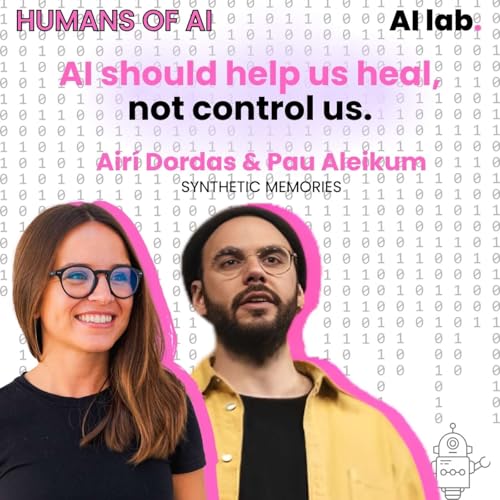
  • Humans of AI | Airí Dordas & Pau Aleikum (Synthetic Memories) - When Machines Remember
    Nov 25 2025


    🔍 In this episode of Humans of AI, we speak with Airí and Pau from Domestic Data Streamers, creators of Synthetic Memories — a research initiative using generative AI to help people reconstruct lost personal and collective memories.

    Aíri and Pau share how the project began during the 2015 refugee crisis and grew into a global effort to support communities affected by migration, conflict, and displacement. They discuss their unique methodology, the importance of culturally aware datasets, and how early “imperfect” AI models can actually deepen emotional recall. They also explore how synthetic memory techniques are now being tested in therapeutic contexts, including work with dementia patients.

    📌 HoAI Highlights

    ⏲️[00:00] Intro

    ⏲️[00:16] The Spark

    ⏲️[03:40] The Impact

    ⏲️[08:18] The Challenge

    ⏲️[15:55] The Future

    ⏲️[21:38] The Takeaway

    The Spark

    🗣️“Being a refugee is not about losing your home — it’s about losing the answer to where do I come from?

    The Impact

    🗣️ “AI can help preserve what displacement, conflict, and disaster try to erase.”

    The Challenge

    🗣️ “Archives are biased per se — so re-biasing a model means taking responsibility for representing a culture in all its richness.”

    The Future

    🗣️“AI should help us understand and connect with each other, not just control or optimise.”

    The Takeaway

    🗣️ “The value of a well-used tool is not in what it produces for us, but in what it produces within us.”

    📌 About Our Guests

    Airí Dordas & Pau Aleikum | Synthetic Memories

    🌐 linkedin.com/in/airidordas

    🌐 linkedin.com/in/pauerrr

    🌐 http://www.syntheticmemories.net

    Synthetic Memories is a research initiative by Domestic Data Streamers that uses generative AI to help people visually reconstruct memories lost through migration, conflict, or time. Built around guided conversations, the project turns personal recollections into emotionally resonant images while addressing cultural and historical bias through close collaboration with local communities. By focusing on identity, healing, and connection, Synthetic Memories shows how AI can preserve stories at risk of disappearing—and support both cultural memory and therapeutic work.

    #AI #ArtificialIntelligence #GenerativeAI

    Afficher plus Afficher moins
    24 min
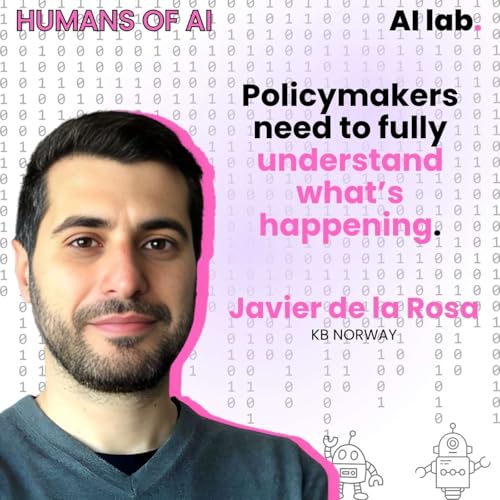
  • Humans of AI | Javier de la Rosa (KB Norway) - AI at National Scale
    Nov 18 2025

    🔍 In this episode of Humans of AI, Javier de la Rosa, Head of Language Models at the National Library of Norway, explains how Norway’s long-term digitisation effort laid the groundwork for powerful, locally grounded AI models. He shares how these tools are now used across public services, the challenges of updating legal frameworks for generative AI, and why supporting public-interest institutions is essential for Europe to build AI that reflects its own languages, values, and cultural identity.


    📌 HoAI Highlights

    ⏲️[00:00] Intro

    ⏲️[00:30] The Spark

    ⏲️[02:04] The Impact

    ⏲️[05:21] The Challenge

    ⏲️[08:44] The Future

    ⏲️[12:40] The Takeaway


    The Spark

    🗣️“Twenty years of digitisation was a leap of faith — but it’s now the foundation that makes Norwegian AI possible.”


    The Impact

    🗣️“Our models are used everywhere — from hospitals and police work to newsrooms. The impact is huge, and so are the expectations.”


    The Challenge

    🗣️“LLMs changed the game. Agreements written before generative AI suddenly didn’t fit anymore, and we had to rethink everything with rights holders.”


    The Future

    🗣️“We want models that protect privacy, run locally, and reflect Norwegian values — and expand into speech and visual AI in a responsible way.”


    The Takeaway

    🗣️“If restrictions become too heavy, small public institutions can’t contribute — and Europe risks losing its voice in AI.”


    📌 About Our Guests

    Javier de la Rosa | KB Norway

    🌐 linkedin.com/in/versae

    🌐 https://ai.nb.no


    The National Library of Norway runs NbAiLab, an applied AI programme that develops open language, speech, and image models based on the library’s extensive digitised collections. The lab focuses on improving access to Norwegian cultural heritage through AI-driven tools such as text and handwriting recognition, speech-to-text, and automated metadata enrichment, while openly sharing models and datasets to support the wider research and GLAM community.


    #AI #ArtificialIntelligence #GenerativeAI

    Afficher plus Afficher moins
    15 min