Épisodes

  • Armin Auchentaller: An Olympic Opportunity
    Feb 5 2026

    The U.S. Olympic Biathlon Team will have a new vibe in Antholz, Italy this week for the Milano Cortina 2026 Olympic Games. Head Coach Armin Auchentaller sees opportunity for a team that blends veteran athletes with some rising young stars. Heartbeat caught up with Auchentaller during the final days of the team’s Ridenour prep camp before the drive to the Antholz valley.


    Four men and four women will represent Team USA in biathlon. On the men’s team, Paul Schommer and Sean Doherty with Schommer competing in his second Games, Doherty his fourth. Maxime Germain will be heading to his first Games buoyed by rising international performances. Meanwhile, Campbell Wright is competing in his second Games, but first as an American. And it comes on the heels of the two silver medals he won a year ago at the World Championships.


    For the women, Deedra Irwin returns for her second Games, after a strong result four years ago in Beijing. After a short break from the international tour, Joanne Reid heads to her third Olympics. And a pair of newcomers to the sport, Luci Anderson and Margie Freed are poised for their Olympic debut.


    For Auchentaller, it will be a Games of much pride. As a native of the Antholz valley, he welcomes the opportunity to show off his hometown, where his father was a part of starting biathlon over a half century ago.


    And to top it all off for the popular coach, his own daughter, Hannah, will make her Olympic debut with the Italian team.


    The action begins Sunday with the mixed relay. You can watch all the action live or on-demand in the USA on NBC’s Peacock.


    Afficher plus Afficher moins
    30 min
  • Fede Fontana: Making Magic with Skis
    Jan 29 2026

    There’s a certain mystique around the waxing cabins at biathlon events, where technicians work late into the night and are up before the sun – all to gain precious seconds out of the bases of skis. Races may be won or lost on the track. But it’s the technicians who put rockets on the skis. Today on Heartbeat, we join the legendary Fede Fontana of U.S. Biathlon as he takes us inside the magic, sharing stories of his decades of experience in the sport.


    While he lives today in Bavaria, Fontana hails from the Frassinoro, Italy, in the Modena area. This tiny village has produced more than its share of ski technicians over the years – a source of great pride to the region.


    Fontana has served the athletes of U.S. Biathlon for over a decade. He and his team of technicians put the magic into the skis, while also serving as the team’s general manager.


    In this episode, we’ll learn how turning out fast skis is a year-round job, from springtime and summer ski selection with the factories, to fine-tuning on snow during the season. Listen in to learn just how many pairs of skis for each athlete are packed into vans as the tour heads from race to race.


    And check out Heartbeat’s past episodes with U.S. Biathlon General Manager Fede Fontana. Now let’s join Fede coming to us live from Nove Mesto as the team prepares for the upcoming Olympic Winter Games in Antholz.

    PAST EPISODES

    Farewell to Fluorocarbons - Nov. 2023

    https://open.spotify.com/episode/7nFkFX0cLVPytUHLloyYTl?si=5961825689824051


    Fede Fontana: Inside the Wax Cabin - Jan. 2023

    https://open.spotify.com/episode/4UP70osdKOxcCp3E889Fn0?si=8984636a13e04eae


    Afficher plus Afficher moins
    37 min
  • Luci Anderson-Margie Freed: Olympic Debut
    Jan 22 2026

    Minnesota natives Luci Anderson and Margie Freed followed similar pathways as state high school cross country stars and successful collegiate skiers. Then both discovered biathlon. And just a few years later, both will make their Olympic biathlon debut at the Milano-Cortina Games this February. Anderson and Freed joined Heartbeat from the IBU World Cup in Ruhpolding on the eve of the Games.


    Freed, now 28, picked up the new sport while training with Craftsbury Green Racing Project after a successful career at University of Vermont. Going into the 2023 season, she borrowed a biathlon rifle and qualified for the European Championships, eventually having the USA’s best IBU Cup finish that season. Now, she’s a regular on the IBU World Cup.


    Meanwhile, Anderson, now 25, skied five seasons for the University of New Hampshire Wildcats, with six NCAA wins. Skiing with Team Birkie, she gave biathlon a try in the summer of 2024, qualifying for the IBU Cup at trials that October. She quickly got her chance at the World Cup.


    Both are examples of U.S. Biathlon’s transfer initiative, finding experienced cross country ski racers who want to give biathlon a try. And both are products of U.S. Biathlon’s Project X.


    With the Olympics in Antholz just around the corner, Anderson and Freed are excited about their opportunity. In this episode of Heartbeat, they talk about their unique pathways, share encouragement to others, and look forward to their dream of becoming Olympians with Team USA.

    PAST EPISODES

    Luci Anderson: Exhilaration of a New Sport - Jan. 2025


    Margie Freed: From XC to Biathlon - Nov. 2023


    Afficher plus Afficher moins
    27 min
  • Annika Pasch: Focus on Health and Wellness
    Nov 17 2025

    From cross country skiing and running to ice hockey, sport has always been a big part of Minnesota native Annika Pasch’s life. Today, she’s added biathlon to her repertoire with the responsibility of managing health and wellness for the U.S. Biathlon Team as part of its partnership with University of Health. Pasch joined Heartbeat as she headed out to Europe for her second season wth the team.


    What motivated her to become an athletic trainer?


    “Just being an athlete, kind of identifying as an athlete myself for so long, just seeing the passion and the hard work that those athletes put into what can essentially become their career,” she said. “I just want to do everything I could to let them be successful. And that's a huge part of my job – just keeping that arrow pointed forward for someone to just keep on the track of success.”


    So what is health and wellness? And why is it important for athletes – and for all of us?


    “Health and wellness is what gets you through every day,” said Pasch. “And if you're not respecting your body and taking care of it 24 over seven, that's lost time. If you look at it as the athletes, it's their job.”


    Her background has taken her to basketball, hockey, and track. And one of the keys for her in her new role with U.S. Biathlon is her own background as a cross country skier.


    When describing her role to others who might not know what an athletic trainer does, she compares it as a cross between a physical therapist and an EMT. “A lot of the education and focus is on first response and emergency care,” she said. But today, a lot of energy goes into injury and illness prevention.


    “That's where that physical therapy, that rehab, the diagnostic piece comes into it,” she said. “And then layered within all of that in the education is pharmacology, general medicine, sports psychology, nutrition. We kind of get a little sprinkling of everything.”


    As a passionate cross country skier herself, she’s now become one of biathlon’s biggest fans. And, yes, she has picked up a biathlon rifle to try shooting. This winter, she will hopscotch around Europe as the U.S. Biathlon Team heads to Antholz for the Olympic Winter Games.


    Get to know Annika Pasch and the valuable support services she’s bringing to biathletes in this episode of Heartbeat, the U.S. Biathlon podcast.

    Afficher plus Afficher moins
    49 min
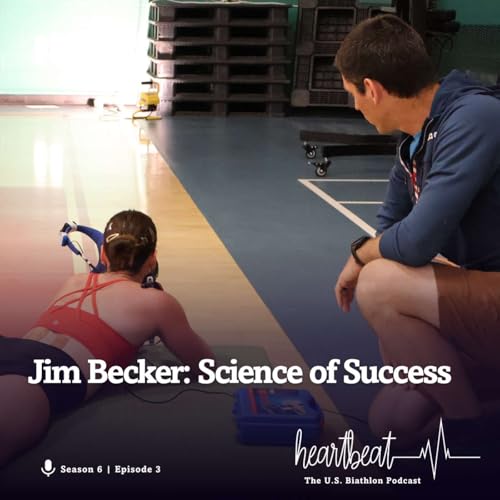
  • Jim Becker: Science of Success
    Oct 31 2025

    Watching biathlon on NBC during the 2018 Winter Olympics inspired New England native Jim Becker to participate in the sport. Today, Dr. Jim Becker is leading an innovative biomechanics research project with the U.S. Biathlon Team, which could make a big difference at the 2026 Winter Games in Italy. Heartbeat met with Becker to discuss his innovative Montana State University program and how it’s helping American biathletes.


    Becker vividly remembers tuning into the Olympics on NBC in 2018. “It was just so cool to watch how things could change in an instant, right? One athlete is leading the race. They come in to shoot. They miss a target. All of a sudden, they're on the penalty loop. Somebody else goes out in the lead. Right? All the way up to the last shoot.


    “You didn't really know what was going to happen. It was just exciting the entire time. Also, as an athlete, you kind of really appreciated the fitness of these individuals and how hard they're working and how fast they're moving. And I've come to appreciate that even more, you know, really getting to know the sport.”


    Today, Becker works in kinesiology – the study of human movement. “From a biomechanical perspective, we're looking at what are the forces that generate that movement? What are the forces that are applied to your body during that movement?”


    The long and short of it is that Becker and his team study human movement to give athletes optimal tactics to capitalize on every single movement.


    Over the past few seasons, his Montana State University biomechanics research team has collected extensive data from video and other tools, analyzed it, and provided feedback to athletes and coaches.


    How can it work in practice? Becker discusses how video of athletes on a given course can provide data to offer tactical advice on how to ski that section faster or more efficiently, thereby conserving energy. And, yes, it really works!


    From Soldier Hollow to Lake Placid, Vuokatti to Antholz, Becker’s student researchers are making a difference for U.S. biathletes. If you like to geek out a bit on the science of sport, this is your podcast.


    Join us for season six, episode three with Dr. Jim Becker to learn more about how the U.S. Biathlon Team is shaving seconds and shooting straighter thanks to innovative data analysis.


    Afficher plus Afficher moins
    39 min
  • Jack Gierhart: Pride of Team
    Oct 8 2025

    It’s been three years since veteran Olympic sport leader Jack Gierhart found his way to U.S. Biathlon. Now entering his fourth season, Gierhart spoke with Heartbeat from the U.S. Biathlon headquarters in Soldier Hollow, outlining some of the innovative athlete support programs that have been implemented, discussing team culture, and sharing the story behind the new U.S. Biathlon logo released this month.


    Gierhart was enthusiastic about the athlete-staff initiative on team culture. In episode one of Heartbeat this season, we spoke with Kelsey Dickinson and Chloe Levins about the team’s initiative to create a values-based, positive team culture. “I remember talking with Kelsey and Jake (Brown), and a couple of other athletes a year-and-a-half ago or so,” said Gierhart. “They were enthusiastic about trying to get this going.” Now the shared values program, driven by both athletes and staff, is firmly in place heading into the 2025-26 season.


    He also highlighted some of the innovative high-performance programs implemented by U.S. Biathlon to support athletes. As an example, High Performance Director Lowell Bailey now works closely with Jim Becker, a masters biathlete himself, at Montana State University on a wide range of initiatives, from physiological biometric testing to 3D motion capture.


    “We're really seeing quite an impact on the performance of our athletes,” he said.


    Simple as it may seem on the surface, another priority area for U.S. Biathlon has been athlete wellness. “One of the areas we really started to focus on about a year and a half ago was how do we reduce athlete illness?” said Gierhart. “That's been the biggest impact on us!”


    He outlined programs in place now through U.S. Biathlon’s partnership with University of Utah Health. Last January, U of U Health Athletic Trainer Annika Pasch joined the team to support overall athlete wellness on the grueling schedule athletes face during the winter season.


    “This concept of minor illness prevention is incredibly important to us,” he added. “So we started to talk about how do we do that? How do we keep our athletes on the race course more frequently? And besides being able and having boots on the ground with the athletes that are able to monitor things in real time and react immediately, is really important.”


    The atmosphere at the final pre-season dryland camp was exhilarating. There was a lot on the line with team trials. And final preparation before the team reassembles in Obertilliach, Austria for a final on-snow test before the World Cup and IBU Cup openers.


    As he reflected back on the last three seasons, his look forward was one of pride. “The work that this team has done over the last three years – we have high goals. Everybody's working really hard. But whatever happens, I'm going to be incredibly proud of this team and our community of what we achieve.”


    Listen in to Heartbeat, season six, episode two, for an insightful look into U.S. Biathlon with CEO Jack Gierhart.


    Afficher plus Afficher moins
    43 min
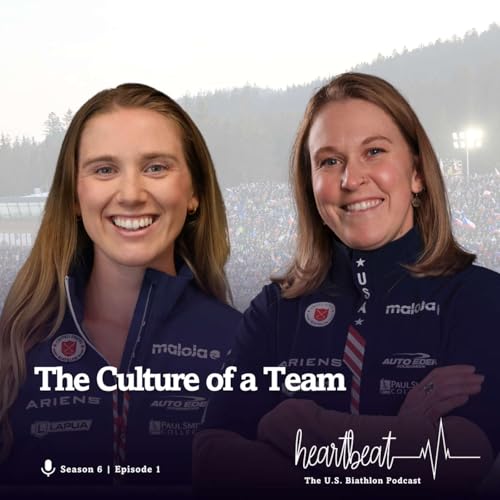
  • The Culture of a Team
    Sep 30 2025

    There are many components to athletic success, from high-performance training to perfecting sport skills. But underlying every successful team is a culture that fosters an atmosphere of success. On the eve of team trials and a fall training camp at Soldier Hollow, veteran U.S. Biathlon Team athletes Kelsey Dickinson and Chloe Levins joined Heartbeat podcast host Tom Kelly for an in-depth look at the athlete-led initiative to build a values-based, positive team culture.


    In addition to competing on the international biathlon stage, both Dickinson and Levins have taken on leadership roles, serving as athlete representatives to both the U.S. Biathlon Board of Directors and the U.S. Olympic and Paralympic Committee. Quite simply, “Our role is really to represent the athlete voice in any decisions being made by US Biathlon,” said Dickinson.


    However, one of their most impactful roles over the last year has been their engagement with both teammates and U.S. Biathlon staff in building a recognizable team culture, including the identification of a set of values that staff and athletes can all rally around.


    US Biathlon Values

    • Respect
    • Grit
    • Growth Mindset


    “We decided that we could all stand by these,” said Levins. “They represent who we want to be, how we want to show up as Team USA – as the staff wants to show up for the athletes, as the athletes want to show up for the staff, and the greater organization as a whole and their country.


    “It was a really special thing to be a part of!”


    The values were adopted by athletes and staff together after a series of group sessions that began at the Vuokatti training camp before last season.


    “We’re looking at this from the perspective of emphasizing that we are a values-led organization,” sai Dickinson. “And creating those values that we can come together around and use to have discussions and support each other, and also hold each other accountable.”


    Want to hear more? Listen in on the new season six of Heartbeat as Chloe Levins and Kelsey Dickinson dive deep into the value-backed culture created by the U.S. Biathlon Team.

    ATHLETE OUTREACH
    Athletes, want to reach out to your US Biathlon athlete representatives? Simply send an email to: athletereps(@)usbiathlon.org.


    PAST EPISODES WITH CHLOE & KELSEY

    Kesley Dickinson: Athlete & Advocate (April 2025)

    Chloe Levins: Bouncing Back (Nov. 2022)

    Kelsey Dickinson: Nordic Culture of the Methow Valley (Dec. 2021)

    Chloe Levins: From Fairway to Biathlon Range (Sept. 2020)

    Afficher plus Afficher moins
    43 min
  • Armin Auchentaller: Seeing What's Possible
    May 22 2025

    At every level, the 2024-25 season was marked by positive steps forward for the U.S. Biathlon Team. As the season ended and a new one began with an on-snow camp in Bend, Ore., Head Coach Armin Auchentaller joined Heartbeat from his home in Antholz, characterizing the season as one of seeing what’s possible. But he was quickly pointed out that now it starts all over again. And how do you get even better?


    “It always helps to have results because people just stay positive,” said Auchentaller. “There's a good mood. People see that things are possible. But I think, the day after those good results or the season, when the next season training season starts, once you had those good results, I think the best is to come back on the ground and just think of almost like, ‘yeah, how can I get better?’”


    In this episode of Heartbeat, Auchentaller speaks to the showcase results of Campbell Wright, winning two silver medals at the World Championships, a career-best for Paul Schommer, and continued development progress by Maxime Germaine, Lucy Anderson and Margie Freed.


    One of the keys to that progress has been shooting. “In order to reach good shooting skills, we need to work on the basics a lot, like dividing all the little things, like learning how to trigger, learning how to aim, learning how to breathe, learning how to bolt, learning how to go into position quick, and all of those little things and little things. Then put those things together. Those need to be high quality. It will take a lot of patience. It will take a lot of personal workload in their off times when they are without the team on their own.”


    One of the keys to the growing success of development athletes is Olympic shooting champion Matt Emmons, who serves as a coach for U.S. Biathlon. “We try to use his expertise in a way where athletes get access to experience what he had himself and open up a different perspective, under a different light, and give the athletes a lot of theoretical feedback through that and a lot of sharing, experience and a lot of expertise from his shooting career.”


    From a 2025 recap to a breakdown of the Bend camp to the vital innovation in the Montana State physiological testing program, Auchentaller covers a lot of ground in this final episode of Heartbeat for the 2025 season.


    Afficher plus Afficher moins
    33 min