Épisodes

  • Autumn Stewart: How Flight Simulation Prepares Students for a Complex World
    Apr 7 2026

    In this episode of Have a Life Teaching, we explore what it really means to prepare students for a future shaped by rapidly evolving technology.

    While tools like flight simulation may seem niche, the deeper conversation is about something much bigger: how we design learning experiences that build decision-making, problem-solving, and real-world application.

    We discuss how immersive environments and AI-powered tools are shifting students from passive learners to active designers and why this shift is critical across all K–12 settings.

    This conversation pushes beyond “using technology” and into how students think, create, and navigate complexity. These skills will define success in both college and the workforce.

    Key Takeaways:

    • Students need opportunities to apply knowledge in dynamic, real-world contexts
    • Simulation and AI tools can amplify—not replace—student thinking
    • The future of learning is less about content coverage and more about decision-making under uncertainty
    • Schools must move from task completion → authentic problem-solving
    • Educators play a critical role in designing environments where students create, not just consume


    Topics Covered:

    • The role of simulation in modern learning
    • AI as a thinking partner vs. shortcut
    • Designing for applied intelligence
    • Preparing students for unpredictable futures
    • Bridging school learning with real-world demands

    Autumn Stewart LinkedIn Page

    Stem Pilot Website

    Music by Aylex

    Afficher plus Afficher moins
    37 min
  • Mariya Gluzman: How Notebook LM Can Support Teaching & Learning
    Mar 31 2026

    In this episode, I’m joined by Mariya Gluzman to explore how educators can use Notebook LM to support—not replace—student thinking.

    We discuss how AI is shifting instruction from product to process, and how tools like Notebook LM can help structure deeper learning, safer AI use, and more intentional instructional design.

    • AI should supplement thinking, not replace it
    • Traditional plagiarism detection is no longer reliable → task design must change
    • Strong instruction in an AI era = process, scaffolding, and feedback loops
    • NotebookLM creates a closed, source-based AI environment for learning
    • Educators can use AI to generate:
    • AI can act as a “study buddy” to support skill development
    • The real shift is from knowing about AI → learning with AI

    The challenge isn’t access to AI—it’s designing learning experiences where AI enhances thinking instead of bypassing it.


    Mariya Gluzman LinkedIn Page

    Brooklyn College Academic Information Technologies

    Music by Aylex

    Afficher plus Afficher moins
    1 h et 7 min
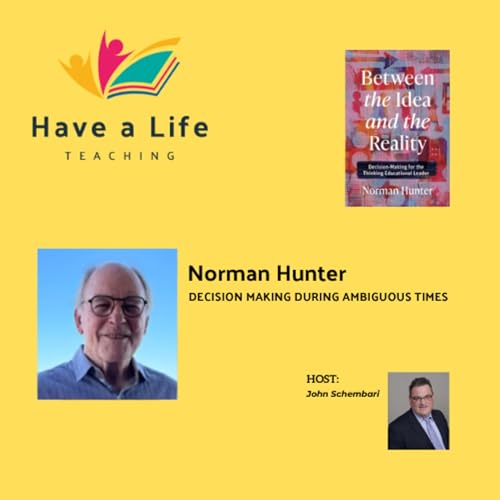
  • Norm Hunter: How to Lead Without Rushing Into Wrong Decisions
    Mar 24 2026

    Leadership Isn’t About the Idea as much as It’s About the Decision

    Most leaders have great ideas. The difference? Execution lives in the shadow between idea and reality.

    In this podcast episode, we speak with Norman Hunter - author of the book "Between the Idea and the Reality: Decision-Making for the Thinking Educational Leader".

    We dive into:

    Why decision-making defines leadership

    How great leaders think beyond the obvious

    What it really takes to move from concept → impact

    If you’re leading a school, team, or classroom… this one hits.

    Listen in and rethink how you lead.


    Norm Hunter LinkedIn Page

    Between the Idea and the Reality - Book (Amba Press)

    Afficher plus Afficher moins
    34 min
  • Natan Last: How Crossword Puzzles Deepen Thinking and Highlight the Hidden Math of Language
    Mar 17 2026

    What can crossword puzzles teach us about learning?

    In this episode of the Have a Life Teaching Podcast, I speak with crossword constructor and social scientist Natan Last, author of Across the Universe: The Past, Present, and Future of the Crossword Puzzle.

    We explore how crossword puzzles bring together language, mathematics, history, and creative thinking—and why they can be powerful tools for classroom learning.

    Natan explains how crossword solving strengthens decoding skills, pattern recognition, and productive struggle. We also discuss how puzzles reflect cultural moments in history and how teachers can use crossword creation as a collaborative learning activity.

    If you’re looking for ways to help students think more strategically and deeply, this conversation offers surprising insights.

    Topics in this episode

    • How crossword puzzles develop analytical and creative thinking

    • Why the best solvers rely on pattern recognition—not just knowledge

    • The mathematics behind crossword grid design

    • Crossword puzzles as cultural and historical artifacts

    • Using crossword creation as a classroom learning strategy

    • How puzzles foster collaboration and community

    Guest

    Natan Last is a crossword constructor whose puzzles appear in The New York Times and The New Yorker. He is also a social scientist whose research focuses on migration and asylum policy.


    Natan Last LinkedIn Page

    Natan Last Website

    Natan Last Book - Across the Universe


    Music by Aylex

    Afficher plus Afficher moins
    32 min
  • Donita Grissom and Vicki Kelchner: How School Leaders Can Build Teacher Resiliency
    Mar 10 2026

    In this episode of the Have a Life Teaching Podcast, John speaks with Dr. Danita Grissom and Dr. Vicki Kelner, co-authors of High Five to Thrive: Five Proven Practices to Unleash Your Passion for Teaching.

    The conversation explores why so many teachers are overwhelmed, why burnout is often created by the system rather than the individual, and what educators and leaders can do to restore hope, regulation, and sustainability. The guests share practical strategies including reconnecting to purpose, developing “hope habits,” self-regulation practices, and simple leadership moves that help teachers feel supported rather than depleted.

    This episode is for teachers, school leaders, coaches, and anyone trying to build healthier, more human-centered schools.


    Donita Grissom LinkedIn Page

    Vicki Kelchner LinkedIn Page

    High Five Book

    Best Questers Website


    Music by Aylex

    Afficher plus Afficher moins
    44 min
  • Jeffrey Riley: How to Increase AI Literacy, Student Safety, and the Future of Teaching
    Mar 3 2026

    In this episode of Have a Life Teaching Podcast, John sits down with Jeff Riley, former Commissioner of Education for Massachusetts and current Executive Director of Day of AI, a nonprofit initiative launched out of MIT.

    Together, they explore what AI truly means for K–12 education beyond the fear, beyond the cheating headlines, and beyond the hype.

    Jeff shares:

    • Why AI literacy may become the “fourth R”

    • How schools can balance innovation with student safety

    • Why banning AI outright may harm students long-term

    • The importance of teaching students to be healthy skeptics

    • How AI can finally make real differentiation possible

    • Why districts should start with guardrails — not panic-driven policy

    • The growing role of AI in global education systems

    • How AI can reduce teacher workload and reignite instructional joy

    They also discuss:

    • The dangers of AI hallucinations and why prompting matters

    • AI companions and the urgent need for parent awareness

    • Why AI leadership cannot live in just one classroom

    • The opportunity to unleash teacher creativity post-COVID

    Jeff’s core message:
    AI is already here. The question is not whether schools will use it but whether they will use it thoughtfully.

    If implemented wisely, AI may reduce administrative burdens, strengthen differentiation, and give teachers back the space to design engaging, joyful learning experiences.


    Jeffrey Riley LinkedIn Page

    Day of AI Website

    Music by Aylex

    Afficher plus Afficher moins
    43 min
  • Suzy Koontz: How to Use Movement to Make Math Stick
    Feb 24 2026

    Anyone who has stepped into a K–5 classroom knows this truth: kids need to move. But they also need strong math foundations. So how do we do both—without sacrificing rigor?

    In this episode, I sit down with Suzy Koontz, CEO and Founder of Math & Movement, to explore how movement-based learning can dramatically increase math fluency, engagement, and student confidence. A former actuary turned education innovator, Suzy shares how a simple trampoline moment with her daughter sparked a 25-year journey into brain-based math instruction .

    We discuss:

    • The brain science behind movement and learning

    • How cross-body motion activates both hemispheres of the brain

    • Why skip counting is foundational for multiplication and division fluency

    • Research showing significant gains in math achievement and self-efficacy

    • How schools can systematize movement-based strategies across classrooms

    • Practical examples teachers can implement immediately

    • The impact on student collaboration, behavior, and math identity

    We also preview Suzy’s upcoming ASCD book, Activate Math: Using Movement to Spark Engagement and Ignite Learning Activate Math: Using Movement to Spark Engagement and Ignite Learning.

    If you believe math should be active, conceptual, and confidence-building—not passive and procedural—this episode is for you.


    Suzy Koontz LinkedIn Page

    Suzy Koontz Web Page

    Math and Movement Website


    Music by Aylex

    Afficher plus Afficher moins
    38 min
  • Deborah Landis: How to Use Costume Design to Make Learning Come Alive (From Indiana Jones to Your Classroom)
    Feb 17 2026

    What can the costume designer behind Raiders of the Lost Ark and Michael Jackson’s Thriller teach educators?

    A lot.

    In this episode, Dr. Deborah Landis, UCLA professor and legendary Hollywood costume designer (also behind The Blues Brothers, Animal House, and Oscar-nominated for Coming to America), breaks down how costume design is actually about:

    • Reading deeply

    • Interpreting text

    • Understanding culture and history

    • Building authentic characters

    • Transporting an audience

    And that’s exactly what great teachers do.

    🎭 Why costume design starts with close reading
    📚 How immersing students in one person or one time period builds lasting understanding
    🎬 The difference between “accuracy” and “authenticity”
    🧠 How asking better questions deepens learning
    👕 Why what we wear tells a story — and how students can use costume to demonstrate understanding
    🔥 What Indiana Jones teaches us about archetypes and engagement
    🎓 Why performance and teaching are more alike than we think

    Dr. Landis shares how her graduate students study Oscar Wilde by examining text, history, politics, art, and culture before ever designing a garment — and why K–12 classrooms can adapt this same immersive approach.

    She reminds us:

    “We’re in the transportation business.”

    So are great educators.

    If you want to make learning feel less like coverage and more like immersion — this conversation will spark ideas across history, ELA, arts integration, and leadership.

    🎧 Listen in and ask yourself:
    How might costume, story, and performance deepen learning in your classroom or school?


    Deborah Landis LinkedIn Page

    Deborah Landis Website

    UCLA School of Theatre, Film & Television

    Dressed: A Century of Hollywood Costume Design - Book

    Afficher plus Afficher moins
    43 min