Couverture de From HU2U

From HU2U

From HU2U

De : Howard University
Écouter gratuitement

À propos de ce contenu audio

From HU2U illuminates experiences at Howard University through hosts and guests whose stories and work which have important implications for the Black community.

All rights reserved.

Sciences sociales
Les membres Amazon Prime bénéficient automatiquement de 2 livres audio offerts chez Audible.

Vous êtes membre Amazon Prime ?

Bénéficiez automatiquement de 2 livres audio offerts.
Bonne écoute !
    Épisodes
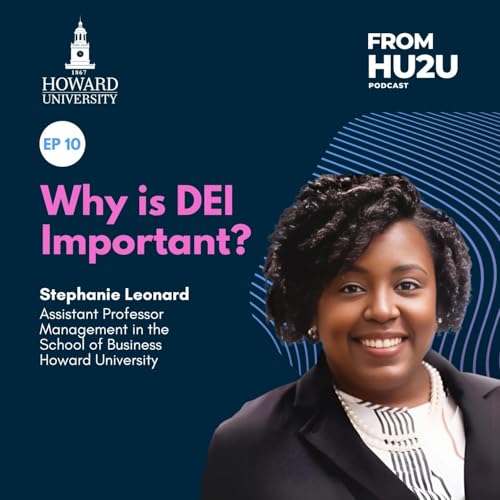
    • Why is DEI Important? feat. Dr. Stephanie Leonard
      Oct 22 2024


      Diversity, Equity, and Inclusion (DEI) has become a major buzzword in the workplace. It intends to increase diversity, equity, and inclusion in the office, but how to make it successful depends on several factors.


      According to a recent Pew Research Center study, 56% say having DEI in the workplace is a good thing. But to make sure a workplace DEI program makes people feel diverse, equal, and included takes a lot more than just checking off some boxes.


      Our guest today is Dr. Stephanie R. Leonard. She is an Assistant Professor of Management in the School of Business at Howard University. Her research focuses on diversity and inclusion phenomena such as organizational rationales for diversity, antecedents for inclusive climates, race-based trauma implications for workplaces, and micro-generational differences. In addition to academia, she has experience working in Human Resources.


      In this episode, Dr. Leonard and host Monica Lewis cover the importance and benefits of DEI, exploring both surface-level and deep-level diversity dimensions, and the moral and business cases for DEI. Dr. Leonard provides insights into the challenges and strategies for implementing DEI programs, highlighting the necessity of an inclusive environment for leveraging the full benefits of diversity. We’ll also touch on common obstacles, the current adolescent phase of incorporating DEI into the workplace, and practical advice for individuals and organizations to advocate for and foster DEI.


      From HU2U is a production of Howard University and is produced by University FM.


      Episode Quotes:


      How can a workplace still offer a DEI friendly environment, even if the actual number of diverse individuals is low?

      15:20: Why should we care about diversity and inclusion if there aren't too many diverse employees here? For me, we still need to celebrate deep-level diversity. These are the dimensions that we cannot see: our differences in personalities, our differences in values, and our different religions. And celebrate what you can celebrate. For instance, if there is a flexible work schedule program that's working well because women are allowed to, there's childcare or things like that. Celebrate that because it's going well. And I also think it's important to plan for the arrival of your diverse employees. You may not have them now, but you still have to plan for them to come.


      Treating DEI as an investment in the workplace

      36:51: That's how you have to treat diversity and inclusion: this is an investment. If we fail, we're going to assess what went wrong, and we're going to get back on the saddle and try it again until we get it right. And that's what you do when it's important to you, when it's at the core of your vision for the company.


      Neglecting diversity crisis management can lead to a downfall of an organization

      19:32: Diversity crisis management: people don't know how to handle a diversity crisis. We know how to handle all kinds of crises, but when it comes to diversity crises, it takes companies weeks to come back and present to the public what is going to be done. And it's just unacceptable. And so all of those things will lead to a downfall and a failure for the organization.


      Guest Profile:

      • Stephanie Leonard | Howard Profiles
      Afficher plus Afficher moins
      33 min
    • The GenAI Revolution, Ep 3: Preparing Howard Alum for Big Tech & Entrepreneurship
      Oct 8 2024
      In this final chapter of our mini-series on AI, we venture beyond campus to spotlight Howard alumni making waves in both big tech and entrepreneurship through the power of AI. Despite the persistent Black wealth gap and underrepresentation of Black professionals in technology, Howard's tech and entrepreneurship ecosystem is fostering a new generation of leaders.Host Dr. Kweli Zukeri delves into the transformative potential for young people in the tech world. We’ll hear success stories from several Howard alumni currently working in big tech and entrepreneurship, how the innovative education and curriculum support at Howard prepared them for these industries, as well as how the Afrotech Conference is creating more opportunities for Black technologists and entrepreneurs.From HU2U is a production of Howard University and is produced by University FM.Episode Quotes:Why now is the best time to be within the technology industry27:03: [Sam Altman] I think this is probably the greatest time, at least since the internet, to be graduating, to be a young person. If you're interested in entering the technology industry, this is a very special opportunity that probably won't come along again for a while. You all got very, very lucky. It's at the birth of a new industry and a time of tremendous change when young people have the most advantage and the most opportunity. There's a reason that I think young people drive a lot of the technological revolutions. You all are way more familiar with AI tools than people older than you. You bring a new set of fresh perspectives. What can be created now? What just wasn't possible before this?HBCUs where culture is created15:09: [Erin Horne McKinney] I think one of the great things about being at an HBCU is that we are the culture creators. Right at ours, there's no such thing as failure—there are learning experiences, right? And those are the things that make you grow. People are coming to us for the culture, for the experience. But one of the things you get as a minor, no matter which HBCU you go to, is that you get that grit. That hustle, learning to overcome obstacles, learning that when somebody says no to you, it’s not really no; it means you need to become a better problem solver, right? So, learning how to problem solve.On turning academic knowledge into practical skills36:29: [Antonio McMichael] I think you get a lot of foundation from the classes that you're taking that will teach you the what and the how, the academic side of things. But you have to be able to take the academic side and turn it into something practical, like actually building things.Guest Profiles and Show Links:Kweli Zukeri | Howard ProfilesKweli Zukeri | LinkedInkweli.zukeri@howard.eduCoded Bias State of Tech Diversity: The Black Tech Ecosystem | NAACPAfroTechAFROTECH™️ ConferenceBlavity IncSimone Tyler | LinkedInErin Horne McKinney | Howard ProfilesERIN (Ear-in) HORNE MCKINNEY, M.A. | LinkedInPNC National Center for EntrepreneurshipBlack Commerce ConferenceHBCU Startup Scholars - PNC National Center for EntrepreneurshipEntrepreneurship Education Innovation GrantLegand Burge | Howard ProfilesLegand Burge | LinkedInAlgorithmic Justice LeagueHoward West: A First Step in Creating More Opportunities for African-American EngineersDr. Grant WarnerRiana Battick | LinkedInSam AltmanOpen AIAntonio McMichael | LinkedInCoretta Martin | LinkedInIEP&Me
      Afficher plus Afficher moins
      49 min
    • The GenAI Revolution, Ep 2: Howard Changemakers Leading the Way
      Sep 24 2024
      In this 2nd episode of our AI series, Dr. Kweli Zukeri dives deep into the transformative work happening within the Howard community to make the AI revolution inclusive, accessible, and impactful for Black communities and beyond.Join us as we highlight groundbreaking projects going on right here, like the creation of an audio database of African American Vernacular English (AAVE) to revolutionize voice assistive technologies, the diversification of healthcare data to address disparities and the training of the next generation of Black data scientists. Plus, we’ll discuss an innovative speech therapy app designed with inclusivity in mind.This episode unpacks Howard’s commitment to tackling AI bias and building inclusive ecosystems—efforts that reflect the proud HBCU legacy of using cutting-edge knowledge to uplift Black communities and drive progress for society at large.From HU2U is a production of Howard University and is produced by University FM.Episode Quotes:On changing the narrative around AAVE19:06: [Kweli Zukeri]: Speech is self-expression. So, being able to speak in one's own dialect of vernacular matters deeply. Reflective of the Black American experience itself, its structure has roots in the languages of West Africa and to survive despite American society's pressures to subdue it. Hence, the so-called code-switching phenomenon most Black professionals feel they must abide by to this day. Racist pressure to brush it aside or keep it in the margins can impact their own feelings and relationship to it, perhaps, subconsciously swaying us to consider it lesser than, which is a form of internalized racism. That's why I'm so excited by the Elevate Black Voices project.One's self-expression influences how effectively people get work done23:48: [David Green]: Your ability to have your natural speech accepted and responded to allows a certain freedom in what you're able to think about and what you're able to articulate. You're not searching for certain words, you're not searching for certain ideas, and you're not trying to put on a performance of a certain kind of voice that you would think would get a better response.On creating a safe space for Black English05:04: [Washington]: We want to create a safe space in celebration of Black English, celebrating all the different dialects, the Southern, the different kinds of ways that Black people speak, so that you don't have to code-switch or pretend to be someone else.Guest Profiles and Show Links:Kweli Zukeri | Howard ProfilesKweli Zukeri | LinkedInkweli.zukeri@howard.eduAnnouncing Howard University's Groundbreaking AI InitiativeGENERATIVE AI | Howard University Provost's OfficeAbout | Howard University PresidentManning Marable The Center for Applied Data Science and AnalyticsAmy Yeboah Quarkume, Ph.D. | LinkedInAmy Quarkume | Howard ProfilesCORES Future LabCognitive and Neurodiversity AI (CoNA) Lab at Morgan State UniversityGabriella Waters | LinkedInGloria Washington | Howard ProfilesGloria Washington | LinkedInHoward AAVE Project | YouTubeInstitute for Human-Centered AISabrina Bramwell, grad studentElevate Black Voices, project supported by Google David Green | Howard Profiles1st year writing program at HowardMLA-CCCC Joint Task Force on Writing and AIConference on College Composition and CommunicationLegand Burge | Howard ProfilesLegand Burge | LinkedInAIM-AHEADMeharry Medical CollegeHNRS 020: The Tech Reparations and Responsibility: Algorithmic Data Bias and Ethics course for Honors Students | Howard UniversityWorlds of Hello app
      Afficher plus Afficher moins
      48 min
    Aucun commentaire pour le moment