Couverture de Fearless Growth with Amanda Setili

Fearless Growth with Amanda Setili

Fearless Growth with Amanda Setili

De : Amanda Setili
Écouter gratuitement

3 mois pour 0,99 €/mois

Après 3 mois, 9.95 €/mois. Offre soumise à conditions.

À propos de ce contenu audio

We all want to do work we love, and as leaders, entrepreneurs and employees, wouldn’t it be great to create workplaces where work feels like play? Where people are tuned in to changes going on in the world around them? Where they’re constantly learning, spotting new opportunities, and taking action to go after them? These traits are essential to an organization's agility and success. In the Fearless Growth podcast, Amanda Setili and her guests explore the mindsets and choices that lead individuals, leaders and their organizations to outstanding performance.©2021 Setili & Associates, LLC Economie Management Management et direction
Les membres Amazon Prime bénéficient automatiquement de 2 livres audio offerts chez Audible.

Vous êtes membre Amazon Prime ?

Bénéficiez automatiquement de 2 livres audio offerts.
Bonne écoute !
    Épisodes
    • Culture as a Competitive Advantage with Meredith Hanrahan
      Aug 22 2024
      How can you make culture a source of sustainable competitive advantage when you’re operating in a complex Fortune 500 business across 30 different countries? Amanda Setili interviews Meredith Hanrahan, Managing Director of People and Culture at Analog Devices (ADI) to learn what Hanrahan and her colleagues do to shape and manage company culture in a disciplined and relentless way. Key tactics include using case studies for culture training, establishing a common language, promoting transparency, and recognizing employees not only for their “wins”, but for their courage and discipline in making difficult trade-offs for the company's greater good.Host: Amanda SetiliGuest: Meredith Hanrahan, Managing Director of People and Culture at Analog Devices (ADI). Meredith has extensive experience in sales, marketing, product, and general management. She’s held key roles in startups like Salary.com and Lycos.com, and at major companies like General Mills, Lindt Chocolate, and Miller Brewing Company. Importance of Culture in Today's Business Environment: [00:01:19] Why culture is important now. CEOs face fierce competition, rapid technological changes, and unpredictable macroeconomic challenges. Culture is crucial for organizational agility, leadership effectiveness, and employee engagement. Over 84% of CEOs recognize culture as important, but less than 30% actively shape it.Defining Culture: [00:01:57] Culture consists of visible and invisible elements: values, norms, beliefs, and habits.It's essentially "how things get done," especially when no one is looking.Collaboration with MIT on cultural commandments.CEO's Role in Shaping Culture:[00:02:44] The gap between recognizing culture's importance and actively shaping it.Cultural triggers: business strategy shifts, acquisitions, new leadership, etc.The tangible impact of intentional culture on market performance and employee engagement.Analog Devices' Cultural Evolution:[00:05:33] .Analog Devices' historical foundation in innovation and risk-taking. The need for cultural adaptation due to acquisitions, new product development, and global expansion. Utilizing organizational cultural profiles to assess and enhance adaptiveness and accountability.Must-Haves for Cultural Transformation:[00:10:16] .Five must-haves for cultural transformationFull leadership commitment and visible role modeling.Clear link between culture and business strategy.Aligning purpose, vision, strategy, and values in a way that everyone understands.Embedding culture in everyday interactions and measuring its impact.Real-life examples of cultural change, including training programs and case studies.Practical Steps for Shaping Culture:[00:32:47] First, define the need for cultural change based on business events or strategic shifts.Take stock through surveys, roundtables, and customer interviews. Align leadership on the importance of culture and its strategic relevance. Educate and train leaders at every level.Embed cultural values into performance management and recognition systems. Create a common language and practical steps for cultural reinforcement.Innovative Practices at Analog Devices:[00:21:08] Virtual cultural sessions and skits to engage a global workforce The ADI Ignite Network to promote innovation across all business areas, not just engineering.Cultural champion networks to advocate and reinforce desired behaviors.Challenges and Solutions in Cultural Transformation: [00:37:00] Addressing limiting beliefs and entrenched behaviors.Encouraging commitment and accountability at all organizational levels.Practical examples of how leaders can role model cultural changes.Importance of Work-Life Balance:[00:42:19] Setting boundaries to ensure employees can recharge and maintain creativity. Real-life scenarios of senior executives adjusting their practices to support work-life balance.Conclusion:[00:45:46] Final thoughts.1. The importance of commitment, practical steps, and continuous reinforcement in cultural transformation.2. Meredith encourages companies of any size to focus on culture as a strategic advantage.Contact Information:Podcast Website: https://setili.com/podcast/Connect with Meredith Hanrahan on LinkedInConnect with Amanda Setili on LinkedIn
      Afficher plus Afficher moins
      46 min
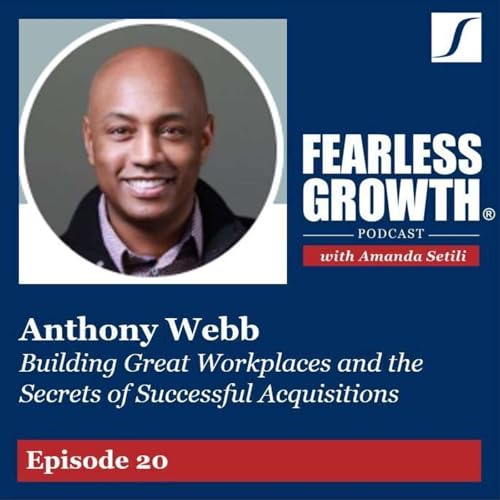
    • Anthony Webb on Building Great Workplaces and the Secrets of Successful Acquisitions
      Aug 7 2023

      Today’s guest highlights the importance of trust, empathy, and understanding in fostering meaningful experiences in the workplace. He also discusses the keys to successful acquisitions, how to avoid common mistakes by acquirers, and how to create post-acquisition strategy.

      Anthony Webb is a mergers & acquisitions lifer, licensed lawyer, venture capital investor, servant leader, and engaged father.

      Currently, he works in Corporate Development and M&A Integration for Adobe.

      Anthony shares what makes work most meaningful to him, from being given the opportunity to solve complex problems, to building great team environments, to driving tangible results by empathizing with others, understanding their objectives, and providing supportive leadership.

      Through a personal experience, Anthony illustrates how creating safe spaces allows trust to be built, in turn paving the way for effective communication. To empower your organization’s “culture carriers,” it is vital to create a space where ideas from both sides can come to the table, promoting innovation and better decision-making.

      Asked what goes into a successful M&A, Anthony unpacks the concept of excellent end-to-end execution. It starts with creating a crisp corporate strategy, followed by homing into the target space, then getting the right people to the table for diligence, and, finally, building an integration strategy and approach.

      Anthony explains that divesting businesses gave him a new perspective that allowed him to understand what to look for in an acquisition. Drawing from these experiences, he provides insight into the often unpleasant surprises that occur during acquisitions and offers strategies on how to avoid them, chief among them being the consequences of being overly optimistic and simplistic in a deal.

      Anthony discusses the importance of knowledge retention and being sensitive to the motivations of the target company's employees. Building trust and openness, according to him, leads to better acquisition outcomes.

      Anthony shares how simply attending routine meetings of the acquired company during a several-month "stabilization period"—allowing all voices to bring ideas to the table—allows acquirers to learn and gain more value from the acquisition for the long-term.

      Connect with Amanda Setili:

      ● www.setili.com

      ● LinkedIn

      ● Twitter

      ● Facebook

      Connect with Anthony Webb:

      ● LinkedIn

      Afficher plus Afficher moins
      52 min
    • Colleen Francis on the Sales Revolution
      Apr 21 2022

      Colleen Francis provides a proven, realistic gameplan to creatively adapt our sales and marketing efforts in a topsy-turvy world.

      Colleen is an award-winning speaker, consultant, and the author of Right on the Money: New Principles for Bold Growth.

      A successful sales leader for over 20 years, Colleen’s results have attracted hundreds of industry-leading clients, including Chevron, John Deere, NCR, Trend Micro, Merck, Abbott, Experian, Royal Bank, and Dow.

      Colleen is a recognized thought leader in sales leadership, an inductee in the Professional Speaker Hall of Fame, and has been named the #1 sales influencer to follow by LinkedIn.

      In Right on the Money, Colleen writes that the past two years could be regarded as “an evolutionary moment for sales”, and that “evolution came by revolution” as a result of the pandemic. That is, the world of sales was forever transformed once salespeople were forced to be creative sans traditional belly-to-belly interactions.

      In fact, many sellers realized that they could be much more efficient and profitable working remotely to meet the needs of the new buyer, instead of being on the road all the time. Expense accounts could be scaled back and a lot of time could be saved—all with virtually no impact on employee and client trust.

      Another huge shift Colleen has seen is the morphing of the business development specialist (BDS) role. Historically, this role has served as a “cold-calling team” that passes leads to senior sales people after a simple vetting process The new and more effective role for these more junior people is nurturing existing customers, giving customers strong reasons to stay loyal to your company.

      In today’s world, Colleen’s clients have found that the inside sales role is better left to an experienced, seasoned professional able to have high-level discussions with prospects.

      Colleen points out that the pandemic revealed poor sales practices, in that some companies had been going overboard on customer-centricity. She explains that a “customer is always right” approach can cost a business money, brand reputation, and access to markets.

      Likewise, there is a danger to incorporating potentially controversial social issues in one’s branding and marketing efforts. Instead, Colleen advises, your company may wish to focus on the good it can do in its own community.

      In Right on the Money, Colleen proposes a formula she calls “the Tempo Triad”, in which she encourages salespeople to engage in conversations across three different media platforms (she recommends LinkedIn, Twitter, and Facebook) in three different ways:

      1) sharing their company’s unique content

      2) sharing something a customer posted

      3) commenting or asking a question about something a customer has posted.

      Connect with Amanda Setili:

      ● www.setili.com

      ● LinkedIn

      ● Twitter

      ● Facebook

      Connect with Colleen:

      ● www.engageselling.com

      Get her book, Right on the Money:

      ● www.amazon.com/Right-Money-Principles-Bold-Growth/dp/163195671X

      Afficher plus Afficher moins
      45 min
    Aucun commentaire pour le moment