Épisodes

  • Evolution (part 2): Natural Selection
    Apr 19 2026

    Ever wondered how some animals survive while others don’t? Or why certain traits — like speed, strength, or camouflage — make such a difference in the wild?


    In this episode, Theo and his mum continue their exploration of evolution by focusing on natural selection — the process that shapes which traits get passed on over time. Together, they discuss how strengths and weaknesses affect survival, how camouflage can mean the difference between life and death between predator and prey.


    Building on Part 1, this episode brings evolution to life through simple, real-world examples that show how small advantages can have a big impact over generations.


    Main show description:


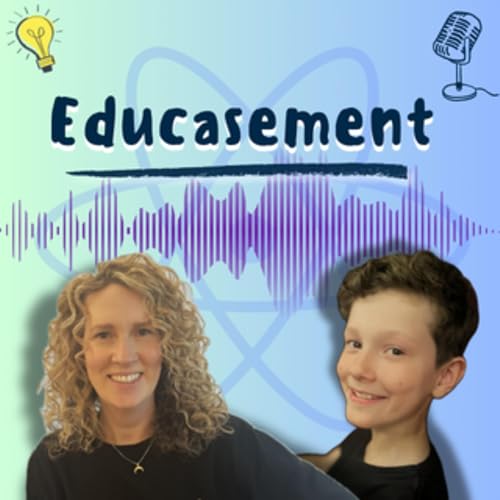
    Theo Casement is a curious kid with a thirst for facts, and in this short, family-friendly podcast he explores big questions about maths, science, and how the world works through relaxed, curiosity-led conversations.


    This podcast is designed to spark curiosity and a love of learning in children and families, encouraging discussion and exploration rather than formal teaching. Perfect for curious kids, parents, and educators who enjoy learning through conversation and big ideas explained simply.


    Follow us on Instagram @educasement for extra resources, visuals, and topic support linked to each episode.


    Got a big question you’d like Theo to explore? Get in touch — we’d love to hear from you.


    Fancy a shout out or would you like to make a guest appearance? Send us some details in the comments and we'll get back to you.

    Afficher plus Afficher moins
    13 min
  • Evolution (part 1): What came first…Chicken or Egg?
    Apr 4 2026

    Ever wondered which came first — the chicken or the egg? Thought it was just a silly question? Or realised it might actually have a scientific answer?


    Then this episode is for you!


    In this episode, Theo and his mum take on one of the oldest and most debated questions of all time. What starts as a simple puzzle quickly turns into a fascinating discussion about evolution, how species change over time, and what we really mean when we say something is a “chicken”.


    Together, they explore how eggs existed long before chickens, how tiny changes across generations can lead to entirely new species, and why the answer might not be as straightforward as it first seems.


    We’re not experts, just curious Casements enjoying a fun debate, but here’s a link to a video we mentioned which helps support our conversation…


    Sources & further learning:


    ‘Which came first - the chicken or the egg’ by AsapSCIENCE - https://youtu.be/1a8pI65emDE?si=-Ugh9QL8yB5YBzC1


    Main show description:


    Theo Casement is a curious kid with a thirst for facts, and in this short, family-friendly podcast he explores big questions about maths, science, and how the world works through relaxed, curiosity-led conversations.


    This podcast is designed to spark curiosity and a love of learning in children and families, encouraging discussion and exploration rather than formal teaching. Perfect for curious kids, parents, and educators who enjoy learning through conversation and big ideas explained simply.


    Follow us on Instagram @educasement for extra resources, visuals, and topic support linked to each episode.


    Got a big question you’d like Theo to explore? Get in touch — we’d love to hear from you.


    Fancy a shout out or would you like to make a guest appearance? Send us some details in the comments and we'll get back to you.

    Afficher plus Afficher moins
    22 min
  • Probability: The Lottery and Coin Flips
    Mar 14 2026

    Ever wondered why winning the lottery is so unlikely? Thought a coin toss should always come out 50/50? Or questioned the odds when you roll a dice?


    Then this episode is for you!


    In this episode, Theo returns to one of his favourite topics — maths — to explore the curious world of probability. Together with his mum (and special guest), he unpacks what probability actually means, why some outcomes are far more likely than others, and how mathematicians work out the chances of things happening.


    Along the way, Theo explains the odds behind winning the lottery, the logic of rolling dice, and introduces a simple heads-or-tails game to test whether things really do balance out over time. The conversation demonstrates Pascal’s Triangle, a surprisingly powerful mathematical pattern that helps explain combinations and probability.


    Making a special appearance this week is the youngest member of the family — little sister Heidi — who joins the experiments and quickly turns the discussion into our funniest episode yet.


    We’re not experts, just curious Casements enjoying a fun debate, but here’s a link to a video that might help with some visuals to support our conversation…


    Sources & further learning:


    Pascal’s Triangle by April Spiller - https://youtu.be/LDK_dBT7wTo?si=kczAlQabgboxvyCA


    Main show description:

    Theo Casement is a curious kid with a thirst for facts, and in this short, family-friendly podcast he explores big questions about maths, science, and how the world works through relaxed, curiosity-led conversations.

    This podcast is designed to spark curiosity and a love of learning in children and families, encouraging discussion and exploration rather than formal teaching. Perfect for curious kids, parents, and educators who enjoy learning through conversation and big ideas explained simply.

    Follow us on Instagram @educasement for extra resources, visuals, and topic support linked to each episode.

    Got a big question you’d like Theo to explore? Get in touch — we’d love to hear from you.

    Fancy a shout out or would you like to make a guest appearance? Send us some details in the comments and we'll get back to you.

    Afficher plus Afficher moins
    22 min
  • The Moon: Phases and Tides
    Feb 28 2026

    Ever looked at the moon and wondered if it’s changing shape? Thought the shadow on the moon is due to the Earth being in between the Sun and Moon? Or wondered how come you can see it in the day time? Then this episode is for you!


    In this episode, Theo veers away from his favourite topic of maths to answer questions his mum has about her wonderment of the moon. Voted for by the public, this topic delves into the eight phases of the moon, what happens to water as the moon orbits Earth and if we can see the moon during the daytime.


    We’re not experts, just curious Casements enjoying a fun debate, but here’s a link to a video that might help with some visuals to support our conversation…


    Sources & further learning:

    Why can we see the moon in the day? by NASA - https://youtu.be/WLhlRUnzbTM?si=9u4ErJ7kAH38KvMN


    Article - https://www.britannica.com/video/How-does-the-Moon-affect-the-tides/-320503


    Main show description:

    Theo Casement is a curious kid with a thirst for facts, and in this short, family-friendly podcast he explores big questions about maths, science, and how the world works through relaxed, curiosity-led conversations.

    This podcast is designed to spark curiosity and a love of learning in children and families, encouraging discussion and exploration rather than formal teaching. Perfect for curious kids, parents, and educators who enjoy learning through conversation and big ideas explained simply.

    Follow us on Instagram @educasement for extra resources, visuals, and topic support linked to each episode.Got a big question you’d like Theo to explore? Get in touch — we’d love to hear from you.

    Fancy a shout out or would you like to make a guest appearance? Send us some details in the comments and we'll get back to you.

    Afficher plus Afficher moins
    16 min
  • Binary, Base 10 and Hexadecimals
    Feb 22 2026

    What are binary, base 10, and hexadecimal — and how do different number systems actually work?

    In this episode, Theo explores how numbers can be represented in different bases, breaking down binary, base 10, and hexadecimal in a fun, simple, and accessible way. He explains how these number systems compare, how counting changes in different bases, and why understanding them helps us see maths in a whole new way. This curiosity-led conversation makes big maths concepts engaging and (hopefully) easy to understand for curious kids and families.

    Try it yourself:

    Test your skills with the hex colour guessing game: https://yizzle.com/whatthehex/

    Sources & further learning:Watch this helpful YouTube explainer video 'HEX CODE for Dummies (The Non-Technical Guide) (Base-16)' by @tutvid on number bases and hex: https://youtu.be/6cJd7eyYBFs

    Main show description:

    Theo Casement is a curious kid with a thirst for facts, and in this short, family-friendly podcast he explores big questions about maths, science, and how the world works through relaxed, curiosity-led conversations.

    This podcast is designed to spark curiosity and a love of learning in children and families, encouraging discussion and exploration rather than formal teaching. Perfect for curious kids, parents, and educators who enjoy learning through conversation and big ideas explained simply.

    Follow us on Instagram @educasement for extra resources, visuals, and topic support linked to each episode.Got a big question you’d like Theo to explore? Get in touch — we’d love to hear from you.

    Fancy a shout out or would you like to make a guest appearance? Send us some details in the comments and we'll get back to you.

    Afficher plus Afficher moins
    21 min
  • Biggest number ever?
    Feb 16 2026

    Ever wondered what the biggest recognised number in mathematics is? In this episode, Theo explores the mind-bending concept of Rayo’s number, one of the largest numbers ever described.

    Together with his curious mum, he breaks down this abstract maths idea in a fun, simple, and accessible way for curious kids and families. From how mathematicians define extremely large numbers to why these concepts matter, this conversation sparks curiosity and encourages a love of learning in young minds.

    Sources & further learning:
    Thanks to Numberphile on YouTube — their video inspired this episode and explains Rayo’s number in depth: Watch here.


    Main show description:

    Theo Casement is a curious kid with a thirst for facts, and in this short, family-friendly podcast he explores big questions about maths, science, and how the world works through relaxed, curiosity-led conversations.

    This podcast is designed to spark curiosity and a love of learning in children and families, encouraging discussion and exploration rather than formal teaching. Perfect for curious kids, parents, and educators who enjoy learning through conversation and big ideas explained simply.

    Follow us on Instagram @educasement for extra resources, visuals, and topic support linked to each episode.Got a big question you’d like Theo to explore? Get in touch — we’d love to hear from you.

    Fancy a shout out or would you like to make a guest appearance? Send us some details in the comments and we'll get back to you.


    Afficher plus Afficher moins
    17 min
  • Sound waves
    Feb 7 2026

    Does a tree falling in a forest still make a sound if nobody hears it? In this episode, Theo explores sound waves, vibrations, pitch, and how we actually hear the world around us.

    Together with his curious mum, he breaks down how sound travels, why some noises are high or low, and how our ears detect vibrations. This fun, accessible conversation sparks curiosity in kids and families while making complex science ideas easy to understand.

    Try it yourself:

    • Play with different sound frequencies using Chrome Music Lab – Oscillators.

    • Watch this StoryBots video: How Do Ears Hear? (Sing-Along) for a fun visual explanation.

    Main show description:

    Theo Casement is a curious kid with a thirst for facts, and in this short, family-friendly podcast he explores big questions about maths, science, and how the world works through relaxed, curiosity-led conversations.

    This podcast is designed to spark curiosity and a love of learning in children and families, encouraging discussion and exploration rather than formal teaching. Perfect for curious kids, parents, and educators who enjoy learning through conversation and big ideas explained simply.

    Follow us on Instagram @educasement for extra resources, visuals, and topic support linked to each episode.Got a big question you’d like Theo to explore? Get in touch — we’d love to hear from you.

    Fancy a shout out or would you like to make a guest appearance? Send us some details in the comments and we'll get back to you.


    Afficher plus Afficher moins
    12 min
  • Why maps lie
    Jan 31 2026

    Why do maps lie? In this episode, Theo explores why no flat map can perfectly show a round planet and why some countries appear much bigger or smaller than they really are.

    Together with his curious mum, he explains how mapmakers make compromises when representing the globe on a flat surface, and why this doesn’t mean maps are “wrong” — it’s just how projections like the Mercator work. This fun, accessible conversation makes complex geography ideas easy to understand and sparks curiosity in kids and families.

    Learn more: Check out The True Size website to explore the Mercator Projection and see how countries really compare.


    Main show description:

    Theo Casement is a curious kid with a thirst for facts, and in this short, family-friendly podcast he explores big questions about maths, science, and how the world works through relaxed, curiosity-led conversations.

    This podcast is designed to spark curiosity and a love of learning in children and families, encouraging discussion and exploration rather than formal teaching. Perfect for curious kids, parents, and educators who enjoy learning through conversation and big ideas explained simply.

    Follow us on Instagram @educasement for extra resources, visuals, and topic support linked to each episode.Got a big question you’d like Theo to explore? Get in touch — we’d love to hear from you.

    Fancy a shout out or would you like to make a guest appearance? Send us some details in the comments and we'll get back to you.


    Afficher plus Afficher moins
    18 min