Épisodes

  • Causality, Experimentation, and Marketplaces | Lawrence De Geest S2E10
    Apr 1 2026

    Send us Fan Mail

    Causality, Experimentation, and Marketplaces

    Meet Lawrence de Geest (Zoox, ex-Lyft, ex-NBA), a former soccer player and an ex-NBA data scientist, who fell in love with marketplaces, despite the fact he hated math.

    In the episode we ponder how to deal with causality when our interventions change the dynamics of the environment we intervene upon, what to do with SUTVA violations, and how to design efficient quasi-experiments.

    - Why simple A/B tests fail at marketplaces
    - How reversing synthetic controls logic can help us design better experiments
    - Why Lawrence thinks that average treatment effect is just a snapshot of here and now
    - How Magellan used data science to prove that Portugal was harvesting spices on Spanish territory

    ------------------------------------------------------------------------------------------------------

    Video version available on YouTube: https://youtu.be/acCy16L33tU
    Recorded in 2026 in San Francisco, USA.

    ------------------------------------------------------------------------------------------------------

    About The Guest
    Lawrence De Geest is an economist and data scientist at Zoox. He was previously a data scientist at Lyft and the NBA, and before joining industry, an Assistant Professor at Suffolk University, with visiting appointments at Boston College and the University of San Francisco. His main research interests are marketplaces, collective action and experimentation. Outside of work he loves biking, surfing, and playing with his dog.

    Connect with Lawrence:
    - Lawrence on LinkedIn: https://www.linkedin.com/in/lawrence-de-geest-21a206a/
    - Lawrence's web page: https://lrdegeest.github.io/

    About The Host
    Aleksander (Alex) Molak is an independent machine learning researcher, educator, entrepreneur and a best-selling author in the area of causality (https://amzn.to/3QhsRz4 ).

    Connect with Alex:
    - Alex on the Internet: https://bit.ly/aleksander-molak


    Support the show

    Causal Bandits Podcast
    Causal AI || Causal Machine Learning || Causal Inference & Discovery
    Web: https://causalbanditspodcast.com

    Connect on LinkedIn: https://www.linkedin.com/in/aleksandermolak/
    Join Causal Python Weekly: https://causalpython.io
    The Causal Book: https://amzn.to/3QhsRz4

    Afficher plus Afficher moins
    1 h et 5 min
  • Do Heterogeneous Treatment Effects Exist? | Stephen Senn X Richard Hahn S2E9 | CausalBanditsPodcast
    Jan 30 2026

    Send us Fan Mail

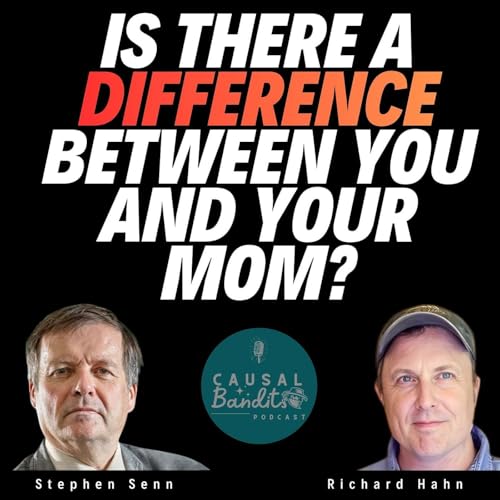
    Do Heterogeneous Treatment Effects Exist?

    For the last 50 years, we've designed cars to be safe...

    For the 50th-percentile male.

    Well, that's actually not 100% correct.

    According to Stanford's report, we introduced "female" crash test dummies in the 1960s, but...

    They were just scaled-down versions of male dummies and...

    Represented the 5th percentile of females in terms of body size and mass (aka the smallest 5% of women in the general population).

    These dummies also did not take into account female-typical injury tolerance, biomechanics, spinal alignment, and more.

    But...

    Does it matter for actual safety?

    In the episode, we cover:
    - Do heterogeneous treatment effects (different effects in different contexts) exist?
    - If so, can we actually detect them?
    - Is it more ethical to look for heterogeneous treatment effects or rather look at global averages?


    Video version available on the Youtube:

    https://youtu.be/V801RQTBpp4
    Recorded on Nov 12, 2025 in Malaga, Spain.

    ------------------------------------------------------------------------------------------------------

    About Richard
    Professor Richard Hahn, PhD, is a professor of statistics at Arizona State University (ASU). He develops novel statistical methods for analyzing data arising from the social sciences, including psychology, economics, education, and business. His current focus revolves around causal inference using regression tree models, as well as foundational issues in Bayesian statistics.

    Connect with Richard:
    - Richard on LinkedIn: https://www.linkedin.com/in/richard-hahn-a1096050/

    About Stephen
    Stephen Senn, PhD, is a statistician and consultant who specializes in drug development clinical trials. He is a former Group Head at Ciba-Geigy and has taught at the University of Glasgow and University College London (UCL). He is the author of "Statistical Issues in Drug Development," "Crossover Trials in Clinical Research," and "Dicing with Death."

    Connect with Stephen:
    - Stephen on LinkedIn:

    Support the show

    Causal Bandits Podcast
    Causal AI || Causal Machine Learning || Causal Inference & Discovery
    Web: https://causalbanditspodcast.com

    Connect on LinkedIn: https://www.linkedin.com/in/aleksandermolak/
    Join Causal Python Weekly: https://causalpython.io
    The Causal Book: https://amzn.to/3QhsRz4

    Afficher plus Afficher moins
    1 h et 8 min
  • Causal Inference & the "Bayesian-Frequentist War" | Richard Hahn S2E8 | CausalBanditsPodcast.com
    Dec 27 2025

    Send us Fan Mail

    *What can we learn about causal inference from the “war” between Bayesians and frequentists?*

    What can we learn about causal inference from the “war” between Bayesians and frequentists?

    In the episode, we cover:

    - What can we learn from the “war” between Bayesians and frequentists?
    - Why do Bayesian Additive Regression Trees (BART) “just work”?
    - Do heterogeneous treatment effects exist?
    - Is RCT generalization a heterogeneity problem?

    In the episode, we accidentally coined a new term: “feature-level selection bias.”

    ------------------------------------------------------------------------------------------------------

    Video version available on the Youtube:

    https://youtu.be/-hRS8eU3Tow
    Recorded in Arizona, US.

    ------------------------------------------------------------------------------------------------------

    *About The Guest*
    Professor Richard Hahn, PhD, is a professor of statistics at Arizona State University (ASU). He develops novel statistical methods for analyzing data arising from the social sciences, including psychology, economics, education, and business. His current focus revolves around causal inference using regression tree models, as well as foundational issues in Bayesian statistics.

    Connect with Richard:
    - Richard on LinkedIn: https://www.linkedin.com/in/richard-hahn-a1096050/
    - Richard's web page: https://methodologymatters.substack.com/about

    *About The Host*
    Aleksander (Alex) Molak is an independent machine learning researcher, educator, entrepreneur and a best-selling author in the area of causality (https://amzn.to/3QhsRz4 ).

    Connect with Alex:
    - Alex on the Internet: https://bit.ly/aleksander-molak

    *Links*

    Repo

    - https://stochtree.ai

    Papers

    - Hahn et al (2020) - "Bayesian Regression Tree Models for Causal Inference" (https://projecteuclid.org/journals/bayesian-analysis/volume-15/issue-3/Bayesian-Regression-Tree-Models-for-Causal-Inference--Regularization-Confounding/10.1214/19-BA1195.full)

    - Yeager, ..., Dweck et al (2019) - "A national experiment reveals where a growth mindset improves achievement" (https://www.nature.com/articles/s41586-019-1466-y)

    - Herren, Hahn, et al (2025) - "StochT

    Support the show

    Causal Bandits Podcast
    Causal AI || Causal Machine Learning || Causal Inference & Discovery
    Web: https://causalbanditspodcast.com

    Connect on LinkedIn: https://www.linkedin.com/in/aleksandermolak/
    Join Causal Python Weekly: https://causalpython.io
    The Causal Book: https://amzn.to/3QhsRz4

    Afficher plus Afficher moins
    1 h et 24 min
  • The Causal Gap: Truly Responsible AI Needs to Understand the Consequences | Zhijing Jin S2E7
    Oct 30 2025

    Send us Fan Mail

    The Causal Gap: Truly Responsible AI Needs to Understand the Consequences

    Why do LLMs systematically drive themselves to extinction, and what does it have to do with evolution, moral reasoning, and causality?

    In this brand-new episode of Causal Bandits, we meet Zhijing Jin (Max Planck Institute for Intelligent Systems, University of Toronto) to answer these questions and look into the future of automated causal reasoning.

    In this episode, we discuss:

    - Zhijing's new work on the "causal scientist"

    - What's missing in responsible AI

    - Why ethics matter for agentic systems

    - Is causality a necessary element of moral reasoning?

    ------------------------------------------------------------------------------------------------------

    Video version available on Youtube:

    https://youtu.be/Frb6eTW2ywk
    Recorded on Aug 18, 2025 in Tübingen, Germany.

    ------------------------------------------------------------------------------------------------------

    About The Guest
    Zhiijing Jin is a researcher scientist at Max Planck Institute for Intelligent Systems and an incoming Assistant Professor at the University of Toronto. Her work is focused on causality, natural language, and ethics, in particular in the context of large language models and multi-agent systems. Her work received multiple awards, including NeurIPS best paper award, and has been featured in CHIP Magazine, WIRED, and MIT News. She grew up in Shanghai. Currently she prepares to open her new research lab at the University of Toronto.

    Support the show

    Causal Bandits Podcast
    Causal AI || Causal Machine Learning || Causal Inference & Discovery
    Web: https://causalbanditspodcast.com

    Connect on LinkedIn: https://www.linkedin.com/in/aleksandermolak/
    Join Causal Python Weekly: https://causalpython.io
    The Causal Book: https://amzn.to/3QhsRz4

    Afficher plus Afficher moins
    1 h et 3 min
  • Create Your Causal Inference Roadmap. Causal Inference, TMLE & Sensitivity | Mark van der Laan S2E6 | CausalBanditsPodcast.com
    Sep 22 2025

    Send us Fan Mail

    Create Your Causal Inference Roadmap. Causal Inference, TMLE & Sensitivity

    If you're into causal inference and machine learning you probably heard about double machine learning (DML).

    DML is one of the most popular frameworks leveraging machine learning algorithms for causal inference, while offering good statistical properties.

    Yet...

    There's another framework that also leverages machine learning for causal inference that was created years earlier.

    Welcome to the world of targeted maximum likelihood estimation (TMLE).

    Our today's guest, Prof. Mark van der Laan (UC Berkeley) is the godfather of TMLE.

    In the episode, we discuss:

    - Similarities and differences between DML and TMLE

    - How to build a causal roadmap for your project

    - How Mark uses math to solve real-world problems

    - Why uncertainty quantification is so important

    ------------------------------------------------------------------------------------------------------

    Video version available on the Youtube: https://youtu.be/qr5JolEAuJU
    Recorded on Sep 16, 2025 in Berkeley, California, US.

    ------------------------------------------------------------------------------------------------------

    *About The Guest*
    Mark van der Laan is a Professor in Biostatistics and Statistics at UC Berkeley. He's the godfather of Targeted Maximum Likelihood Estimation (TMLE), a semiparametric framework that uses machine learning to estimate causal effects or other statistical parameters from observational data, and its new incarnation Targeted Machine Learning.

    *About The Host*
    Aleksander (Alex) Molak is an independent machine learning researcher, educator, entrepreneur and a best-selling author in the area of causality (https://amzn.to/3QhsRz4 ).

    Connect with Alex:
    - Alex on the Internet: https://bit.ly/aleksander-molak

    *Links*
    Libraries

    - Deep LTMLE (Python): https://github.com/shirakawatoru/dltmle

    Papers

    - Dang, ..., van der Laan et al. (2023) - "A Causal Roadmap for Generating High-

    Support the show

    Causal Bandits Podcast
    Causal AI || Causal Machine Learning || Causal Inference & Discovery
    Web: https://causalbanditspodcast.com

    Connect on LinkedIn: https://www.linkedin.com/in/aleksandermolak/
    Join Causal Python Weekly: https://causalpython.io
    The Causal Book: https://amzn.to/3QhsRz4

    Afficher plus Afficher moins
    1 h et 30 min
  • Causal Inference, Human Behavior, Science Crisis & The Power of Causal Graphs | Julia Rohrer S2E5 | CausalBanditsPodcast.com
    Jun 4 2025

    Send us Fan Mail

    *Causal Inference From Human Behavior, Reproducibility Crisis & The Power of Causal Graphs*

    Is Jonathan Heidt right that social media causes the mental health crisis in young people?

    If so, how can we be sure?

    Can other disciplines learn something from the reproducibility crisis in Psychology, and what is multiverse analysis?

    Join us for a conversation on causal inference from human behavior, the reproducibility crisis in sciences, and the power of causal graphs!

    ------------------------------------------------------------------------------------------------------

    Audio version available on YouTube: https://youtu.be/YQetmI-y5gM
    Recorded on May 16, 2025, in Leipzig, Germany.

    ------------------------------------------------------------------------------------------------------

    *About The Guest*
    Julia Rohrer, PhD, is a researcher and personality psychologist at the University of Leipzig. She's interested in the effects of birth order, age patterns in personality, human well-being, and causal inference. Her works have been published in top journals, including Nature Human Behavior. She has been an active advocate for increased research transparency, and she continues this mission as a senior editor of Psychological Science. Julia frequently gives talks about good practices in science and causal inference. You can read Julia's blog at https://www.the100.ci/


    *Links*
    Papers

    - Rohrer, J. (2024) "Causal inference for psychologists who think that causal inference is not for them" (https://compass.onlinelibrary.wiley.com/doi/10.1111/spc3.12948)

    - Bailey, D., ..., Rohrer, J. et al (2024) "Causal inference on human behaviour" (https://www.nature.com/articles/s41562-024-01939-z.epdf)

    - Rohrer, J. et al (2024) "The Effects of Satisfaction with Different Domains of Life on General Life Satisfaction Vary Between Individuals (But We Cannot Tell You Why)" (https://doi.org/10.1525/collabra.121238)

    - Rohrer et al (2017) "Probing Birth-Order Effects on Narrow Tr

    Support the show

    Causal Bandits Podcast
    Causal AI || Causal Machine Learning || Causal Inference & Discovery
    Web: https://causalbanditspodcast.com

    Connect on LinkedIn: https://www.linkedin.com/in/aleksandermolak/
    Join Causal Python Weekly: https://causalpython.io
    The Causal Book: https://amzn.to/3QhsRz4

    Afficher plus Afficher moins
    1 h et 22 min
  • MSFT Scientist: Agents, Causal AI & Future of DoWhy | Amit Sharma S2E4 | CausalBanditsPodcast.com
    Apr 14 2025

    Send us Fan Mail

    *Agents, Causal AI & The Future of DoWhy*

    The idea of agentic systems taking over more complex human tasks is compelling.

    New "production-grade" frameworks to build agentic systems pop up, suggesting that we're close to achieving full automation of these challenging multi-step tasks.

    But is the underlying agentic technology itself ready for production?

    And if not, can LLM-based systems help us making better decisions?

    Recent new developments in the DoWhy/PyWhy ecosystem might bring some answers.

    Will they—combined with new methods for validating causal models now available in DoWhy—impact the way we build and interact with causal models in industry?

    ------------------------------------------------------------------------------------------------------

    Video version available on Youtube:

    https://youtu.be/8yWKQqNFrmY

    Recorded on Mar 12, 2025 in Bengaluru, India.

    ------------------------------------------------------------------------------------------------------

    *About The Guest*
    Amit Sharma is a Principal Researcher at Microsoft Research and one of the original creators of the open-source Python library DoWhy, considered the "scikit-learn of causal inference." He holds a PhD in Computer Science from Cornell University. His research focuses on causality and its intersection with LLM-based and agentic systems. Amit deeply cares about the social impact of machine learning systems and sees causality as one of the main drivers of more useful and robust systems.

    Connect with Amit:
    - Amit on LinkedIn: https://www.linkedin.com/in/amitshar/
    - Amit on BlueSky:
    - Amit 's web page: http://amitsharma.in/

    *About The Host*
    Aleksander (Alex) Molak is an independent machine learning researcher, educator, entrepreneur and a best-selling author in the area of causality (https://amzn.to/3QhsRz4 ).

    Connect with Alex:
    - Alex on the Internet: https://bit.ly/aleksander-molak

    Support the show

    Causal Bandits Podcast
    Causal AI || Causal Machine Learning || Causal Inference & Discovery
    Web: https://causalbanditspodcast.com

    Connect on LinkedIn: https://www.linkedin.com/in/aleksandermolak/
    Join Causal Python Weekly: https://causalpython.io
    The Causal Book: https://amzn.to/3QhsRz4

    Afficher plus Afficher moins
    1 h et 10 min
  • Causal Secrets of N=1 Experiments | Eric Daza S2E3 | CausalBanditsPodcast.com
    Mar 31 2025

    Send us Fan Mail

    📽️ FREE Online Course on Causality

    📕 Causal Inference & Discovery in Python


    Causal Secrets of N=1 Experiments

    Join me for a one of a kind conversation on the opportunities and challenges of n-of-1 trials, Eric's causal journey, his path into statistics, his love of sci-fi, and how single-subject experiments could reshape personalized medicine.

    Video version available here


    About The Guest

    Dr. ​Eric J. Daza is a biostatistician and health data scientist with over 22 years of experience (Cornell, UNC Chapel Hill, Stanford). He works at Boehringer Ingelheim. Eric is a creator of Stats-of-1, a health innovation newsletter & podcast on n-of-1 trials, single-case designs, switchback experiments, and personal AI for digital health/medicine.

    All views and opinions expressed by Dr. Eric J. Daza represent no one but himself. These views and opinions do not represent the views and opinions of his employer.

    Connect with Eric:

    • Eric on LinkedIn
    • Eric on BlueSky
    • Eric's web page


    About The Host

    Connect with Alex:

    • Alex on the Internet
    • 👉🏼 Consulting and Causal AI Training For Your Team: hello causalpython.io


    Episode Links

    Papers

    • Daza (2018) - "Causal Analysis of Self-tracked Time Series Data Using a Counterfactual Framework for N-of-1 Trials"
    • Matias, Daza et al (2022) - "What possibly affects nighttime heart rate? Conclusions from N-of-1 observational data"

    Books

    • Asimov, I (1991) - "Foundation"

    Apps

    • StudyU

    Webpages

    • Stats-of-1

    Support the show

    Causal Bandits Podcast
    Causal AI || Causal Machine Learning || Causal Inference & Discovery
    Web: https://causalbanditspodcast.com

    Connect on LinkedIn: https://www.linkedin.com/in/aleksandermolak/
    Join Causal Python Weekly: https://causalpython.io
    The Causal Book: https://amzn.to/3QhsRz4

    Afficher plus Afficher moins
    1 h et 1 min