Couverture de CarsBarn

CarsBarn

CarsBarn

De : J S
Écouter gratuitement

À propos de ce contenu audio

CarsBarn.ca Podcast is the ultimate pit stop for Canadian auto enthusiasts. From deep dives into classic restorations to the latest performance stats and industry news, we bring the garage talk to your headphones. Tune in for honest reviews, expert insights, and a celebration of everything on four wheels.

CarsBarn.ca

Les membres Amazon Prime bénéficient automatiquement de 2 livres audio offerts chez Audible.

Vous êtes membre Amazon Prime ?

Bénéficiez automatiquement de 2 livres audio offerts.
Bonne écoute !
    Épisodes
    • The North Star: Project Arrow and Canada’s EV Future
      Jan 22 2026

      In this episode, we dive into the story of Project Arrow, the first-ever all-Canadian electric vehicle. Developed by the Automotive Parts Manufacturers' Association (APMA), this isn't just a concept car - it’s a rolling showcase of Ontario’s industrial grit and technological innovation.

      We’ll explore:

      • The Collaboration: How over 50 Canadian suppliers came together to build a vehicle from the ground up.
      • The Technology: From advanced cybersecurity to sustainable materials, what makes the Arrow a global competitor.
      • The Identity Shift: Why this project marks Canada's transition from an assembly hub to a leader in zero-emission design.

      read more at https://go.CarsBarn.ca/3Qlr5m

      Afficher plus Afficher moins
      18 min
    • One EV Battery Versus Ninety Hybrids
      Jan 21 2026
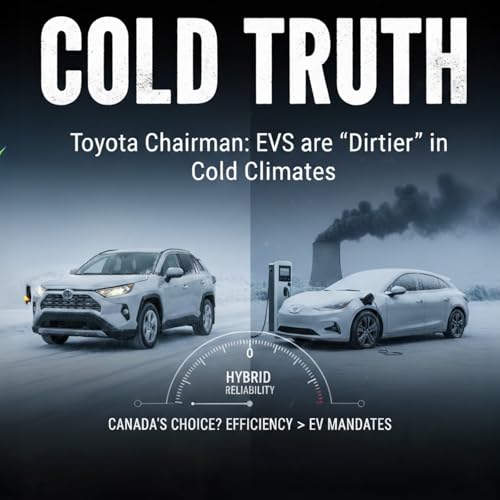
      • The 1-6-90 Rule: Toyota chairman Akio Toyoda explains that the raw materials required for one long-range EV battery could instead be used to produce six plug-in hybrids (PHEVs) or 90 traditional hybrids [01:53].
      • Emission Reduction at Scale: The video argues that replacing 90 gas-powered cars with 90 hybrids is 37 times more effective at reducing overall carbon emissions than replacing a single gas car with one full EV [03:14].
      • The "Carbon Debt": Manufacturing large EV batteries is energy-intensive, meaning an EV starts its life with a higher carbon footprint than a gas car. This "debt" must be paid off through driving, which takes much longer if the local power grid is not clean [06:50].
      • Geographical Impact:
        • "Clean Zones": In places like Quebec or BC, where the grid is hydro-powered, EVs are the greenest choice [06:06].
        • "Dirty Zones": In regions relying on natural gas or coal (like the Canadian Prairies), a hybrid may be more environmentally friendly over its lifecycle than an EV [06:29].
      • The Physics of Winter: Cold weather reduces EV battery efficiency by up to 50%. While gas engines provide "free" cabin heat as a byproduct of combustion, EVs must drain their batteries to run heaters, making them even "thirstier" for electricity in winter [08:25].
      • The Long Game: Toyota is focusing on hybrids while waiting for solid-state battery technology (targeted for 2027-2028), which promises to be lighter, faster-charging, and more resilient in the cold [11:11].
      • Environmental Theater: The video concludes by questioning whether rushing into full EVs everywhere is a real solution or "environmental theater," suggesting that "unsexy" solutions like hybrids may actually be more revolutionary due to their scalability [13:22].
      Afficher plus Afficher moins
      15 min
    Aucun commentaire pour le moment