Épisodes

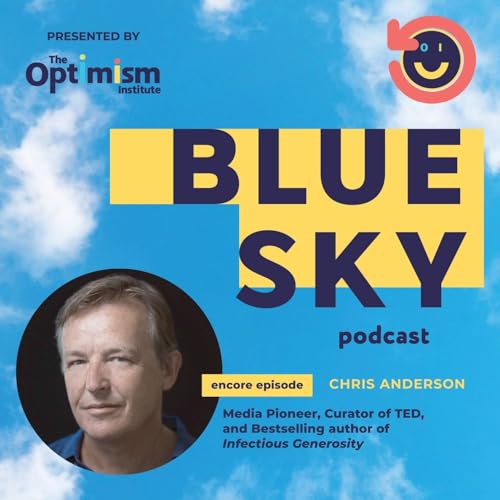
  • ENCORE PRESENTATION: TED Leader Chris Anderson on His New Book, Infectious Generosity, and Why He Believes That Now Is the Time for Us All to "Reclaim the Internet" for Good
    Jan 14 2026
    Chris Anderson was inspired by the growth of TED once they expanded from being simply a conference company to adding the concept of offering their talks free to the world over the internet. He's now calling on us all to "reclaim the internet" and use it as a force for spreading less hate and division and more kindness and generosity. His new book, Infectious Generosity, lays out clearly the reasons why generosity is good for the world — as well as for us as individuals — then details a plan by which this movement can spread virally. Chris's views on these subjects are aligned perfectly with the work of The Optimism institute and he shares them with great enthusiasm in this uplifting and inspiring episode of Blue Sky. Chapters: 00:00 Welcome Chris Anderson to Blue Sky Bill Burke welcomes Chris Anderson, head of TED, to the Blue Sky Podcast. Chris discusses his new book, "Infectious Generosity," and his mission to use the internet as a force for good, combating online division. 02:14 TED's Impact and TEDx's Success Chris shares how TED made its videos freely available online, which surprisingly enhanced the conference rather than hurting it. He explains the success of TEDx, a free licensing model that enabled 65,000 volunteers to create events globally, generating billions of views. 06:00 The Internet's Downfall and Human Nature Chris discusses how the internet, especially social media, went astray, preying on our 'lizard brains' and promoting outrage. 11:47 Generosity and Happiness Chris explains the deep connection between generosity and happiness, citing a Chinese proverb that highlights helping others as a path to lifelong joy. He emphasizes that while the internet can be negative, it also offers a powerful tool for spreading positive change. 15:57 Reclaiming the Internet: Tactics Chris discusses tactics for reclaiming the internet, focusing on making 'good stuff' go viral by evoking authentic human emotion. He uses the example of 'The Kindness Pandemic' Facebook group and highlights the need for creativity and courage to break through online negativity. 21:09 Our Role in Shaping Social Media Chris emphasizes that users are not helpless in shaping their social media experience, stressing the importance of conscious choices in who to follow and what content to engage with. 27:47 The Uniqueness of Our Time and Generosity Strategy Chris highlights the unique historical moment that allows for widespread generosity due to frictionless digital sharing and its reputation-building power. 33:06 Embracing Imperfect Generosity and Gratitude Chris encourages letting go of the idea of 'perfect generosity,' urging celebration of all motivations behind giving, even those with mixed intentions. 39:25 Podcast Recommendation and Host Reflections Bill Burke recommends 'Two Lives,' a character-driven narrative podcast about overcoming darkness, which has received several awards. 42:21 Neuroplasticity, Optimism, and AI for Good Chris discusses neuroplasticity and how our narratives shape us, emphasizing that kindness, like a muscle, grows with exercise. He introduces the Infectious Generosity Guru (TIG), an AI tool designed to help individuals brainstorm ways to spread generosity online. 49:15 A Vision for a Better Future Chris outlines his continued work with TED, focusing on the Audacious Project to collaboratively fund large-scale change initiatives. He emphasizes that optimism is a stance—a determined effort to find and illuminate pathways to a better future, urging collective action to reclaim the internet and inspire change.
    Afficher plus Afficher moins
    54 min
  • ENCORE PRESENTATION: NYT Bestselling Author Matt Ridley on His Motivation to Write The Rational Optimist and Why He Believes That Human Prosperity Will Inevitably Continue to Increase
    Jan 7 2026
    Matt Ridley's seminal book, The Rational Optimist, has inspired many since its publication in 2010 and greatly influenced the creation of The Optimism Institute. In this far-ranging discussion, Matt will describe an early education that he said was steeped in pessimism but how later in life he found that much of what he'd been taught was simply not true. This led him to set on a nearly evangelical quest to spread the word that interaction and trade between people and nations, including the free exchange of ideas, will continue to set us on an inexorable path towards increasing prosperity. Chapters: 00:00 Introducing Matt Ridley Bill Burke introduces Matt Ridley, acclaimed author of "The Rational Optimist" and other influential books. He highlights Ridley's extensive background, including his service in the House of Lords and his work on various scientific committees. 02:39 From Pessimism to Rational Optimism Matt Ridley shares his personal journey from a pessimistic upbringing in the 1970s to becoming a 'rational optimist' based on evidence. He recounts how his research for 'The Rational Optimist' revealed that many assumed negative trends, like decreasing happiness with wealth, were actually false. 06:01 The Genesis of "The Rational Optimist" Ridley explains his evangelical motivation for writing 'The Rational Optimist,' aiming to counter pervasive doom and gloom, especially among young people. He also sought to explore the evolutionary roots of human prosperity and growth, driven by an innate curiosity about why the world was improving. 07:28 Ideas Have Sex: Cooperation and Trade Matt Ridley delves into his concept of "ideas having sex," explaining how human cooperation, trade, and the exchange of specialized skills drive prosperity. He posits that this fundamental human tendency to swap goods and ideas is as crucial to cultural evolution as sex is to natural evolution. 13:50 Social Media's Impact: Polarization and Progress Ridley reflects on social media's impact on his 'ideas having sex' theory, acknowledging its initial promise for communication but also its role in political polarization. 19:29 Panglossian vs. Rational Optimism Ridley distinguishes his rational optimism from Panglossian optimism, emphasizing that he believes the world can and should be improved, not that it's already perfect. He counters common pessimistic arguments by pointing to long-term improvements in living standards and the gradual nature of good news compared to sudden bad news. 23:56 Trust and the Pencil's Lesson Matt Ridley discusses the importance of interpersonal trust for societal prosperity, contrasting it with institutional trust. He also elaborates on the 'I, Pencil' essay, illustrating how millions of specialized individuals unknowingly collaborate to produce even a simple item like a pencil. 33:15 Gratitude, Specialization, and Daily Miracles Ridley encourages gratitude for the vast network of people who contribute to our daily lives, using the example of a simple meal. 36:50 Climate Change: A Problem to Be Solved Matt Ridley shares his nuanced perspective on climate change, acknowledging it as a real threat but cautioning against panic and exaggeration. He suggests viewing it as a problem solvable through human ingenuity, while also highlighting the overlooked environmental benefits of CO2 and the harm caused by some climate prevention measures. 42:51 The Future of Innovation: Worries and Hopes Ridley discusses the limitless nature of knowledge and innovation, emphasizing communication over population size for progress.
    Afficher plus Afficher moins
    50 min
  • Amy King's Innovative and Optimistic Approach to Solving Homelessness in America
    Dec 31 2025
    Amy King watched the devastating aftermath of Hurricane Katrina and seeing people sheltered in a leaking football stadium inspired her to work with her husband on shelter solutions. The result was Pallet, a company that makes safe, secure, and easily assembled temporary shelters. In this episode she shares her inspiring story and details about her remarkable company. Chapters: 00:00 Introduction to Amy King and Pallet This chapter introduces Amy King, founder and CEO of Pallet, a public benefit corporation addressing homelessness. 02:07 From Child Psychology to Social Enterprise Amy King shares her journey from studying child psychology, where she observed the impact of troubled homes, to founding Pallet. Her interest in people and the influence of early experiences shaped her path toward addressing societal challenges like homelessness. 04:37 The Genesis of Pallet: From Katrina to Construction Amy discusses how her husband's construction company accidentally led them to employ individuals from the justice system, many of whom had experienced homelessness. 07:19 Public Benefit Corporation Model Amy explains why Pallet operates as a public benefit corporation rather than a nonprofit, emphasizing its dual mission of workforce development and providing shelter. 11:13 Pallet Shelters and Deployment Strategy Amy describes the innovative design of Pallet shelters—lightweight, panelized, and quick to assemble, with features like heat, AC, and easy cleaning. She details Pallet's partnership with cities and Zillow to identify and utilize vacant public land for shelter villages, which are temporary and designed for easy relocation. 15:35 The Transformative Impact of Pallet Shelters Amy elaborates on how Pallet shelters provide more than just a roof, offering a managed care environment with wraparound services for mental health, substance use, and housing placement. This stability allows individuals to engage with services and break the cycle of homelessness, as exemplified by a tenant named Matthew. 20:29 Hope for Ending Homelessness & Political Challenges Amy discusses Pallet's broad reach across the US and Canada and her controversial but hopeful view on ending homelessness. She addresses the political complexities and the need for sufficient services and innovation to address root causes, moving towards 'functional zero' homelessness. 25:57 Disaster Relief and Versatile Solutions Amy highlights Pallet's role in disaster relief, noting the political challenges of working with organizations like FEMA and the need for non-congregate shelter solutions. She explains the versatility of Pallet's product, which can be repurposed for both disaster response and homelessness, providing flexibility for communities. 31:10 Economic Viability and Community Recovery Amy discusses the economic benefits of using Pallet shelters for disaster relief, contrasting them with expensive hotel stays and emphasizing the importance of keeping residents near their communities for recovery. This approach helps maintain local economic bases and encourages volunteer participation by providing convenient housing for relief workers. 34:19 Transformative Impact on Individuals and Families Amy shares her favorite part of the work: witnessing the profound transformation of individuals who gain employment and stability through Pallet. She emphasizes how this not only changes the lives of the employees, many of whom were formerly incarcerated or homeless, but also reunites and positively impacts their families, especially their children. 38:46 Getting Involved with Pallet Amy encourages listeners to get involved with Pallet by reaching out through their website or email to support their mission. She emphasizes the value of local constituent engagement in driving political conversations and understanding community stakeholders to expand their impact.
    Afficher plus Afficher moins
    42 min
  • Empathy Expert Mimi Nicklin Explains Why and How She's Optimistically Attacking the World's Empathy Deficit
    Dec 17 2025
    Mimi Nicklin left a successful career as a marketing executive to take on the task of educating the world on the value and power of empathy. In this episode, Mimi describes the alarming "empathy deficit," its root causes, and practical strategies like self-empathy and "ALUR" (Authenticity, Listening, Understanding, Recognition) that she espouses to reconnect our workplaces and world. Chapters: 00:00 Mimi Nicklin's Global Journey Mimi Nicklin, a British native, has spent nearly two decades living and working across Asia Pacific and the Middle East, finding her passion and purpose in this part of the world. Her extensive international travel and diverse cultural experiences have significantly shaped her perspective on human connection and understanding, laying the groundwork for her specialization in empathy. 04:19 The Empathy Lightbulb Moment Mimi's journey into empathy began when a business coach questioned if her leadership style was intuition or empathy, sparking a personal revelation. This led her to discover the 'empathy deficit,' a significant societal issue that no one seemed to be addressing in 2019, prompting her to dedicate her work to this crucial topic. 08:56 Causes of Empathy Deficit Empathy has declined by 48% in the last 30 years, a critical issue for human survival, not just thriving. Mimi identifies urbanization, digitization, and overwhelming stress and anxiety as the primary root causes of this global empathy deficit, which impacts our ability to access empathetic parts of the brain. 12:32 Connectivity Paradox and Fear Despite increased physical proximity in cities and the promise of social media, people feel more disconnected and lonely than ever, a paradox Mimi attributes to a fundamental lack of understanding. This disconnection is largely driven by subconscious fear, exacerbated by the constant influx of overwhelming information from 24/7 news, leading people to retreat into their 'tribes' for safety. 17:13 The Power of Self-Empathy Mimi introduces 'self-empathy' as a crucial, yet untrending, skill for understanding oneself and managing overwhelming external information. She shares a personal example of choosing not to watch the news to protect her mental well-being, emphasizing that this ability to understand personal limits is vital in a world largely beyond individual control. 22:10 Balancing Humanism and Capitalism Mimi argues that balancing humanism and capitalism is not difficult but underutilized, emphasizing that growth and profit can and should go hand-in-hand with human well-being. She highlights that organizations with engaged and empathetic cultures achieve higher profits, engagement, and innovation, underscoring that humanism is a driver of business success, not an impediment. 25:37 The Art of Listening-Led Leadership Mimi stresses the critical importance of active, intentional listening in leadership, noting that many leaders are unaware of their own listening deficiencies. True listening, she explains, involves decoding information to understand, rather than merely hearing or preparing a reply, and is fundamental for empathy, innovation, and collaboration within teams. 32:06 Patience, Presence, and Pace Mimi highlights patience and presence as essential pillars for authentic listening and achieving long-term goals, contrasting them with the modern rush for instant gratification. 34:48 ALUR: Authenticity, Listening, Understanding, Recognition Mimi introduces her ALUR framework for leadership: Authenticity, Listening, Understanding, and Recognition, emphasizing that authenticity, rooted in patience and presence, is paramount for genuine connection. \ 41:39 The Empathy Empire's Impact Mimi emphasizes the significant financial and human costs of not listening and disengagement, noting that many employees resign due to poor relationships with their bosses. She describes her 'Empathy Empire' through keynote speaking, writing books like 'The Connection Prescription,' masterclasses, and media work, all aimed at fostering global empathy and balancing humanism with technology.
    Afficher plus Afficher moins
    48 min
  • Technology Management Expert Paul Leonardi on Why Technology Exhausts Us and What We Can Do About It
    Dec 10 2025
    Paul Leonardi is an expert in technology management and has developed a deep understanding for why today's digital tools—even those that are helpful—can contribute to our growing sense of exhaustion. Pulling from research he's written about in his book Digital Exhaustion, he explains why this happens and as importantly, what we can do about it. Chapters: 02:00 Why Digital Exhaustion? Paul Leonardi discusses his 20-year career helping companies implement new technologies and his observation of the increasing dread people feel towards new tools. He highlights how the solutions to digital overload are not working, leading to widespread exhaustion. 04:36 The Types of Digital Switching Paul explains three kinds of digital switching: between modalities (apps), domains of work, and arenas (work/home). He emphasizes that these switches, though seemingly innocuous, cause significant cognitive strain and mental exhaustion due to the brain's reorientation time. 07:20 Cumulative Exhaustion and Control Paul explains that digital exhaustion is a cumulative problem, building slowly over time from seemingly small attention switches. 11:29 Expectations and Response Patterns Paul discusses how people tend to overestimate the urgency of messages and fall into a 'hero symptom' of quick responses, leading to a vicious cycle. He explains how this creates an exhausting game of chase, where individuals try to outdo each other in fast replies. 14:35 Strategies for Managing Expectations Paul suggests asking for clarity on urgency and adopting a philosophy of 'waiting' (one hour, one day, one week) to reset response patterns. He also highlights the effectiveness of out-of-office messages and direct communication in setting realistic expectations and reducing perceived urgency. 20:59 Measuring Digital Exhaustion Paul describes his 'Digital Exhaustion' rating, inspired by the Maslach Burnout Inventory, which measures how much digital tools wear people out. He reveals a precipitous rise in digital exhaustion rates from 2002 to 2022, with major spikes in 2010 (smartphones/social media) and 2021 (pandemic). 26:10 Unforced Errors and Self-Views Paul discusses 'unforced errors' like sleeping with phones in bed and constantly viewing oneself during video calls, which contribute to exhaustion. He explains how the 'self-view' on video platforms is a metaphor for the constant self-curation and inference-making we do across all online platforms, leading to mental fatigue. 31:08 The Exhaustion of Upward Comparison Paul references a 1950s Stanford study on upward comparison and how social media amplifies this, leading to exhaustion from comparing oneself to others' curated ideal lives. He discusses how AI will further exacerbate this issue by creating unrealistic avatars for comparison. 36:07 Antidotes and Small Wins Paul suggests taking online content at face value without extrapolating deeper meanings to combat upward comparison and the stories we create. 42:45 Resonance and Pushback Paul shares that the most pleasing feedback on his book is the distinction between a sustainable approach to digital exhaustion versus unsustainable digital detoxes. The main pushback he receives is about the 'waiting' strategy, with people fearing it will make them seem impolite or ghosting.
    Afficher plus Afficher moins
    47 min
  • Guy Kawasaki Describes Working with Steve Jobs and Other Remarkable People Who've Used Optimism as a Strategic Advantage
    Dec 3 2025
    Guy Kawasaki has had an amazing life and career. After growing up in Hawaii, he went to California for college and later went on to what was then known as Apple Computer where he was a self-described "brand evangelist" during some of their highest growth and most entrepreneurial years. He describes Steve Jobs as being optimistic almost to the point of being delusional, and working for him has inspired Guy to be interested in mold-breaking people ever since, hence the name of his popular podcast, Remarkable People. He has also written 17 books on a variety of subjects, his latest being Wiser Guy, which was released earlier this year. Chapters: 00:00 Welcome to Blue Sky Bill Burke introduces Guy Kawasaki as a remarkable guest on Blue Sky, highlighting Guy's background as chief evangelist at Apple and Canva, and his extensive writing. Guy shares his preference for being a podcast guest due to less prep work, contrasting with the host's five-hour preparation time. 03:10 From Hawaii to Stanford Guy recounts his childhood in Kalihi Valley, a lower-middle-income part of Hawaii, and how a public school teacher's advice led him to a private school, then Stanford. He describes feeling immediately at home at Stanford in 1972, despite it being pre-tech, and the campus's amazing atmosphere. 06:17 Apple, Steve Jobs & the 1984 Ad Guy discusses his two stints at Apple, particularly his time in the Macintosh division under Steve Jobs from 1983 to 1987. He reveals the Macintosh team's mission to preserve democracy and freedom through computing and shares the behind-the-scenes story of the iconic 1984 Super Bowl ad, which the board initially wanted to pull. 11:49 Evangelizing Apple & Sales Skills Guy details how Apple evangelized its new operating system in the 1980s through fervor rather than just money, contrasting with the corporate image of IBM. He also shares his 'checkered past' of dropping out of medical, dental, and law school, leading him to an MBA and invaluable sales experience in the jewelry business, which he considers essential. 17:02 Steve Jobs: Visionary & Demanding Guy describes working for Steve Jobs as the most formative experience of his career, calling Jobs a visionary and passionate, albeit demanding and intimidating, leader. He emphasizes that Jobs was a 'mission-driven egoist' who cared only about making the best computer, disregarding personal biases like race or gender. 23:01 Remarkable People Podcast Origins Guy explains his decision to start the 'Remarkable People' podcast, initially inspired by the lucrative ad model of another podcaster, and his realization that his access to remarkable individuals and business experience uniquely positioned him. He highlights the strategic advantage of having prominent guests like Jane Goodall to attract others. 30:08 Jane Goodall: A Source of Hope Guy recounts his personal connection to Jane Goodall, stemming from a TEDx interview, and how she became his first podcast guest. He describes her as the most remarkable person he's interviewed, embodying hope and tireless dedication to her cause, even declining a rest offer at 90 due to 'too much to do.' 36:30 Optimism as a Strategic Advantage Guy discusses optimism as a strategic advantage, asserting that it's crucial for achieving anything significant, combining realism with the belief that challenges can be overcome. He shares his experiences of taking up ice hockey at 44 and surfing at 60, attributing it to a 'growth mindset' and the belief that one is never too old to learn new things.
    Afficher plus Afficher moins
    45 min
  • Could Venture Capital Invest in World Peace? Guest Brian Abrams Has Set Out to Do Just That
    Nov 26 2025
    We all know that huge sums of money are invested in creating new, more effective weapons of war. Brian Abrams sees an opportunity to invest instead in what he calls "peace tech," emerging businesses using technologies and creative methods designed to prevent war from happening in the first place. He's created a new firm, B Ventures, and in this Blue Sky episode he describes with infectious optimism his exciting vision for the future. Chapters: 00:00 Introduction to Brian Abrams Bill Burke introduces Brian Abrams, founder of B Ventures Group, an investment fund focused on global peacebuilding and conflict resolution through "peace tech." Brian's extensive background in managing over $1 billion in assets and his human-centric investment philosophy are highlighted. 02:09 From Founder to Venture Capitalist Brian shares his career journey, starting as an entrepreneur in India where he experienced failure, which led him to realize his strength in spotting opportunities rather than operationalizing them. He then transitioned to venture capital in Israel, building a fund from $2 million to over $1.2 billion, emphasizing the role of luck and a pivotal moment in fostering peace initiatives. 08:28 The Genesis of Peace Tech Brian reflects on his past experiences, including a startup's condition to include Palestinian teammates during an acquisition, which planted the seed for his current work. He explains his philosophy of using money to serve people and approaching problems from a bottom-up perspective, leading him to focus on peace tech as an alternative to military tech. 10:17 The Rationale for Peace Tech Drawing inspiration from Thich Nhat Hanh's philosophy of 'interbeing,' Brian articulates why war is illogical and a form of collective self-harm. He emphasizes the enormous economic cost of violent conflict, totaling $19 trillion annually, and how venture capital's bottom-up, experimental approach can offer innovative solutions for peacebuilding. 15:28 AI in Crisis Simulation Brian describes an investment in a startup founded by a Harvard researcher who developed an AI-powered crisis simulation platform. This technology aims to anticipate and prevent future conflicts, like potential World War III over Taiwan, by running thousands of scenarios daily, far exceeding traditional war games. 21:32 Business Model for Peace Tech Brian explains the twofold business model for peace tech startups: selling to friendly governments and to companies for competitive landscape analysis. He emphasizes that a for-profit model ensures scalability and continuous funding, unlike grants, allowing for exponential growth and a virtuous cycle to prevent major conflicts. 29:23 Peace Tech: Agile and Ethical Brian highlights the agility of venture-backed peace tech companies compared to traditional government or academic initiatives, citing an example of a startup rapidly forming after the dismantling of the US Institute of Peace. He defines peace tech as anything that preempts, mitigates, or resolves violent conflict, adhering to a 'first do no harm' principle. 34:26 Peace Tech Investments and Ecosystem Brian discusses additional investments, including a company creating digital twins of societies to understand and model civil conflicts like those between Armenia and Azerbaijan. He describes the growing Peace Tech ecosystem, drawing parallels to the private space industry's exponential growth, and aims to build a global community of founders and investors. 41:12 Conclusion and Call to Action Bill Burke reflects on how technology's ability to show the grim reality of war might increase the fervent desire for peace. Brian encourages listeners to connect via LinkedIn and join the Peace Tech community, expressing his strong optimism for the future impact of this movement.
    Afficher plus Afficher moins
    47 min
  • Scott Nash Reflects on His Remarkable Career Marked by Curiosity, Experimentation, and Optimism
    Nov 19 2025
    Blue Sky host Bill Burke first met Scott Nash nearly 30 years ago, when both were working in the cable television business. In the years since, Scott has gone on to a successful career in publishing, both as an illustrator and an author, and with his wife Nancy co-founded Illustration Institute on a small island in Maine. In this episode, Scott describes his outgoing, experimental, and optimistic nature and how these traits have led to his remarkable success in publishing, art direction, and non-profit entrepreneurship. Chapters: 00:00 Introduction & Early Childhood Scott shares that he moved nine times before second grade, which taught him to make new friends and thrive on connection, fueling his optimism and artistic development. 03:47 Education and Early Career Scott Nash discusses his education at the Swain School of Design and Cranbrook, an experimental school that shaped his playful approach to design. 09:05 Early Days of Cable TV Scott highlights how their 'handmade' approach to branding for networks like Nickelodeon, which included assigning the color orange and constantly changing logos, stood out in an industry that traditional executives weren't taking seriously. 14:20 The Flat Stanley Phenomenon Scott Nash discusses his work illustrating Flat Stanley, a book that became a widespread educational phenomenon due to teachers encouraging kids to create and mail their own Flat Stanley figures. 19:16 Illustrating vs. Writing Own Books Scott Nash reflects on the differences and joys of illustrating books for other authors, like Flat Stanley, versus writing and illustrating his own works, such as The High Skies Adventures of Blue Jay the Pirate. 23:05 Defining Illustration & Illustration Institute's Founding Scott Nash defines illustration as 'visual art that enhances a specific narrative,' encompassing comics, graphic novels, and even narrative pottery. He explains how his passion for academia and 'rogue schools' led him to establish the illustration department at Maine College of Art and, later, co-found the Illustration Institute. 31:19 Highlighting Illustrators & Their Impact Scott Nash shares his love for classic children's book illustrators like Garth Williams, known for Stuart Little and Homer Price, and Robert McCloskey, famous for Make Way for Ducklings. He recounts the emotional and intellectual impact of Illustration Institute's exhibitions, which showcase original works and highlight the often-uncredited illustrators behind beloved stories. 34:27 AI's Impact on Creativity and Authenticity Scott Nash discusses the cyclical nature of creative trends, noting a shift from highly creative, handmade works in the early days of cable to a more corporate, homogenized phase. He expresses critical optimism about AI, hoping it will spur a countertrend towards more authentic, handmade creations. 39:59 Ethical Concerns and Public Voice in AI Scott Nash expresses concern about the business-driven rush to implement AI without a clear ethical framework, fearing it could lead to low-quality content and potential harm if not properly regulated. 42:45 Future of Illustration Institute & Closing Scott Nash details the Illustration Institute's future plans, including developing traveling exhibitions for libraries across the country, such as 'The Great State of Illustration in Maine' and the ambitious 'Illustrious Saurus,' which explores dinosaur depictions from paleontology to fantasy. He emphasizes the institute's mission to highlight illustration's critical rigor and broad appeal, connecting Maine's artistic reach with global themes and sharing his childlike enthusiasm for storytelling.
    Afficher plus Afficher moins
    50 min