Couverture de Beyond the Blueprint - Better Healthtech By Design

Beyond the Blueprint - Better Healthtech By Design

Beyond the Blueprint - Better Healthtech By Design

De : Beyond the Blueprint - Health Series
Écouter gratuitement

À propos de ce contenu audio

Redefining Healthcare Through Design Thinking Dialogues with clinicians & HIT professionals, clinical leadership, and industry innovators on integrating healthcare design into technology deployments to tackle complexity, drive innovation, improve patient care, & foment transformative change.2025 Hygiène et vie saine Maladie et pathologies physiques Science
Les membres Amazon Prime bénéficient automatiquement de 2 livres audio offerts chez Audible.

Vous êtes membre Amazon Prime ?

Bénéficiez automatiquement de 2 livres audio offerts.
Bonne écoute !
    Épisodes
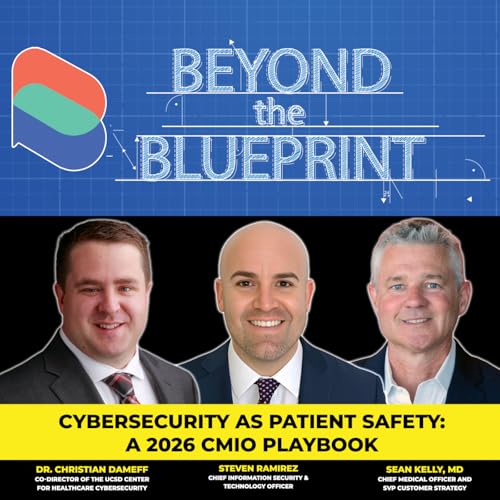
    • EP43 - Cybersecurity as Patient Safety: A 2026 CMIO Playbook - Dr. Christian Dameff, Steven Ramirez, Dr. Sean Kelly
      Jan 19 2026
      In this episode we're joined by Dr. Sean Kelly (Imprivata), Dr. Christian Dameff (UC San Diego Health), and Steven Ramirez (Renown Health) to explore a critical yet often misunderstood frontier: the intersection of cybersecurity and patient safety. Together, we unpack how clinical leaders can prepare for digital outages, ransomware attacks, and the escalating threat landscape—not as isolated IT events, but as high-stakes clinical disruptions. From real-time decision-making to cultural readiness, this conversation is a practical playbook for CMIOs navigating care delivery in an age where system failures can mean delayed diagnoses, canceled surgeries, and compromised outcomes. Whether you lead tech, safety, or care teams, this episode offers a bold call to reframe cybersecurity as a core component of clinical resilience—and why every hospital needs a downtime plan that actually works. Key Takeaways Cybersecurity is clinical safety. Outages impact real patients—diverting ambulances, delaying chemo, and compromising care at the bedside.Generic downtime plans don't cut it. Too often, they're dusty binders with vague bullet points. Real preparedness requires clinical playbooks tailored to workflows, not just systems.Clinician training must go beyond checkbox compliance. Studies show most phishing training has minimal impact. Real-time, workflow-based education is more effective.Paper downtime isn't intuitive anymore. Many clinicians—especially newer ones—have never documented without digital tools. Drill-based preparedness is critical.Security and speed can coexist. With adaptive tools, it's possible to embed safeguards that protect systems without blocking care delivery.Every department responds differently to cyber events. Cross-functional coordination—especially between IT and clinical ops—is key for effective triage and recovery.Identity is the new perimeter. Over 80% of cyber events stem from compromised credentials. Guardrails and behavior-based analytics are essential.We need to measure what works. Cyber tools should be held to the same evidence-based standards as clinical interventions.CMIOs must bridge the gap. As translators between the boardroom, command center, and bedside, they're uniquely positioned to lead a new model of digital resilience. Episode Highlights 00:00 | Cybersecurity Is Now a Clinical Crisis 01:53 | Welcome to Beyond the Blueprint 02:30 | Why Cyber Threats Are Patient Safety Threats 03:09 | Meet the Panel: Imprivata, UCSD, and Renown Health 04:00 | From IT Problem to Bedside Risk 05:20 | Building Cyber Resilience into Daily Workflow 07:00 | Downtime Plans: Why Most Are Useless 09:30 | Clinical Ransomware Playbooks: A New Standard 11:16 | Preventative Cyber Hygiene and Workflow Mapping 13:10 | Supporting ICU, Dialysis, and Cancer Care During Outages 14:43 | Chain of Command in the First 5 Minutes of a Breach 16:00 | Frontline Leadership: Silos or Shared Command? 17:10 | Why Mid-Acuity Patients Are the Hidden Risk 18:00 | Friction vs. Safety: Rethinking MFA and Access 20:00 | Cross-Functional Models for Risk Escalation 22:00 | Eliminating Email to Reduce Phishing Risk 23:15 | Biometric Access, Passkeys & Adaptive Controls 24:00 | Why You Must Drill Downtime Workflows 26:00 | When to Trigger Paper-Based Systems 27:30 | Cultural Inertia vs. Clinical Necessity 28:45 | Scaling Resilience Across Diverse Hospitals 29:15 | AI Guardrails and Workflow Protections 30:22 | CMIO Challenge Question: Is Training Worth It? 31:55 | Rethinking Evidence in Cyber Tools 33:00 | Training Doesn't Work—But This Might 35:00 | Four Steps to Take in the Next 30 Days 36:15 | Final Takeaway: Don't Be the Dept. of No 38:00 | Closing Thoughts: Cybersecurity Is Patient Care Guests: Dr. Sean Kelly, Dr. Christian Dameff, Steven Ramirez Host: Gregg Malkary - Spyglass Consulting Group Cohost: Keith Washington - Companions in Courage Foundation Sponsored by: Simplifi Medical Audio/Video: Tim Jones - Health Nuts Media Marketing: Josh Troop - Troop-Creative Learn More at: www.beyond-blueprint.com
      Afficher plus Afficher moins
      40 min
    • EP42 - Why RTLS Is Core Infrastructure in Healthcare - Todd Frantz, Ali Youssef, Paul Zieske
      Dec 29 2025
      In this episode we're joined by Todd Frantz (AdventHealth), Ali Youssef (Henry Ford Health), and Paul Zieske (Why Where Matters) to explore how next-gen real-time location systems are reshaping care delivery. Together, we dive into the evolution from dots-on-a-map asset tracking to intelligent platforms that drive staff safety, streamline workflows, and generate high-fidelity data for AI. From ED duress alerts to ambient analytics and digital wayfinding, this conversation is a roadmap for health leaders rethinking how hospitals move, sense, and respond in real time. Whether you're planning a new facility or optimizing frontline operations, this episode will change how you think about RTLS—and why it belongs at the center of your infrastructure strategy. Key Takeaways RTLS 2.0 goes beyond asset tracking—it integrates workflow, staffing, and safety data for real-time decision-making.Hospitals lose thousands of staff hours each year searching for equipment, impacting patient care and satisfaction.Successful RTLS adoption requires cultural alignment, transparency, and trust—not just technology deployment.Staff duress alerts and par level management are delivering fast wins and improving frontline safety.Enterprise-wide RTLS platforms unlock more value than siloed deployments—especially when integrated with EHRs and facility systems.High-fidelity location data is foundational for AI-driven insights, workflow automation, and digital twins.The ROI of RTLS includes reduced burnout, improved patient flow, equipment utilization, and faster care team coordination.Integration remains a challenge—vendors must support open standards and shared APIs to break down data silos.RTLS should be treated like core infrastructure—designed into new buildings, not bolted on after.Emerging tech like computer vision will extend RTLS into human activity recognition, situational awareness, and predictive care. Episode Highlights 00:00 | Why RTLS Adoption Starts with Trust, Not Tech 01:53 | Welcome to Beyond the Blueprint 02:30 | From Dots on a Map to Real-Time Intelligence 03:09 | Meet the Panel: AdventHealth, Henry Ford, and Why Where Matters 04:00 | Is RTLS Now Core Infrastructure? 05:09 | The Hidden Costs of Outdated RTLS Platforms 06:02 | Workflow Integration and the Role of Location Data in AI 07:17 | Where Hospitals Miss Safety & Workflow Red Flags 08:14 | Real-Time Context and Robotics Integration 09:00 | The Chessboard Effect: Duress Alerts as a Point of Entry 10:00 | Are Enterprise Standards Emerging Across IDNs? 11:16 | Choosing the Right Tool for the Right Workflow 12:00 | Intelligent Lighting and Digital Front Doors 13:00 | Open Epic and the Rise of Indoor Wayfinding 14:00 | Integrating RTLS into Daily Workflow: It's Cultural 15:00 | When RTLS Fails the First Time—and Why That's Normal 16:15 | The Location Team: A Hidden Implementation Advantage 17:15 | "Blame the Process, Not the People" 18:21 | Safety Stats and Clinician Buy-In for Duress Alerts 19:49 | From Staff to Patient Expectations: The Culture Shift 20:00 | Why RTLS Data Integration Is Still So Hard 21:15 | Strategic Vendor Relationships > APIs Alone 22:45 | Will Epic Open Up? A Look at Market Influence 24:00 | How AI Wrappers Could Solve Interop Gaps 25:15 | The AAA Model: Analytics, Automation, and AI 26:00 | Why You Should Never Throw Away RTLS Data 27:15 | Use Cases for Retrospective AI + Workflow Analysis 28:16 | AI Isn't the Goal—It's a Tool in Your Automation Stack 29:11 | What's Next? Computer Vision & Human Activity Recognition 30:03 | From ORs to Restrooms: Situational Awareness at Scale 31:35 | The Future of RTLS: Friction Reduction + Design Insight 33:57 | Customer Experience in Outpatient and Waiting Areas 34:55 | Final Takeaways: Safety, Trust, and Strategic Deployment Guests: Todd Frantz, Ali Youssef and Paul Zieske Host: Gregg Malkary - Spyglass Consulting Group Cohost: Keith Washington - Companions in Courage Foundation Sponsored by: Simplifi Medical Audio/Video: Tim Jones - Health Nuts Media Marketing: Josh Troop - Troop-Creative Learn More at: www.beyond-blueprint.com
      Afficher plus Afficher moins
      36 min
    • EP41 - From Mannequins to Metaverse: The Future of Nursing Simulation - Dr. William Scott Erdley (
      Dec 13 2025
      What if the future of nurse training didn't just include mannequins—but holograms, AI conversations, and full-on metaverse environments? In this episode of Beyond the Blueprint, we're joined by Dr. William Scott Erdley, a retired simulation pioneer and former Director of Simulation & Clinical Skills Labs. With decades of experience in nursing education, Dr. Erdley unpacks the evolution of clinical simulation—from standardized patients and mannequin drills to immersive technologies like VR, AI, and even wetware. Together, we explore how simulation builds confidence, strengthens care team collaboration, and prepares clinicians for rare, high-stakes scenarios. And we take a bold look at what's next: from smarter simulators to holographic mentors. Whether you're leading a health system or reimagining nursing education, this episode is a front-row seat to the future of clinical readiness. Key Takeaways Simulation offers high-fidelity, repeatable practice that boosts confidence and reduces clinical error. Nursing simulation now extends far beyond mannequins—into VR, AI-powered patients, and virtual tele-simulations. Standardized patients and realistic role-playing help build empathy, communication, and interprofessional collaboration. OB, neonatal, and code-team scenarios benefit especially from regular simulation refreshers. ROI is seen in fewer adverse events, reduced turnover, improved morale, and onboarding efficiency. Emerging tools like AI and VR are making simulations more accessible and scalable. Simulation is not just about tech—it's about mindset, pedagogy, and patient-centered design. Debriefing is where the deepest learning happens—focus on reflection and resilience, not performance. Academic-medical partnerships can expand access without massive capital investments. The future of simulation is immersive, intelligent, and increasingly personalized. Episode Highlights 00:00 | What Exactly Is Clinical Simulation? 00:29 | Real-World Save: Simulation Training Takes Flight 01:22 | Meet Dr. Scott Erdley: From Logic Tests to Leading Simulation Labs 03:23 | Simulation as Clinical Experience: The Early Days 05:29 | Skills, Communication, and Confidence: Why Sim Matters 06:26 | Learning to Call the Doctor at 2AM 07:13 | Repeatable Scenarios: Standardizing High-Stakes Practice 08:24 | When Simulation Saves Lives—Even at 30,000 Feet 09:18 | 75% of Nursing Programs Now Use Simulation Labs 09:58 | Code Team Drills with Mannequins: Practice Under Pressure 11:16 | OB and Neonatal Use Cases—and Legal Implications 13:52 | Strategic Planning: Why Are You Investing in Sim? 14:32 | Simulation for Onboarding, Oncology, and More 15:35 | ROI: From M&M Rates to Hiring Efficiency 16:20 | Academic Partnerships as an Access Strategy 17:21 | AI and VR: Opening the Simulation Toolbox 18:19 | Conversational AI and Psych Nursing Sim Scenarios 19:26 | Standardized Patients: Humanizing the Training Process 20:45 | Merging AI with Robotics: A Future with Thinking Mannequins 24:11 | From Wetware to Brain Interfaces: A New Era in Care 25:06 | Ready Player One Meets Real-World Nursing 26:02 | Why Debriefing > Critique: Coaching Through Reflection 27:04 | Simulating Conflict: Aggressive Patients, Interdisciplinary Tension 29:18 | Prompt-Based Simulations: A Natural Language Future 30:00 | Final Advice: Simulation as Strategy—and a Whole Lot of Fun Guest: Dr. William Scott Erdley Host: Gregg Malkary - Spyglass Consulting Group Cohost: Keith Washington - Companions in Courage Foundation Sponsored by: Simplifi Medical Audio/Video: Tim Jones - Health Nuts Media Marketing: Josh Troop - Troop-Creative Learn More at: www.beyond-blueprint.com
      Afficher plus Afficher moins
      36 min
    Aucun commentaire pour le moment