

“Before Stone, Before Solomon: The Forbidden Idea That Adam Was a Mason”
Impossible d'ajouter des articles
Échec de l’élimination de la liste d'envies.
Impossible de suivre le podcast
Impossible de ne plus suivre le podcast

“Before Stone, Before Solomon: The Forbidden Idea That Adam Was a Mason”
-
Lu par :
-
De :
À propos de ce contenu audio
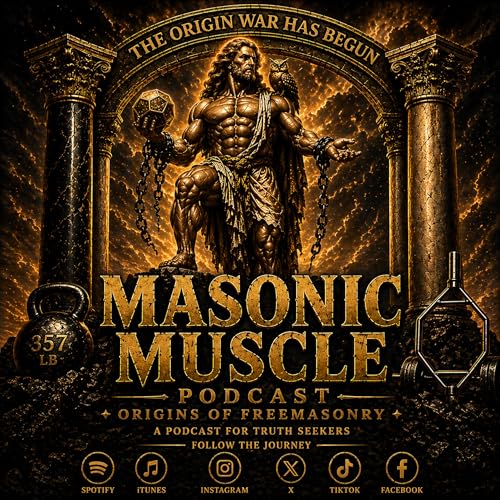
Summary: Masonic Muscle — Pagan Mystery Origins Episode
This episode of Masonic Muscle explores one of the most controversial and intellectually provocative theories about Freemasonry—the idea that its roots trace back not just to medieval stonemasons, but to the ancient pagan mystery schools of Egypt, Greece, and Rome.
The Pagan Mystery Theory suggests that Freemasonry preserves the structure and symbolism of ancient initiation systems. These mystery schools used secrecy, ritual progression, and symbolic death-and-rebirth experiences to transform initiates—elements strikingly similar to modern Masonic degrees. (Universal Co-Masonry)
This theory gained momentum in the 18th and 19th centuries, when scholars and Masons began looking beyond operative guild origins. Influential figures like Antoine Court de Gébelin, Albert Pike, and Manly P. Hall argued that Masonic symbols and teachings echoed ancient religious and philosophical traditions. Their work framed Freemasonry as a continuation of universal wisdom, rather than a purely medieval institution.
Supporters of the theory point to strong symbolic parallels:
Initiation rituals centered on transformation
Shared themes of light, darkness, and rebirth
Secret teachings revealed progressively
Some Masonic writers even argue that ancient pagan mysteries functioned similarly to modern lodges—preserving deeper truths through symbolic instruction and initiation. (Universal Co-Masonry)
However, critics push back hard.
Opponents argue there is no direct historical evidence linking ancient mystery schools to modern Freemasonry. Most historians instead trace Freemasonry to medieval stonemason guilds that evolved into philosophical societies over time. (MasonicFind)
The debate ultimately comes down to this:
Proponents: See continuity in symbolism and philosophy
Opponents: Demand documented historical lineage
The truth likely sits in the middle—Freemasonry may not descend directly from pagan mysteries, but it almost certainly drew inspiration from ancient traditions during its intellectual development.
Beyond history, the episode emphasizes a deeper message: Freemasonry is not just about where it came from—it’s about what it does to you. The rituals, symbols, and teachings are tools for transformation, regardless of their origin.
To bring that idea into the modern world, Masonic Muscle ties this philosophy to physical discipline. Just as ancient initiates underwent trials, modern Masons are encouraged to strengthen both mind and body through:
Consistent training over motivation
Mastery of foundational exercises (push-ups, squats, pull-ups)
Building mental resilience through physical effort
The takeaway is clear: whether the roots are medieval or ancient, the purpose remains the same—self-mastery.
#MasonicMuscle #Freemasonry #MasonicPodcast #AncientMysteries #EsotericKnowledge #Brotherhood #SelfMastery #MindAndBody #MasonicLife #HiddenHistory #Philosophy #Initiation #MensWork #Discipline #StrengthAndHonor