Épisodes

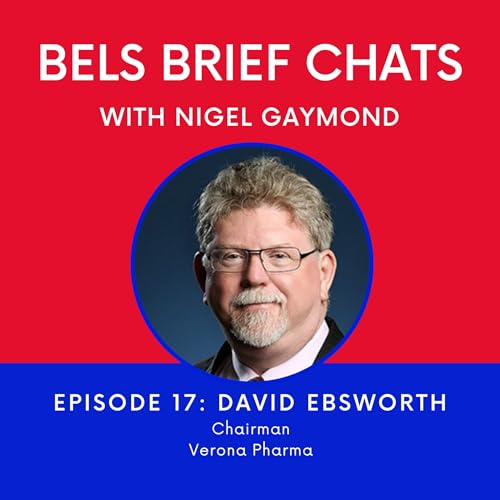
  • BELS Brief Chats Episode #17 – Dr David Ebsworth
    Jul 14 2025

    The son of a military man, David Ebsworth was educated at Duke of York’s Royal Military School, where his A levels included German and Chemistry. At the University of Surrey, he earned a double honours degree covering both subjects, and then a PhD, looking at industrial relations in the German and UK chemical industries.

    Following an interesting, successful, diverse career in pharma and biotech, David currently manages a portfolio career focused on the UK and Europe. He chairs four of the five companies with which he is involved. Two, ActiMed and Verona Pharma, are UK companies.

    Verona, a 10-year labor of love for David, took the well-trodden path to the US to raise $200 million for their Phase 3 trial of a COPD treatment now on the US market. This podcast recording predates Merck & Co’s decision in July 2025 to acquire Verona, one of the most successful biotechs in the UK, for $10 billion.

    The UK R&D tax credit scheme, unparalleled in any other country, is fantastic.

    The UK has certainly become a great venue for founding companies.

    We (the UK) probably do not celebrate our success as much as we should.

    I find the BELS Brief Clips digest incredibly useful for updating me on what is going on in the UK.

    I often forward on articles of interest from BELS to my companies.

    Afficher plus Afficher moins
    33 min
  • BELS Brief Chats #16 – Dr Karen Akinsanya.
    Jul 4 2024

    Karen Akinsanya PhD is President of R&D, Therapeutics at Schrödinger. This followed leadership positions at Merck & Co and at Ferring Pharmaceuticals.

    Raised initially in Bristol and then in the suburbs of Surrey, in this episode of BELS Brief Chats, Karen shares her roots in our sector, undoubtedly stimulated by the healthcare and scientific backgrounds of her parents, especially her father bequeathing to her at a young age his wooden microscope. She received her BSc in biochemistry from Queen Mary University of London and her PhD in endocrine physiology from the Royal Postgraduate Medical School at Imperial College London. Her professional path has been forged by her ambition and an insatiable curiosity that leads her to constantly question things. This had led her to numerous career experiences including her current leadership position at a company sitting squarely at the nexus of technology convergence.

    Karen also has first-hand experience of the extensive British-educated talent working abroad. “Almost on a weekly basis I bump into someone who has a British accent in the US or even recently in Japan! Brits get around. There has to be a way of tapping into this global UK talent”.

    Karen also has a fundamental understanding of why BELS is so important. “Partnerships and collaborations are really driven by relationships and networks”.

    Afficher plus Afficher moins
    43 min
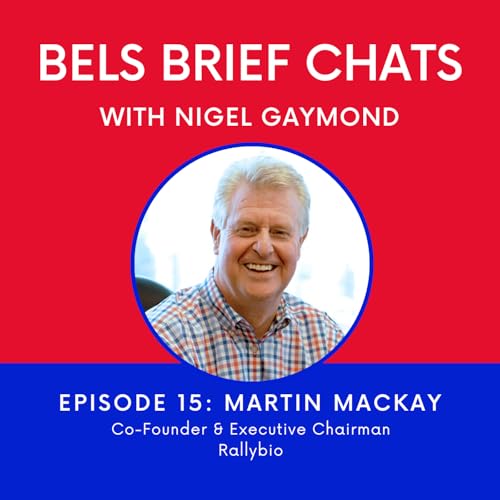
  • BELS Brief Chats Episode #15 – Dr Martin Mackay.
    Jul 4 2024

    From humble beginnings in Edinburgh, Martin Mackay PhD’s lifelong passion for football and his beloved Heart of Midlothian, allied to a total fascination with the ‘coolness’ of lab coats, were parlayed into a hugely impressive career, including major research leadership roles at industry titans such as Pfizer, AstraZeneca and Alexion. Now, “having a blast” in the world of biotech with Rallybio, he still also exerts his influence and experience on big corporates via board seats at Novo Nordisk and Charles River Labs.

    Martin points to his current experience of leading a biotech: “At Rallybio, sitting here in Connecticut, our first five deals were consecutively in Norway, Sweden, the UK, France and Canada! It points to our heritage that we are willing to look anywhere for great assets and programs.”

    When Martin considers the UK’s importance in the life science universe he asserts: “No question, the UK is a good place to do business and we will continue to go back there where it is appropriate to do so... I am confident that future UK governments will continue to be supportive towards life science institutions across the UK. It is a great place to do science and to grow.”

    Afficher plus Afficher moins
    58 min
  • BELS Brief Chats Episode #14 – Dr Gillian Cannon.
    Aug 30 2023

    Dr Gillian Cannon currently serves on multiple boards and in an executive role at Roivant as Head of Commercial Innovation. Her 30-year career has included leadership roles in major pharma including Merck & Co, UCB and Otsuka Pharma. She hails from Newcastle, received her BSc from Edinburgh University and earned her PhD in Health Administration at Temple University. While Gillian resides in Princeton, New Jersey, she generously shares her expertise, experience, perspectives, and time with organizations and individuals in the UK, e.g., serving on the boards of Edinburgh Innovation and Our Future Health*, the UK’s largest ever health research programme, bringing 5 million people together to develop new ways to prevent, detect and treat diseases. As a result, Gillian’s perspectives on the UK life science scene are well informed and au courant.

    “We are all British-educated life scientists so we have stuff in common just by being that.”

    “The better the UK is seen for its innovation and its science, the better it is for all of us. We can publicize how great the UK is, but also get involved in making it greater.”

    With BELS there is real opportunity to do something really productive to help the country and the companies we work for.”

    Afficher plus Afficher moins
    53 min
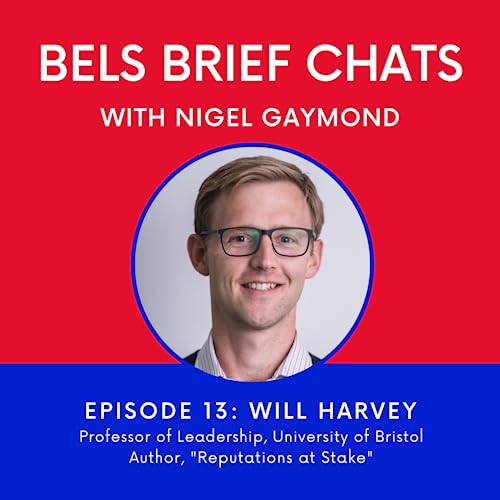
  • BELS Brief Chats #13 – Professor Will Harvey.
    Jun 25 2023

    Will Harvey, MPhil, BA, PhD—When we recorded this episode of BELS Brief Chats, Will was a Professor of Leadership at the University of Bristol School of Management. He is presently Professor of Leadership at Melbourne University and Director of the Social Purpose Centre. Will conducts research, teaches and consults in the areas of reputation, leadership, talent management and migration. He is also an International Research Fellow at the Oxford University Centre for Corporate Reputation. He has worked with pharmaceutical, healthcare, energy, mining, management consulting, executive search, local and national government, supranational, aviation and food organisations. He has studied, taught and worked with multiple organisations in Africa, Asia, Europe, North America and Oceania.

    Will’s new book, Reputations at Stake, investigates how reputation requires careful management and explains the influence of reputations—from the big picture to the minutiae. Nigel and Will have a timely discussion about the UK’s reputation globally in the face of much negative reporting on the political and economic fronts. They consider the potential power of the BELS community of British-educated life scientists working abroad to enhance the UK’s fortunes in the sector.

    “Britain has so much talent that gets sent all over the world.
    But we’re not particularly good at leveraging that talent. It is an enormous opportunity.”

    Afficher plus Afficher moins
    44 min
  • BELS Brief Chats #12 – Dr Fiona Marshall.
    Jun 2 2022

    Fiona Marshall discovered a love for science at school. She eschewed medicine for biochemistry at the University of Bath and then chose neuroscience for her PhD at Cambridge, while also accumulating industry experience. She lived through the transformation of Glaxo to GSK, shifted to biotech at Millennium where she worked with the likes of Allan Marchington (BELS Advisory Council member). After a mid-career break, she re-entered industry with Heptares and today is stationed in the US leading research at MSD/Merck & Co. A return to the UK will come in due course.

    Meanwhile, Fiona carries positive feelings about the state of UK life sciences. “The UK is one of the front runners when it comes to science and research. We saw that during pandemic; we really were leading in terms of sequencing, understanding the virus and how it evolved.” About the role BELS can play in the UK life sciences ecosystem: “It’s two ways: informing people outside the UK about the great environment in the UK… but also encouraging UK companies to think globally. Success is about making connections, and I think that’s something the BELS community can really help with.”

    Afficher plus Afficher moins
    28 min
  • BELS Brief Chats Episode #11 – Dr Gillian Leng.
    Feb 18 2022

    At the age of 10 she wanted to be a vet, at 17 a scientist, and at 21 she settled on medicine. Gillian Leng trained as a doctor at Leeds University, studied peripheral arterial disease in Edinburgh for several years, then worked as a consultant in public health in Bedfordshire. It’s no surprise that she considers joining NICE in 2001 to be her best career move, initially to set up the clinical guidelines program. Today some 400 guidelines are in place. During the COVID-19 pandemic, NICE rapidly created a suite of “living guidelines”. Now a shift toward such continuous updating is very much the direction of travel.

    Gillian succeeded Sir Andrew Dillon as only the second CEO of NICE, a process-driven organisation which strives to build trust with the public, the health system, and industry. Regarding the latter, she discusses how NICE and the MHRA are looking to engage with industry much earlier to ensure a better “lit runway”. She recently decided to retire from NICE after the untimely death last year of her husband, Paul; her initial intent is to finish his book.

    Afficher plus Afficher moins
    36 min
  • BELS Brief Chats Episode #10 – Dr Calum Macrae
    Feb 1 2022

    Born into a medical family on the Isle of Skye, Dr Calum Macrae’s path to Edinburgh University and London to study medicine and become a leading cardiologist, geneticist and developmental biologist is not a great surprise. His drive to “follow the science” took him to Boston where he trained with seminal thought leaders in human genetics and gained world-class clinical training in internal medicine and cardiology. Calum’s interests—in genomics, disease modeling, developmental biology, drug discovery and systematic approaches to discovering new phenotypes—are overarched by a fascination with the role that disruptive innovation can have in refashioning the clinical-translational interface. In late 2016, Calum and his team won the landmark One Brave Idea research award, focused on uncovering the causes of heart disease. Equally at home in the open spaces (as one would expect from a child of Skye) as he is with the attractions of living in great cities, Calum is increasingly involved with the UK and foresees spending more time there going forward.

    Afficher plus Afficher moins
    46 min