Épisodes

  • Ep. 17: Last Sunday of the Church Year – Anno Domini Podcast
    Nov 22 2020
    9 min
  • Ep. 16: Reformation Day and All Saints Day - Anno Domini Podcast
    Oct 30 2020
    Often hymns both old and new speak of going to heaven when you die as though heaven is our final home. Scripture speaks of something else though. It speaks of our life being a seed that, when planted in the ground, waits patiently for the day when it will rise again. Hello everyone and Welcome to episode #16 of the Anno Domini Podcast. A podcast dedicated to the supremacy of Christ over all things including our days, weeks, and months. Join me as we explore how Christ is revealed through the cyclical life of the church calendar year. We’ll discover how this calendar once structured culture and how it can again. We’ll also discuss practical ways to observe and celebrate these holy days in our quest to glorify God and live the good life in the midst of all good He has given us. The James Jordan article I reference: http://www.biblicalhorizons.com/open-book/no-28-concerning-halloween/ It has been over 5 months since our last episode of the Anno Domini podcast. During those 5 months, we have been observing the period of the Church calendar known as Ordinary time. We are approaching the end of this period with the coming celebration of Reformation Day and All Saints Day. On these days, we celebrate the life of the church as it has grown in maturity through its reformation as well as the lives of those saints that have gone on to glory from Abel to Zachariah and from Stephan to the present. Historical The calendar can be divided roughly into two halves. The first half, beginning at Advent, marks the life of Christ and includes celebrations such as Christmas, Epiphany, Easter, Pentecost, etc. During the first half of the church year we celebrate the life of Christ. This is a season of special days and feasts: a festal or festive time. The second half of the church year is marked by the Ordinal numbers of weeks going back to Pentecost. Ordinal numbers signify a position relative to something else. Therefore, Last Sunday, October 25th, was the 21st Sunday after Pentecost. This ordinary time is certainly not mundane or boring, or forgettable, but simply isn’t marked by any feasts. Instead, each Lord’s Day is marked with it’s ordinal position relative to Pentecost. This is important because while the first half of the Church year marks the life of Christ, the second half marks the work of the Spirit, given at Pentecost. This is the work of the Spirit as He brings about transformation through the ministry of the Church during Ordinary time. Extraordinary things can happen during Ordinary time which we will soon see. This leads us into the two holidays which mark the beginning of the end of Ordinary time; Reformation Day on October 31st and All Saints Day on November 1st. Let’s start with Reformation Day, this actually was liturgically observed last Sunday October 25th. If you attend a reformed church, it is likely they referred to it as Reformation Sunday. Often, reformed churches take the entire month of October to mark the reformation but the actual day on the calendar is this Saturday the 31st. On Reformation Day, we celebrate the glorious Protestant Reformation that is officially marked as starting on October 31st, 1517. This is the day in history, in the midst of Ordinary time, that Martin Luther nailed his 95 theses to the castle church door in (vit-en-berg) Wittenberg Germany. Within this document, Luther took an extraordinary step of faith by calling out the massive corruption within the catholic church at the time. Luther specifically took issue with the church selling indulgences. Believers were promised that buy indulgences would get their loved ones out of purgatory and into heaven. This of course is high-handed, oppressive, and shameless wickedness and Luther’s extraordinary act of courage began in earnest a protest that had been forming in the catholic church fo...
    Afficher plus Afficher moins
    47 min
  • Ep. 15: Trinity Sunday - Anno Domini Podcast
    Jun 7 2020
    The bottom line is that our allegiance is to our God and Creator and to His people. When we sin it is against Him. When we are forgiven it is because of His mercy. When we walk in freedom it is because of His grace. A double portion. This gospel is independent of any nation, tribe, or tongue. We are Christians first. Period. Nothing should come before our unity as Christians. Song: We All Believe in One True God Passage: Genesis 1-2:4, Acts 2 14a, 22-36, Matthew 28:16-20 (download lectionary here) Hello everyone and Welcome to episode #15 of the Anno Domini Podcast. A podcast dedicated to the supremacy of Christ over all things including our days, weeks, and months. Join me as we explore how Christ is revealed through the cyclical life of the church calendar year. We’ll discover how this calendar once structured culture and how it can again. We’ll also discuss practical ways to observe and celebrate these holy days in our quest to glorify God and live the good life in the midst of all good He has given us. Last week I said that Pentecost might be the most important day we mark on the Church Calendar. My reasoning is that only with the coming of the Holy Spirit, are those of us who belong to Christ are actually given new hearts. Jesus said that we would be born again by the Spirit. The Father sends the Son. The Son atones for the sins of His people, and the Spirit gives them new hearts so that they can approach the holiness of the Father. It is this beautiful trinitarian reality that we celebrate on Holy Trinity Sunday. Father, Son, and Holy Ghost, living in perfect harmony, three in one and one in three. The triune God head. Practical Trinity Sunday is here. We are now beginning a new time within the Church Calendar; Ordinary Time. While the first half of the Church year focuses on the Life of Jesus, the second half focuses on the life of the Church now that the Spirit has come and filled our hearts with love of God and love of His people. This is where we get our idea of things being ordinary and special. The first half is special because it is all about the life of Christ, the second half is ordinary, or numbered, because we, the saints that comprised His bride, the Church, are being transformed into a better representation of Him. Ordinary isn’t boring, in fact, without ordinary you don’t have special. Things are only special if they are set against ordinary things. We are now living in the time of Pentecost and therefore we number our weeks as they correspond to the Pentecost Sunday when the Spirit was given to us. In this way we balance our focus on the life of Christ and the life of Christ’s people as they try and become more like Him. Biblical Each episode of the Anno Domini podcast, we try and look at some or all of the readings found in the church lectionary. For those of you who are new, the lectionary is simply a prepared set of readings that are connected in a germane way to the day or week of the Church Calendar. This is a set group of readings that ALL the church is reading together regardless personal devotions. Usually there is an Old Testament Reading, A Psalm, a Gospel passage, and an Epistle reading. These passages usually share commonalities although sometimes you have to work to spot them. For Trinity Sunday the passages are from Genesis 1-2:4, Matthew 28:16-20 and Acts 2:14a, 22-36. I will actually be reading snippets of each of these passages to highlight why they were chosen for Trinity Sunday. Let’s start with the passage from Genesis. Genesis 1:26-28 Then God said, “Let us make man in our image, after our likeness. And let them have dominion over the fish of the sea and over the birds of the heavens and over the livestock and over all the earth and over every creeping thing that cr...
    Afficher plus Afficher moins
    32 min
  • Ep. 14: Pentecost - Anno Domini Podcast
    May 29 2020
    On Pentecost we celebrate an unraveling of the curse of Babel, tongue’s in Christ are now united in love and truth instead of divided and confused. On this day we celebrate that when the Spirit comes, people are changed, lives are renewed, and the Gospel marches on in victory. Song: Come Down O Love Divine Passage: Numbers 11:24-30, Acts 2 1-21, John 7:37-39 Hello everyone and Welcome to episode #14 of the Anno Domini Podcast. A podcast dedicated to the supremacy of Christ over all things including our days, weeks, and months. Join me as we explore how Christ is revealed through the cyclical life of the church calendar year. We’ll discover how this calendar once structured culture and how it can again. We’ll also discuss practical ways to observe and celebrate these holy days in our quest to glorify God and live the good life in the midst of all good He has given us. Pentecost has come! Christ is Risen, is Ascended and is Reigning, and now in the kindness of God the Spirit has been poured out onto all believers. Just as at the beginning of the world the Spirit hovered over the waters of the deep and from the formless and void was brought forth a new creation, on Pentecost, the Spirit hovers over His lost children and recreates them into living sacrifices fitted with tongues of fire from heaven. On Pentecost we celebrate an unraveling of the curse of Babel, tongue’s in Christ are now united in love and truth instead of divided and confused. On this day we celebrate that when the Spirit comes, people are changed, lives are renewed, and the Gospel marches on in victory. On the Day of Pentecost, that great vision of hope that came to Moses in the wilderness became not just a hope only but a reality. What was his vision and hope and how was it fulfilled? That is what we will find out together as we celebrate the coming of the Holy Spirit on this glorious Day of Pentecost. Biblical There are three major readings for Pentecost. One is from of course Acts 2 where we learn about the story. However there is an Old Testament reading as well from Numbers 11 as well as a 3 verse section from the Gospel of John. All together it is Numbers 11, Acts 2, and John 7. In Acts chapter 2 we read the story of the coming of the Holy Spirit on Pentecost. The believers are together with one accord in Jerusalem during the most holy week of the Jewish calendar. Jerusalem is filled with people from all over the known world. All of a sudden there is a mighty wind. This wind however isn’t whistling through the eaves of the house, oh no this wind is INSIDE the house and what’s more coming with the tremendous wind comes FIRE! This fire descends and rests on each of the heads of the believers and they are filled with the Holy Ghost. They then began to speak in a variety of real languages which, not by accident, were spoken by the multitudes that had come from all over the region to Jerusalem. We are given an extensive list of the many nations present each of which is hearing the gospel preached in his or her own language for the very first time. Some marvel that plain Galileans could speak fluently the many languages present. Some mock, and explain it away by saying they were drunk. And then Peter rises and gives his first real sermon preaching the good news that God has come to dwell among us and made His Son Jesus both Lord and Christ. The multitudes are convicted and 3000 souls were converted. This is familiar ground to many of us. There is a temptation though to fall into the modern day trap of thinking atomistically instead of holistically. To the modern man, everything can be reduced to atoms or at least to the simplest of its parts. We say you’re sick because a tiny virus has infected you. We say you’re healthy because tiny building blocks called vitamins and minerals are in sufficient quantities to keep you healthy. Anything worth understanding the thinking goes is worth understanding in its part...
    Afficher plus Afficher moins
    39 min
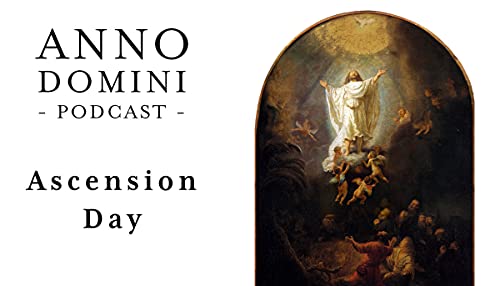
  • Ep. 13: Ascension Day - Anno Domini Podcast
    May 20 2020
    "...the 40 days following that glorious Easter morning are filled with joy unspeakable, countless alleluias, and hope that does not disappoint, because the love of God has been poured out within our hearts as a result of the Resurrection of Christ. However His resurrection was a part of His over all mission to save the world. The next step following Resurrection is Ascension and glory!" Listen to the hymn! Read the podcast transcript! Welcome to episode #13 of the Anno Domini Podcast. A podcast dedicated to the supremacy of Christ over all things including our days, weeks, and months. Join me as we explore how Christ is revealed through the cyclical life of the church calendar year. We’ll discover how this calendar once structured culture and how it can again. We’ll also discuss practical ways to observe and celebrate these holy days in our quest to glorify God and live the good life in the midst of all good He has given us. Happy Ascension Day to you! It has been over 6 weeks since the last episode of Anno Domini and in that time we continue to celebrate the resurrection of Christ. During family worship I often will begin with the words “Christ is Risen, Alleluia!” to which my wife and children reply “He is risen indeed, Alleluia!” While Lent, the 40 days preceding Easter are marked with repentance, and a sort of bittersweet dread knowing that the cross awaits, the 40 days following that glorious Easter morning are filled with joy unspeakable, countless alleluias, and hope that does not disappoint, because the love of God has been poured out within our hearts as a result of the Resurrection of Christ. However His resurrection was a part of His over all mission to save the world. The next step following Resurrection is Ascension and glory! Historical / Practical When we look through the list of commonly celebrated Church Calendar days, Ascension Day and the following Ascension Sunday are two days that are often altogether ignored by Christians. It’s very rare for a church to have an Ascension Day service and most churches won’t even give it any mention on the proceeding Sunday. The significance is often not understood as celebrating this day has fallen out of practice and because of this, one of the most important days of the Christian calendar is missed and often without a second thought. I hope to change that perspective in some small way today. So let me begin with this, just as Jesus spent 40 days in the wilderness alone, fasting, and being tempted by the devil, so now having been raised to life and having been given a glorified body, He will spend His last 40 days on earth fellowshipping with His people, eating and drinking, and enjoying His victory over death. At the conclusion of these 40 days we are told in the Gospel of Luke and the Acts of the Apostles that Jesus was taken up in and received into a cloud of glory and the disciples were unable to see Him. He was received into the glory cloud and the two cherubim flanking the entrance into this glory cloud, came and promised the disciples that He would one day come again in this same way. For Jesus, after He ascended into glory, we are told throughout the New Testament that He was seated at the right hand of God to reign over everything until He has put the last enemy under His feet, death itself. For most Christians, this is a fairly familiar story although hardly celebrated. While the coming of Christ into the world gets a LOT of attention, Here at the Anno Domini podcast, we did 8 episodes during Advent, Christmas, and Epiphany and yet here we’re only doing 1 episode for Christ’s victorious ascension and His enthronement over all creation. Why do we ignore what could be argued is the most important part of Christ’s life, His coronation as King? Good Friday and Easter Sunday play out for us the epic struggle of Good triumphing over evil but it is in Christ’s Ascension that the King is crowned. I’m sure there are many...
    Afficher plus Afficher moins
    36 min
  • Ep. 12: Easter - Anno Domini Podcast
    Apr 12 2020
    "The resurrection is the axis on which the entirety of Christianity hangs. As Paul tells us, if Christ has not risen then we, Christians, ought to be more pitied than anyone else. We are delusional beings following nothing but a mirage. Throw out the resurrection and you are left with an empty shell that is no more unique, redemptive, or salvific than every other religion the deceived of this world have to offer." Easter Sunday Song: Christ Jesus Lay in Deaths Strong Bands Passage: Exodus 14 + Psalm 16 Hello everyone and Welcome to episode #12 of the Anno Domini Podcast. A podcast dedicated to the supremacy of Christ over all things including our days, weeks, and months. Join me as we explore how Christ is revealed through the cyclical life of the church calendar year. We’ll discover how this calendar once structured culture and how it can again. We’ll also discuss practical ways to observe and celebrate these holy days in our quest to glorify God and live the good life in the midst of all good He has given us. Well folks this is the day we’ve all been waiting for. The day when Christ, who came in the very flesh of man yet was also also fully God conquered death and the grave and rose from the tomb. Death could not hold Him. Christ is risen! Practical Easter Sunday. Resurrection Sunday. The day in which Christians everywhere can offer one another the following greeting “Christ is risen” and they can be certain to receive back the glorious reply “He is risen indeed.” Our faith rests upon the very real, historical, and literal resurrection of the body of Christ. As the Apostles Creed so aptly puts it “I believe in God, the Father almighty, maker of heaven and earth; And in Jesus Christ his only Son our Lord; who was conceived by the Holy Ghost, born of the Virgin Mary, suffered under Pontius Pilate, was crucified, dead, and buried. He descended into hell. The third day he rose again from the dead. He ascended into heaven, and sitteth on the right hand of God the Father almighty. From thence he shall come to judge the quick and the dead. I believe in the Holy Ghost, the holy catholic Church, the communion of saints, the forgiveness of sins, the resurrection of the body, and the life everlasting. Amen.” The resurrection is the axis on which the entirety of Christianity hangs. As Paul tells us, if Christ has not risen then we, Christians, ought to be more pitied than anyone else. We are delusional beings following nothing but a mirage. Throw out the resurrection and you are left with an empty shell that is no more unique, redemptive, or salvific than every other religion the deceived of this world have to offer. We need creed’s like the Apostles Creed because we are constantly being tempted to water down the potency of the gospel. The Apostles Creed is a line in the sand stating, here is where the faith lives and dies. To compromise on anything in this creed is to compromise the gospel itself. But more than creeds, we need a Savior to whom the creed really belongs. Having faith is nothing special…many people have incredible faith. No it is not the amount of faith we have that matters, it is in whom we place our faith that makes the difference between right and wrong, life and death, heaven and hell. If we have but the tiniest scrap of faith, say faith the size of a mustard seed, faith that is nothing to brag about but that faith is placed directly in the loving care of Christ, we are promised there is nothing that cannot be done. Entire mountain ranges can be torn from their roots and drowned in the sea should God so desire. Christians have the best creeds because they are true they are not only beautiful and awe inspiring but they barely begin to scratch the glory of the one to whom they are written about. Biblical There are 10 passages to be read on Easter. 5 on Easter morning and 5 for Easter day. We have readings from E...
    Afficher plus Afficher moins
    31 min
  • Ep. 11: Good Friday - Anno Domini Podcast
    Apr 10 2020
    The path toward salvation involves our King suffering execution for crimes He didn’t commit, sins He was not guilty of, and punishment He did not deserve. This is the Good News that while we were still sinners, Christ died for us. And He died for us, on Good Friday. Good Friday Song: Stricken Smitten and Afflicted Passage: Isaiah 53 Hello everyone and welcome to episode #11 of the Anno Domini Podcast. Today’s episode is all about Good Friday. It is common to wonder why the Church would celebrate the sorrows of the cross. the The beautiful polyphonic choir you are enjoying is singing a rendition of Psalm 51 written in 1630 by Gregorio Allegri titled: Miserere mei, Deus which is my clumsy pronunciation of the Latin phrase: “Have mercy on me, O God” This song was originally written to be exclusively sung in the Sistine Chapel Holy Week. Transcribing the song was forbidden and so only those who happened to be present in the Sistine Chapel during Holy Week would ever hear this song. That is until a 14 year old boy, visiting Rome from Austria attended a Wednesday night service during Holy Week and heard the song sung. He then transcribed the song on paper later that night entirely from memory. The forbidden song was now available for the world to hear and enjoy. Oh and the 14 year old genius who accomplished this? His name was Wolfgang Amadeus Mozart. Practical Good Friday is the time on the Church Calendar year when Christians remember their Lord in His sorrow. Christ was deserted after giving His disciples the “new” commandment to love one another. Instead of loving Him their King with their actions, they all fled and even Peter denied knowing Him. This was a bitter time in the history of the world. As Jesus said speaking to the Jews “But this is your hour--when darkness reigns." The perfect and spotless lamb of God would be Good Friday usually involves gathering together for an evening service. Parishioners enter quietly and leave quietly. There is a atmosphere of sobriety and somberness. This isn’t the service for glad handing and swapping fishing stories with your social groups. It is a time of mourning and pondering upon the wickedness of mankind and the truly heroic nature of God’s work here on earth. This day is called Good Friday for that very reason. Although mankind, left to our own devices and desires is very bad, God sent His Son into the world to save the world. The path toward salvation involves our King suffering execution for crimes He didn’t commit, sins He was not guilty of, and punishment He did not deserve. This is the Good News that while we were still sinners, Christ died for us. And He died for us, on Good Friday. Biblical Our biblical portion from the lectionary is found at the end of Isaiah 52 and all of chapter 53. Let’s hear the word of God and discuss it. Behold, my servant shall act wisely; he shall be high and lifted up, and shall be exalted. As many were astonished at you— his appearance was so marred, beyond human semblance, and his form beyond that of the children of mankind— so shall he sprinkle many nations. Kings shall shut their mouths because of him, for that which has not been told them they see, and that which they have not heard they understand. Who has believed what he has heard from us? And to whom has the arm of the Lord been revealed? For he grew up before him like a young plant, and like a root out of dry ground; he had no form or majesty that we should look at him, and no beauty that we should desire him. He was despised and rejected by men, a man of sorrows, and acquainted with grief; and as one from whom men hide their faces he was despised, and we esteemed him not. Surely he has borne our griefs and carried our sorrows; yet we esteemed him stricken, smitten by God, and afflicted. But he was pierced for our transgressions; he was crushed for our iniquities; upon him was the chastisement that brought us peace, and with hi...
    Afficher plus Afficher moins
    20 min
  • Ep. 10: Maundy (Holy) Thursday - Anno Domini Podcast
    Apr 9 2020
    "We should be eating good bread, hearty chunks that satisfy and not puffed rounds of styrofoam. We should be drinking the potent cup of blessing which in Scripture is always wine and it should be good wine. We should be feasting because we were at one time at war with God. But now by the broken body and shed blood of Christ we can come in peace to the Lord's Table." Maundy Thursday Song: How Sweet and Awful is the Place Passage: 1 Corinthians 23-32 Hello everyone and Welcome to episode #10 of the Anno Domini Podcast. A podcast dedicated to the supremacy of Christ over all things including our days, weeks, and months. Join me as we explore how Christ is revealed through the cyclical life of the church calendar year. We’ll discover how this calendar once structured culture and how it can again. We’ll also discuss practical ways to observe and celebrate these holy days in our quest to glorify God and live the good life in the midst of all good He has given us. We are well into Holy Week and with the Kingly and Joy Filled entrance of the previous Palm Sunday comes the sinking realization that our King of Glory, received with the praise and adulation fit for the King of Kings, will soon be Stricken, Smitten, and Afflicted, stripped of His glory and will be nailed to the cross at the hands of wicked men. As awful as this, Christ knew this was coming. He told His disciples in Luke chapter 18 verse 31-34 “Behold, we are going up to Jerusalem, and all things that are written by the prophets concerning the Son of Man will be accomplished. For He will be delivered to the Gentiles and will be mocked and insulted and spit upon. They will scourge Him and kill Him. And the third day He will rise again.” This means Jesus knew exactly what was coming. He knew the agonizing death that awaited Him. He knew that He was about to become the vilest of sin for His people. The spotless Lamb of God, would take on and bear every sin, every single sin of His people. Even those sins that seem to our dulled senses “small”, He would bear for our sake. He knew also His own Father in Heaven would turn His back on Him in Justice leaving Him utterly forsaken. Jesus knew all of these things but instead of turning inward, instead of turning the focus on Him and the monument task that awaited Him in just a few short hours. Well instead of having a pity party, being in a bad mood, ranting, letting off some steam, having a few drinks to relax….instead of doing any of those things, Christ sat down with His disciples and washed them, and taught them, and fed them. He gave His church one of our most treasured gifts on that most Holy Thursday…Maundy Thursday. Practical Maundy Thursday which is also called Holy Thursday is celebrated the day before Good Friday. The word Maundy is an ancient word that comes from Middle English and Old French words that and is based on the Latin root that means “commandment.” It refers to the teaching of Christ during the Last Supper when Jesus tells His disciples “A new commandment I give to you, that you love one another: just as I have loved you, you also are to love one another. By this all people will know that you are my disciples, if you have love for one another.” Christ was emphatic during His earthly ministry that He did not come to set aside or change the law of God. He fully submitted Himself to His Father’s Law. Except for those parts that found their completion in His death, burial, and resurrection, things like dietary restrictions, ceremonial laws of uncleanness, sacrificial ordinances, etc., we are promised that Heaven and Earth will pass away before the smallest part of God’s Law passes away. Therefore when Christ tells us He is giving us a “new” commandment we should try and understand this as not “new” as in novel but new as in the way Christ comes to make ”all things new.” In other words, He has come to...
    Afficher plus Afficher moins
    33 min