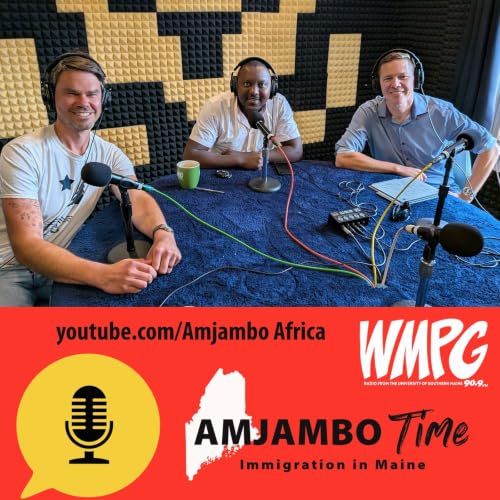
Épisodes

  • From Memory to Meaning- KWIBUKA 32
    Apr 19 2026
    Hello and welcome to Amjambo Time, I’m Éloge Willy Kaneza.Today, we take you to Bates College, where memory, healing, and intergenerational dialogue came together during the commemoration of the 32nd anniversary of the Genocide against the Tutsi in Rwanda.
    In this episode, we bring you voices from across generations—students, scholars, and survivors—each reflecting on what it means to remember, and why that responsibility continues today.Alexandre E. Dauge-Roth, a leading scholar of the genocide, reflects on memory, silence, and the responsibility of education.
    Benjamin Ndamukunda shares how commemoration shapes his generation’s understanding of identity and resilience.
    Solomon Kayobotsi offers a powerful reflection on memory as a reclaiming of truth.
    James L. Reese speaks about the role of universities in fostering dialogue, justice, and responsibility.
    And Landry Kwizera reminds us that behind the numbers are real lives, memories, and a responsibility to never forget.You’ve been listening to Amjambo Africa.
    From Bates College, the message is clear: memory is not only about the past—it is a responsibility for the future.
    I’m Éloge Willy Kaneza.
    Thank you for listening.
    Afficher plus Afficher moins
    52 min
  • Turning stories into safe harbors for young
    Mar 29 2026
    Today, we’re talking about the power of storytelling — and how books can build bridges, strengthen identity, and create a sense of belonging, especially for immigrant families.
    My guest today is Kirsten Cappy, Executive Director and co-founder of I’m Your Neighbor Books, a Maine-based nonprofit working across the United States to foster inclusive classrooms and communities through children’s literature.In this episode, you’ll hear how stories can become spaces of connection, tools for learning, and even safe havens for children and families navigating new cultures and new lives.
    Thank you for listening to Amjambo Time, a podcast produced by Amjambo Africa.
    Today’s conversation with Kirsten Cappy reminds us that stories are more than words on a page — they are bridges between people, cultures, and generations.
    Stories bring us together, help us understand one another, and remind us of our shared humanity.
    If you enjoyed this episode, please share it, subscribe, and continue supporting independent journalism that reflects and uplifts our communities.
    Afficher plus Afficher moins
    43 min
  • MOXIE PUBLIC SCHOOLS
    Mar 8 2026
    Hello and welcome to Amjambo Time, the podcast where we explore stories, ideas, and conversations shaping our communities.
    I’m your host, Eloge Willy Kaneza.
    Today’s episode focuses on an important initiative in Maine’s education landscape: MOXIE Public Schools, a new public charter school preparing to open its doors in Portland in 2026.
    At a time when many immigrant and refugee families are navigating uncertainty — from immigration enforcement to long asylum backlogs and housing instability — MOXIE aims to become more than a school. Its founders envision a learning community built on dignity, participation, and trust.
    Seats will initially be limited in grades 6 and 9, with the first student offers expected in April 2026, following a public lottery scheduled for April 1. Families are encouraged to submit an interest form early, in a process that MOXIE describes as relational rather than transactional.
    But beyond enrollment timelines, the bigger question remains: what does a truly human-centered school look like for students whose lives have been shaped by migration, displacement, and uncertainty?
    To explore that question, I spoke with Virgel Hammonds, one of MOXIE’s founding leaders, and Robert Karl, a historian and professor at Minerva University who has spent years studying migration, trauma, and asylum processes.
    Our conversation explores language access, belonging in schools, trauma-informed education, and how communities can rebuild trust between families and institutions.
    Here is our conversation. You’ve been listening to Amjambo Time, hosted by Eloge Willy Kaneza.
    My guests today were Virgel Hammonds, founding leader of MOXIE Public Schools, and Robert Karl, historian and professor at Minerva University.
    We discussed the challenges immigrant and refugee families face in education systems — and how new models like MOXIE are trying to create schools where students feel seen, heard, and supported.
    If you’d like to learn more about MOXIE Public Schools or submit an interest form for enrollment, you can find more information through their official channels.
    Thank you for listening, and until next time, this is Amjambo Time — where stories, ideas, and community meet.


    Afficher plus Afficher moins
    51 min
  • ICE and the Housing Crisis
    Feb 15 2026
    Welcome to Amjambo Time. I’m Eloge Willy Kaneza. Today, we’re talking about how recent ICE operations in Maine spread fear through immigrant communities — and how that fear quickly turned into a housing crisis for hundreds of families.
    In late January, fear moved faster than snowstorms. It crept into apartments, workplaces, and school drop-off lines. Streets emptied, doors stayed closed, and livelihoods went silent. For many immigrant families, the surge in ICE raids didn’t just threaten arrests — it triggered a housing emergency.
    To understand the impact, I spoke with Claude Rwaganje, executive director of ProsperityME, a community organization supporting immigrants and refugees across Maine. Rwaganje told us, “People were afraid to go to work, afraid to take their children to school, afraid to go to church or even to the grocery store.”
    Even those with legal status — green card holders or asylum seekers — stayed home, unsure who might be next. That meant no income, but rent didn’t wait. One single mother didn’t leave her apartment for a week. Her car was towed, costing five hundred dollars, with no income to cover it.
    The ICE surge affected more than families. Immigrants make up much of Maine’s essential workforce — hospital staff, cleaners, drivers, and food service workers. When fear forced them into hiding, hospitals struggled to staff shifts, businesses couldn’t operate, and children missed school.
    Rent quickly became the most urgent problem. Families lost income overnight, had no savings, and eviction notices loom after 30 days of unpaid rent. To respond, ProsperityME launched an emergency housing relief fund, providing up to three hundred dollars per household to cover part of rent or prevent immediate crisis.
    The fund prioritizes families affected directly by ICE raids, those with reduced wages, and the most vulnerable households. It’s a one-time intervention — not an ongoing subsidy — designed to help families regain stability.
    While evictions haven’t peaked yet, the risk is real. ProsperityME works with partners like Project Home, which has raised three hundred thirty thousand dollars for rental relief. But the line between fear and eviction remains thin.
    This crisis underscores a vital truth: immigrants are essential to Maine. They’re workers, taxpayers, business owners, and members of our communities — not criminals. When enforcement disrupts their lives, it affects the state’s economy, housing, and social cohesion.
    Thank you for listening to this episode of Amjambo Time. Stay informed, stay engaged, and continue supporting our immigrant communities.
    Follow us online at www.amjamboafrica.com and on our social media platforms. Share stories from your community by reaching out to us — we want to hear from you.
    Until next time, keep listening, keep learning, and keep building stronger communities together.
    Afficher plus Afficher moins
    31 min
  • MAINE FAITH LEADERS UNITE
    Jan 25 2026
    Across the United States, and here in Maine, communities that once felt safe are confronting a new climate of fear. Houses of worship, cultural centers, and immigrant organizations are increasingly facing threats driven by hate, misinformation, and political polarization.
    In this episode, we look at a rare and powerful response: faith leaders, immigrant advocates, and civil society groups in Maine coming together across religious and cultural lines to protect vulnerable communities. At the center of this effort is LD 2107, a bill that would create a Nonprofit Security Grant Program to help organizations strengthen their safety without sacrificing their mission.
    Through a conversation with Zach Schwartz, director of the Jewish Community Relations Council at the Jewish Community Alliance, we explore rising antisemitism, threats facing African and immigrant communities, and why solidarity — not silence — is essential in moments like this.
    This is a story about fear, yes — but also about courage, memory, and unity.
    You’re listening to Amjambo Time.
    As we close today’s episode, one message stands out clearly: security is not just about locks, cameras, or guards — it is about dignity, belonging, and the right to exist without fear.
    From synagogues to mosques, churches to cultural associations, the coalition behind LD 2107 shows what is possible when communities refuse to be divided by hate. Their work reminds us that history — from the Holocaust to the 1994 Genocide against the Tutsi — teaches a painful but urgent lesson: violence does not begin with weapons, but with words, exclusion, and indifference.
    What’s happening in Maine is more than a local legislative effort. It is a model of solidarity in a fractured world — a reminder that when one community is threatened, all are at risk, and when communities stand together, they become stronger.
    If you’re in Maine, your voice matters. Engage, testify, and speak out. And wherever you are listening from, remember: protecting vulnerable communities is not optional — it is a shared responsibility.
    Thank you for listening to Amjambo Time.
    I’m Eloge Willy Kaneza.Until next time — stay informed, stay engaged, and stay human.
    Afficher plus Afficher moins
    32 min
  • Farming New Roots
    Jan 4 2026
    Welcome to Amjambo Time,
    the podcast where stories from Africa and its diasporas meet memory, resistance, and hope.I’m Éloge Willy Kaneza, journalist with Amjambo Africa.Today’s episode takes us to Portland, Maine, in November 2025, where art became testimony and music carried the weight of exile, survival, and faith.In a powerful reimagining of Handel’s Messiah, refugee artist and poet Nyamuon Nguany Machar, also known as Moon, brought the stage to life with Gospel Messiah—a fusion of gospel, spoken word, theater, and lived refugee experience.This is not just a performance.
    It is a story of displacement and belonging.
    A story of mothers, fathers, and children forced to carry home on their backs.
    A story of joy as resistance.In this episode, we listen to Moon’s voice—calm, fierce, and deeply human—as she explains how art becomes memory, advocacy, and healing.Stay with us.You’ve been listening to Amjambo Time,
    a production of Amjambo Africa.Today, we heard how Gospel Messiah transformed a classical Western oratorio into a living archive of refugee experience—where poetry breathes, gospel cries out, and survival becomes sacred.Nyamuon Machar reminds us that refugees are not statistics.
    They are storytellers.
    They are creators.
    They are witnesses of history.As Moon says, “Joy is a form of resistance.”
    And sometimes, choosing to survive—to protect one’s peace—is itself an act of courage.If this story moved you, share it.
    Talk about it.
    Let it travel beyond borders.I’m Éloge Willy Kaneza.
    Thank you for listening to Amjambo Time.Until next time—
    stay human, stay curious, and stay connected.
    Afficher plus Afficher moins
    38 min
  • MAHORO PEACE ASSOCIATION
    Dec 14 2025
    Today’s episode takes us deep into a crisis unfolding thousands of miles away in the high plateaus of South Kivu, eastern Democratic Republic of Congo — and into the streets of American cities where a diaspora is mobilizing with urgency.
    Before we hear from our guest, Douglas Gasore Kabunda, President of the Mahoro Peace Association, we take you first to Maine and Indiana, where the Banyamulenge community has been rallying to raise the alarm about what they describe as a deadly blockade imposed on their families in Minembwe.
    In Portland, Maine, under a biting winter cold, community leader Claude Rwaganje stood before protesters and told them why they had gathered — why parents brought their children, why elders walked slowly with signs in their hands, why they refused to remain silent while loved ones were trapped without food or medicine.
    And in Indiana, voices like Laurent Mwungura carried the same message: that what is happening in Minembwe is not a distant conflict but a humanitarian emergency requiring urgent international action — including from lawmakers in Washington.
    These demonstrations have become a collective cry for visibility, protection, and justice.
    And now, to understand the heart of this crisis — and why the diaspora is calling for U.S. intervention — we turn to someone who has been documenting the situation closely.
    Afficher plus Afficher moins
    33 min
  • ICE DETENTIONS
    Nov 23 2025
    54 min