Couverture de A Question of Law

A Question of Law

A Question of Law

De : A Question of Law
Écouter gratuitement

À propos de ce contenu audio

A podcast that discusses the law in a fresh and accessible way, for people of all levels of proficiency.Copyright 2020 All rights reserved. Politique et gouvernement Sciences politiques Sciences sociales
Les membres Amazon Prime bénéficient automatiquement de 2 livres audio offerts chez Audible.

Vous êtes membre Amazon Prime ?

Bénéficiez automatiquement de 2 livres audio offerts.
Bonne écoute !
    Épisodes
    • Extradition, Freedom of Speech & Julian Assange
      Apr 7 2021

      This edition of A Question of Law will focus on the topics of extradition, freedom of the press and Julian Assange. Our guest Ben Keith, barrister at 5 Saint Andrew's Hill, will explain these concepts and put them in perspective in the context of Julian Assange's extradition requests.

      Explaining, at first, the extradition proceedings that Assange has been subjected to (7:15), Ben will clarify how the European Arrest Warrant (EAW) functions, its speedy and efficient procedures which until the UK exited the EU was adapted to its needs (8:50). We will soon understand that the process requires very little evidence about the offence allegedly committed as the EAW is based on trust and cooperation between all European countries.

      We'll then discuss whether the use of this ultra-effective instrument was appropriate and proportional in Julian Assange's case ( 13:25), taking into account the controversies around the allegations, the lack of charges and the fear of further extradition to the US. Ben will explain that the issue was mainly to do with two different legal systems (14:25), that there was no risk of further extradition and that the process did not infringe on Assange's freedom of movement under the European Convention of Human Rights (8:54).

      Similarly, Ben will explicate how the extradition treaty between the UK and the USA works (24:30). Despite a few inherent unbalances (24:56), the procedure is, here too, fundamentally grounded on trust.

      Then we will explore the recent Court's decision to block Julian Assange's extradition request to the US (27:37). Summarising the most important points, Ben will provide highly informative insights on the Judge's decision to reject the argument according to which the request was politically motivated (28:09) and shed light on the differences between political motivation and political offence (28:36). Instead, he will explain how she looked at the combination of horrific prison conditions in the US and Assange's mental health issues (29:18) to conclude that sending him to a supermax prison would almost certainly lead him to commit suicide (31:50).

      Ben will then turn to the question of freedom of speech and whether Julian Assange acted as a journalist expressing his press freedom when he released classified information to mainstream newspapers or whether there were sufficient reasons to believe that this constituted an offence susceptible to justify his extradition (37.06).

      Based on these analyses, he will reveal why he thinks this decision is particularly interesting (39:20) and what is likely to happen at the appeal stage (40:08).

      Finally, he will share with us why he decided to become a barrister (41:16) will reveal the proudest moment of his career (43:00), the significant hurdles intrinsic to the profession (44:06), the most important lesson he has learnt (44:54) and provide valuable advice for aspiring barristers (46:13).

      Afficher plus Afficher moins
      50 min
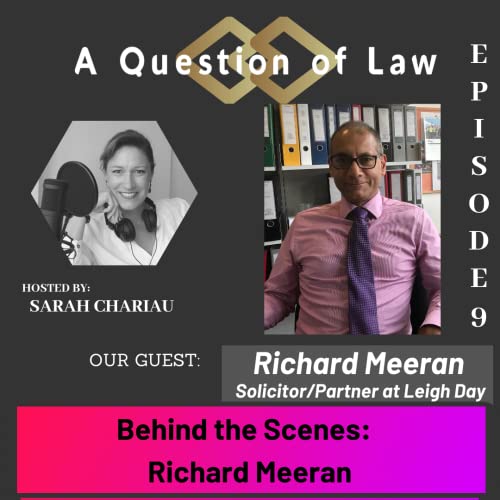
    • Behind the Scenes: Richard Meeran
      Mar 17 2021

      In this episode of A Question of Law, our returning guest, Richard Meeran, will reveal the driving forces that have fuelled his determination throughout his career and have led him to pioneer an area of law for which he is world-renowned.

      This second special edition of the year in our podcast series will focus on Richard’s motivations to become a lawyer, his encounters with discrimination and racism, his deeply felt sense of injustice and how those have shaped his career. Full of purpose, insight and advice, this episode will allow us to look behind the scenes to unveil the deep reasons which drove Richard to develop the concept of corporate liability for multinational parent companies. His inexorable passion will become evident when he talks about the cases that have marked his career and the depth of his attachment to Leigh Day's ethos. However, he will also reveal how he has tackled his most significant hurdle, the importance of placing victims’ interests at the centre of litigation and the self-belief required to be successful. Finishing this episode with precious advice for aspiring lawyers based on his own experience, he will also divulge how he likes to unwind after a long week.

      This podcast is personal and insightful, and I feel incredibly privileged to have had the opportunity to shed light on the personal thoughts of a, usually, very private lawyer!

      Thank you.

      Afficher plus Afficher moins
      36 min
    • Seeking Remedies for Corporate Wrongdoing
      Feb 24 2021

      In this episode of a Question of Law, our guest, Richard Meeran, partner at Leigh Day, will discuss how he has pioneered the development of parent corporate liability and access to judicial remedies in the UK.

      Through three examples, Richard will describe the harm that multinational corporations can inflict on developing countries' local communities. He will explain that Cape PLC’s employees (5:24) suffered and died of asbestos-related diseases, that Thor Chemicals’ workers were poisoned by mercury (7:43), whereas Anglo American South Africa has allegedly poisoned children and local communities with lead.

      He will then explain that such human rights abuses are permissible because hosting countries are so dependent on investments and jobs that they willfully allow multinationals to operate with impunity (12:02), at times with state officials' complicity (13.09). Such an environment greatly hinders victims' chances of accessing justice and remedies in their local courts (18:20).

      Influential International initiatives have been adopted (20:13) to prevent and remedy corporate abuses, but their voluntary nature has limited their impact (24:34).

      Richard will then explain that he has developed UK multinational parent company liability using tort law. He convinced British courts that a duty of care could be assigned to parent companies domiciled in the UK for their subsidiaries' abuses committed abroad (27:29). This novel approach has the advantages of providing jurisdiction to British courts and circumventing the corporate veil issue (28:29). The second significant obstacle was the principle of Forum non-conveniens, which he managed to overcome with two landmark cases (30:42) by demonstrating that substantial justice could not be obtained in local courts. The legal principle of the duty of care owed by the parent company was cemented in case-law in 2012 (34.22) and confirmed in 2019 (35.15). But liability still depends on the nature of the parent company control over its subsidiary, making disclosure of documents a critical element (37.03).

      He will then look at the evolution of this area of law in other jurisdictions (38.19) and the lingering hurdles some still face (38.37), to conclude that the inconsistency and incertitude of the process calls for an internationally binding treaty (41:00) which should ascertain the duty of care and facilitate victims access to justice (43.19).

      More information about Richard’s work can be found on:

      https://www.leighday.co.uk/about-us/our-people/partners/richard-meeran/

      Landmark cases won in court:

      Connelly v RTZ Corporation Plc [1997] 3 WLR 373

      Lubbe & Others v Cape Plc 2000 1 WLR 1545

      Tabra & Others v Monterrico Metals Plc [2009] EWHC 2475; [2010] EWHC 3228

      Other case settled:

      Ngcobo v Thor Chemicals Holdings Ltd & Desmond Cowley

      Ongoing case:

      Lead poisoning class action against Anglo American South Africa Limited

      Afficher plus Afficher moins
      46 min
    Aucun commentaire pour le moment