

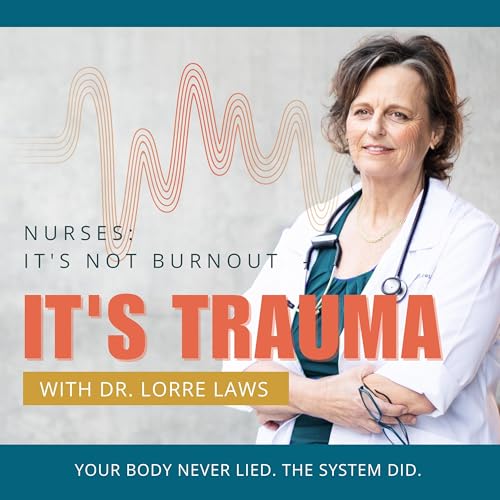
#85: The Burnout Lie: Why Nurses Are Actually Experiencing Trauma.
Impossible d'ajouter des articles
Échec de l’élimination de la liste d'envies.
Impossible de suivre le podcast
Impossible de ne plus suivre le podcast

#85: The Burnout Lie: Why Nurses Are Actually Experiencing Trauma.
-
Lu par :
-
De :
À propos de ce contenu audio
In this episode of Nurses! It’s Not Burnout. It’s Trauma., host Dr. Lorre Laws challenges one of the most accepted explanations in healthcare: burnout.
For decades, nurses have been told their exhaustion, anxiety, insomnia, and emotional numbness are signs of burnout. The message has been clear. Try harder. Build resilience. Practice more self care.
But the science tells a different story.
Dr. Lorre explains how the burnout concept entered healthcare in the 1970s and how it shifted responsibility away from unsafe systems and onto individual nurses. Instead of recognizing the repeated exposure to traumatic events in healthcare environments, institutions adopted a narrative that placed the burden on nurses to cope better.
Research now shows that many of the symptoms labeled as burnout match clinical trauma responses across five domains: physical, cognitive, emotional, behavioral, and existential.
Through the stories of nurses like Camille and Taylor, Dr. Lorre illustrates how mislabeling trauma as burnout keeps nurses trapped in cycles of self blame and ineffective coping strategies. When nurses finally understand the true root cause, the path toward healing begins to change.
This episode opens a new series exploring the neuroscience of nurse trauma and the steps nurses can take to begin healing at the nervous system level.
Question of the Day
When you hear that what you have been experiencing may actually be trauma, not burnout, what suddenly makes sense about your own experience in nursing?
Key Takeaways
The burnout concept entered healthcare in 1974 and quickly became the dominant explanation for nurse exhaustion.
Labeling nurse trauma as burnout shifted responsibility from healthcare systems to individual nurses.
Research has identified significant levels of PTSD symptoms among nurses working in high stress clinical environments.
Dr. Lorre’s analysis shows that 91 percent of nurses experience at least one PTSD related symptom.
Nearly one in four nurses meets full diagnostic criteria for PTSD.
Seventy six percent of symptoms labeled as burnout align with trauma responses.
Many nurses receive little or no trauma informed support despite working in high trauma environments.
Recognizing the experience as trauma, rather than personal weakness, is the first step toward healing.
What You Will Learn in This Episode
How the burnout narrative became embedded in healthcare culture.
Why traditional self care strategies often fail for nurses.
The five domains where trauma symptoms appear in nurses’ lives.
How repeated exposure to unsafe conditions affects the nervous system.
Why understanding the real root cause changes the path toward healing.
Links and Resources
Free Nurse Trauma Assessment
Discover how trauma is showing up across five domains of your life.
https://drlorrelaws.com/assessment
Free Resource Vault
Nervous system regulation tools, MicroDoses Matter practice, box breathing, and more.
https://drlorrelaws.com/vault
Book: Nursing Our Healer's Heart, A Recovery Guide for Nurse Trauma and Burnout
https://drlorrelaws.com/book/
Contact Dr. Lorre directly
team@drlorrelaws.com
Connect and CTA
Subscribe and leave a review on Apple Podcasts.
Join nurses worldwide who receive Dr. Lorre’s weekly insights on the nurse health crisis, nervous system science, and evidence based healing. No toxic positivity. No blame the nurse coping strategies. Just truth.
Learn more at
https://drlorrelaws.com
Credits
Host: Dr. Lorre Laws
Podcast: Nurses! It’s Not Burnout. It’s Trauma.
© 2026 The Haelan Academy. All rights reserved.