Couverture de 4th Period U.S. History

4th Period U.S. History

4th Period U.S. History

De : Mr. Stepp
Écouter gratuitement

Welcome to 4th Period U.S. History — or, as it’s more lovingly referred to, 4Push.
This class explores the histories and experiences of the United States from what should be its rightful origins in 1676, all the way to the moment when men finally got off their collective asses and gave women their due rights—and the vote. We’ll be exploring what I consider the single driving line throughout U.S. history: Can we dominate anyone who isn’t white and male?

This course will focus heavily on slavery and how it forms the very foundation of this country. We’ll examine the origins of U.S. government, how it’s supposed to work, and where the real power lies within its three branches. We’ll also cover gender, race, ethnicity, and religion—and yes, probably tear apart the idea that Americans are always amazing, heroic, and all-knowing. This class will shine light on the darker corners of our nation’s past and, hopefully, expose you to more than you ever realized. American history is vast and deeper than a few white dudes writing some bold-as-hell statements on parchment and sailing them back to England with a metaphorical middle finger. This isn’t your older relative’s history class that focused on memorizing dates and names.

4th Period U.S. History class aims to give you an unbiased look at U.S. history—the facts, as best as they can be represented, given what we know. This course will challenge you and make you think twice about what it means to be a citizen. I hope that realization brings growth—and maybe even a deeper connection to your fellow neighbors. Don’t be afraid of our past, even if you know there are some skeletons in those closets. We all have an experience and a history in this country. We all have a voice in this country. And you all have a welcome, waiting seat in this class.

If you come have a seat and find you enjoy the course, your subscription to my main Spreaker HQ would go a long way in growing this class, and would help this poor teacher deliver high quality content to you lovely folks. You can find my Spreaker page HERE.

Now, lets start class!Copyright Mr. Stepp
Épisodes
  • Ep 49- Kick the Can: The Blood-Money Compromises
    May 19 2026
    Class is back in session. Today we look at the legal gymnastics of a nation trying to balance its books on the back of human bondage. Slavery wasn't just a moral failing; it was a highly lucrative system generating mountains of cash—a sin so profitable that neither political party dared to liquidate it. Instead, Congress spent thirty years passing frantic, short-term compromises to keep the system on life support.

    We break down the legislative ledger: the Missouri Compromise of 1820, which drew an arbitrary line in the sand; the Compromise of 1850, which introduced a brutal, federalized shakedown called the Fugitive Slave Act; and the Kansas-Nebraska Act of 1854, where the cowardice of "popular sovereignty" outsourced the decision to the public, turning the prairie into a corporate war zone known as Bleeding Kansas. This isn't a story of great statesmen finding peace; it’s a forensic analysis of how the American republic repeatedly kicked the can down the road until it finally hit the brick wall of the Civil War.

    Become a supporter of this podcast: https://www.spreaker.com/podcast/4th-period-u-s-history--5621461/support.

    Visit the class at Spreaker.com and follow! Link to the page HERE! It would mean a lot and go a long way in helping grow class! Thank you for your support!
    Afficher plus Afficher moins
    40 min
  • Ep 48-The Theft of Mexico: How to deal real estate with warfare
    May 14 2026
    In today's class we’re issuing a correction on the "Lone Star" ledger and diving into the receipts of the Mexican-American War. We investigate how Texas’s 1845 annexation was less of a legal merger and more of a "monstrous novelty" that ignored the lack of constitutional provisions for such a hostile takeover.

    We examine the "Invasion Americana" through the eyes of those who saw the fine print: President Herrera, who warned that the annexation trampled on international dignity; President Polk, who used the "Thornton Affair" to claim American blood was shed on American soil—despite the land being under heavy dispute; and U.S. Grant, who later admitted the war was an unjust land grab following the "bad example of European monarchies

    Finally, we frame the Treaty of Guadalupe Hidalgo not as a peace deal, but as "Polk’s Louisiana Purchase"—a forced real estate closing where $15 million and a gun to the head secured half of Mexico’s territory. We’re moving past the "Manifest Destiny" myths to look at the true cost of the acquisition.

    Become a supporter of this podcast: https://www.spreaker.com/podcast/4th-period-u-s-history--5621461/support.

    Visit the class at Spreaker.com and follow! Link to the page HERE! It would mean a lot and go a long way in helping grow class! Thank you for your support!
    Afficher plus Afficher moins
    33 min
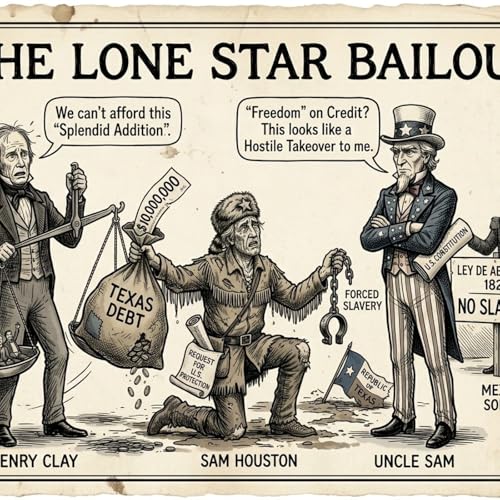
  • Ep 47- The Lone Star Bailout: From "Revolutionaries" to Debtors in Ten Years
    May 12 2026
    Class in in session! Last week, we watched John Brown try to restart the heart of the Republic with a pike; this week, we’re looking at the people who tried to expand it with a bad check. Todays' class dives into the ultimate irony of the 1840s: the "independent" Republic of Texas—a nation supposedly built on the rugged, leave-me-alone defiance of the "300 families"—collapsing under its own weight and begging for a U.S. security blanket just ten years after its birth. It turns out being a "Lone Star" is a lot less romantic when you’re broke and the neighbors want their land back.


    The reality of this "revolution" wasn't a noble quest for liberty, but a blatant refusal to follow the laws of a sovereign nation. We track the friction back to the late 1820s, when American settlers moved into Mexican territory and immediately began breaking the house rules—specifically by forcing slavery into a land that had already abolished it. By the time the smoke cleared from their war for independence, the newly minted Republic was essentially a failed state: drowning in $10,000,000 of debt and absolutely terrified of the very military they claimed to have outrun.

    Instead of standing as a monument to rugged individualism, Texas leadership began a desperate pivot, pleading for the United States to step in and absorb their mess. This wasn't a mutual agreement between equals; it was a hostile takeover driven by sheer, stubborn will. Proponents used "preposterous" legal gymnastics to bypass the Constitution, choosing to ignore the awkward fact that they had no legal treaty or territorial right to the land they were snatching. Ultimately, the annexation served as a dishonest tool to expand the reach of slaveholders, weighing down the rest of the Union by dragging an unholy institution into foreign soil through political muscle rather than a shred of respect for international law.


    Become a supporter of this podcast: https://www.spreaker.com/podcast/4th-period-u-s-history--5621461/support.

    Visit the class at Spreaker.com and follow! Link to the page HERE! It would mean a lot and go a long way in helping grow class! Thank you for your support!
    Afficher plus Afficher moins
    39 min
adbl_web_anon_alc_button_suppression_c
Aucun commentaire pour le moment