Épisodes

  • Ep 26- Taco Don Chickens Out & The ICE War in Minneapolis
    Jan 23 2026
    This week on the pod we keep it real about what’s actually happening in the U.S.: a president lovingly nicknamed Taco Don proves once again that when push comes to shove, he chickens out — at least on invading Greenland, opting instead for some vague economic access “deal” that looks like a diplomatic shrug from Davos.

    We dive into the chaos unfolding in Minneapolis where a surge of ICE enforcement has sparked protests, shootings, and outrage — including a 37-year-old mother killed by an ICE agent, and the shocking detention of a 5-year-old boy and other schoolchildren caught in the machinery of immigration enforcement.

    We also touch on the Treasury’s tremors over European bond sell-offs, the political theater masquerading as strength, and why this whole mess feels like a eulogy for humanity. And yeah — it’s a short class this week because life happened: health setbacks, personal chaos (spoiler: explosive dog diarrhea), and the world at large refusing to behave so I could deep-dive. But next week? We’re back on the grind with sharper content and even sharper takes

    Become a supporter of this podcast: https://www.spreaker.com/podcast/4th-period-u-s-history--5621461/support.

    Visit the class at Spreaker.com and follow! Link to the page HERE! It would mean a lot and go a long way in helping grow class! Thank you for your support!
    Afficher plus Afficher moins
    44 min
  • Ep 25- I don't recognize you anymore Lady Liberty.....what happened to you?
    Jan 21 2026
    Today’s episode comes straight from the eye of the storm — no deep dive into historical context like usual, because the world isn’t waiting for us to be ready. I meant to record a prepared class, but life (a sick dog + a thrown-out back) had other plans — and honestly, the news these days is the class.

    We’re unpacking a world that feels completely untethered: from the latest in Minneapolis where Renee Good — a 37-year-old mother and poet — was shot and left unresponsive for minutes before medical help arrived, sparking protests and national controversy over federal enforcement tactics and use of force, particularly by ICE during a massive immigration operation.

    We’ll talk about what it even means when a sovereign NATO ally feels threatened by the U.S., how international markets react to geopolitical brinkmanship, and the uncomfortable reality that the U.S. — long cast as “the good guy” — increasingly looks like something else on the world stage.

    I look out at the United States and I don't recognize what I see.

    Become a supporter of this podcast: https://www.spreaker.com/podcast/4th-period-u-s-history--5621461/support.

    Visit the class at Spreaker.com and follow! Link to the page HERE! It would mean a lot and go a long way in helping grow class! Thank you for your support!
    Afficher plus Afficher moins
    50 min
  • Ep 24 - We Tried Chaos. It Didn’t Take
    Jan 16 2026
    In class this week we discuss that The Articles of Confederation were born out of fear—fear of kings, fear of centralized power, fear of ever recreating the thing the colonies had just finished bleeding to escape. What they produced instead was a government so loose, vague, and structurally hollow that it barely qualified as a government at all. No executive with teeth. No unified courts. No real way to tax, regulate, or enforce anything. Just a polite suggestion that thirteen very opinionated states maybe cooperate if they felt like it.

    It did not take long for that experiment to fall apart. Thirteen currencies, thirteen legal systems, thirteen supreme courts, and no consistent rule of law meant chaos dressed up as liberty. You could commit a crime in one state and simply cross a border to make it someone else’s problem. Economic collapse followed political paralysis, and when people finally snapped—looking at you, Shays’ Rebellion—it became painfully clear that “freedom without structure” was just instability with better branding.

    This class breaks down why the Founding Fathers—who absolutely wanted limited government—realized that no structure was worse than too much. The Constitution wasn’t a betrayal of the Revolution; it was a course correction. It unified the states, established shared law, and, for the first time, framed Americans not as Virginians or New Yorkers first, but as The People of the United States. Turns out, shouting into the wind isn’t governance—and eventually, even revolutionaries learn that rules matter.

    Become a supporter of this podcast: https://www.spreaker.com/podcast/4th-period-u-s-history--5621461/support.

    Visit the class at Spreaker.com and follow! Link to the page HERE! It would mean a lot and go a long way in helping grow class! Thank you for your support!
    Afficher plus Afficher moins
    1 h et 1 min
  • Ep 23- Built on Distrust...but in a good way
    Jan 13 2026
    Class this week is about the three branches of government, checks and balances, and the wildly optimistic assumption that everyone involved would respect the rules. We walk through how the legislative, executive, and judicial branches are supposed to check each other, why those checks exist, and why they were intentionally designed to slow things down. Delay wasn’t a mistake — it was the defense against bad laws, bad ideas, and bad people moving too fast.

    We dig into the uncomfortable truth that the system only works because the branches are supposed to dislike each other. The president was never meant to be a king, Congress was never meant to rubber-stamp power, and the courts were built to get in the way. The Founders assumed ambition would clash with ambition and that mutual suspicion would keep anyone from grabbing too much power. It’s not elegant. It’s not efficient. It’s supposed to be irritating.

    And then we talk about the part that isn’t written down. Checks and balances only work if the people using them actually give a damn about the rule of law. When laws become suggestions, norms become jokes, and accountability becomes optional, the entire system turns into set dressing. The Constitution can’t enforce itself — and right now, that’s the problem.

    Become a supporter of this podcast: https://www.spreaker.com/podcast/4th-period-u-s-history--5621461/support.

    Visit the class at Spreaker.com and follow! Link to the page HERE! It would mean a lot and go a long way in helping grow class! Thank you for your support!
    Afficher plus Afficher moins
    1 h
  • Ep 22 - Humanity Is Not a Political Position
    Jan 9 2026
    This week’s class is not about distant history. It’s about what is happening now. About the reality of state power, violence, and fear unfolding in the United States in real time—and what it means when institutions meant to protect instead harm. This episode acknowledges the killing of Renee Good, the recent shootings involving border enforcement, the global consequences of U.S. intervention abroad, and the growing sense that the ground beneath us is shifting faster than many are prepared to face.

    This is also an episode rooted in uncertainty. There are no clean conclusions here, no neat historical arc that resolves itself with time. Instead, this episode names the fear felt by immigrant communities, by protesters, and by people watching the country’s promises feel increasingly conditional. It raises difficult questions without pretending to solve them: How is this justified? How is it defended? How does cruelty get reframed as necessity? And what does it cost when silence or neutrality becomes the easier choice?


    Most importantly, this episode draws a clear line. This course can no longer pretend to be unbiased in the face of policies and actions that undermine the most basic ideals this country claims to stand for. This is not a partisan declaration, a party endorsement, or a rejection of disagreement. It is a statement rooted in humanity—and in the belief that “life, liberty, and the pursuit of happiness” must mean something for everyone, or it means nothing at all. I do not have answers beyond this: move forward with purpose, act with courage and resolve, and push back against tyranny in whatever capacity you can.

    Become a supporter of this podcast: https://www.spreaker.com/podcast/4th-period-u-s-history--5621461/support.

    Visit the class at Spreaker.com and follow! Link to the page HERE! It would mean a lot and go a long way in helping grow class! Thank you for your support!
    Afficher plus Afficher moins
    44 min
  • Ep 21- Implied Rights & Vibes: Federalists vs. Anti-Federalists
    Jan 7 2026
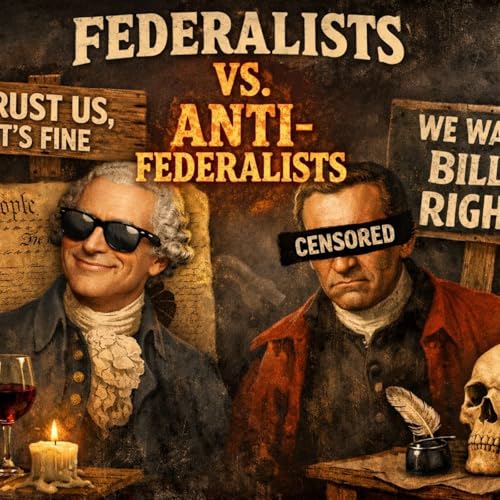
    Welcome back from winter break—because nothing says “new year, fresh start” like diving straight into how the United States almost tripped over its own founding documents. This episode was recorded before the break, but the chaos holds up beautifully. We’re picking up right where the Founders left off: arguing loudly, writing anonymously, and pretending that “implied rights” were a solid plan for a brand-new nation.

    This week we break down the Federalists, who looked at the Constitution and said, “No worries, all your rights are in there… somewhere.” Figures like Alexander Hamilton, John Jay, and James Madison argued that listing rights was unnecessary—and possibly dangerous—because surely the government would never abuse powers that were only vaguely defined. History, as always, was taking notes.

    Then we turn to the Anti-Federalists, who were not buying the “trust us” model of governance. Writers using pen names—because criticizing the foundation of the country was already risky business—pushed hard for explicit protections. Figures often associated with this camp, like Patrick Henry, argued that guaranteed rights didn’t weaken the Constitution—they strengthened it. Shockingly, demanding written limits on government power turned out to be a good idea. Who could’ve guessed?

    Become a supporter of this podcast: https://www.spreaker.com/podcast/4th-period-u-s-history--5621461/support.

    Visit the class at Spreaker.com and follow! Link to the page HERE! It would mean a lot and go a long way in helping grow class! Thank you for your support!
    Afficher plus Afficher moins
    57 min
  • Winter Break
    Dec 24 2025
    In the short winter break message, and take a minute to explain why the last class didn't make it out when it should have-Life has gotten really loud as the year has come to an end-and I also want to take a minute to wish you a warm and meaningful holiday season. What do you celebrate Christmas, Hanukkah, Kwanzaa, Yule, Festivus, Gothmas, or whatever celebration that brings you comfort, joy, and surrounds you with loved ones. I hope you find rest, Laughter, and a little piece before you head into the new year. I will see you back in class on January 6, 2026.

    Become a supporter of this podcast: https://www.spreaker.com/podcast/4th-period-u-s-history--5621461/support.

    Visit the class at Spreaker.com and follow! Link to the page HERE! It would mean a lot and go a long way in helping grow class! Thank you for your support!
    Afficher plus Afficher moins
    2 min
  • Ep 20- December 7th, 1941: A Voices in Time Lecture 2 - Lose of American Innocence
    Dec 9 2025
    This special lecture drags us out of the neat timelines of early U.S. history and into the explosion that forced America into World War II. December 7th, 1941 wasn’t just a surprise attack—it was the end result of years of resentment, broken promises after World War I, and Western powers refusing to fully accept Japan as an equal at the global table. Layer on top of that the American embargo on oil, gasoline, and raw materials, and you get an island empire with no fuel, no patience, and nothing left to lose. Desperation didn’t cause the war—but it sure finished loading the gun.

    We also confront the darker truth behind expansion itself. Japan—alongside its ally Germany—wasn’t just chasing territory for resources or security. Wrapped inside that ambition was a far more dangerous hunger for domination, racial purity, and imperial control. Expansion was marketed as survival. In reality, it was enforced hierarchy at gunpoint. From there we follow Operation Z: Japan’s carrier fleet vanishing into the North Sea, nearly destroyed by storms and detection, only to reappear like a ghost eleven days later, 200 miles off Oahu. At 6:10 a.m., midget submarines hunted beneath Pearl Harbor, Hickam and Wheeler Fields were hit first to pin American aircraft to the ground, and the sky filled with fire.

    The Arizona became a burning tomb. The Oklahoma rolled and trapped hundreds of sailors inside its iron belly. The Nevada—bloody, burning, but moving—became the lone ship that tried to escape the kill zone. And when the smoke cleared, the damage didn’t stop with steel and bone. Pearl Harbor detonated a global wave of racial hatred: American propaganda twisted Japanese soldiers into monsters, while Japanese propaganda went so far as to have terrified Japanese civilians with lies that Americans would rape and slaughter them—driving families to suicide in panic when U.S. Soldiers invaded their territories. This lecture isn’t about clean heroics or movie-ready villains. It’s about empire, fear, racial mythology, and what happens when nations addicted to power finally collide at sunrise.

    Become a supporter of this podcast: https://www.spreaker.com/podcast/4th-period-u-s-history--5621461/support.

    Visit the class at Spreaker.com and follow! Link to the page HERE! It would mean a lot and go a long way in helping grow class! Thank you for your support!
    Afficher plus Afficher moins
    1 h et 8 min