

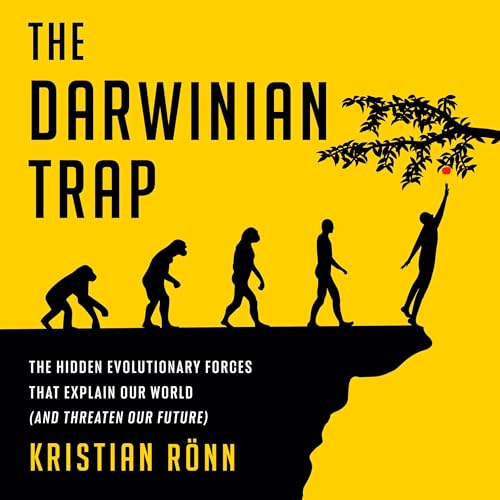
The Darwinian Trap
The Hidden Evolutionary Forces That Explain Our World (and Threaten Our Future)
Impossible d'ajouter des articles
Désolé, nous ne sommes pas en mesure d'ajouter l'article car votre panier est déjà plein.
Veuillez réessayer plus tard
Veuillez réessayer plus tard
Échec de l’élimination de la liste d'envies.
Veuillez réessayer plus tard
Impossible de suivre le podcast
Impossible de ne plus suivre le podcast
Bénéficiez gratuitement de Standard pendant 30 jours
5,99 €/mois après la période d’essai. Annulation possible à tout moment

The Darwinian Trap
Lu par :
Jamie Renell
Acheter pour 15,48 €
-
Lu par :
-
Jamie Renell
-
De :
-
Kristian Rönn
“Essential reading . . . a lively, ultimately hopeful examination of how incentivizing the wrong values and actions has led to some of our most intractable problems.”—Eric Ries, New York Times bestselling author of The Lean Startup
When people talk about today’s biggest challenges—pollution, misinformation, artificial intelligence, inept CEOs, and politicians—they tend to frame the conversation around “bad people” doing “bad things.” But is there more to the story?
Humans, it turns out, are intrinsically wired to seek short-term success at the expense of long-term prosperity. Kristian Rönn, an entrepreneur formerly affiliated with the University of Oxford’s Future of Humanity Institute, calls these deeply rooted impulses “Darwinian demons.” These forces, a by-product of natural selection, can lead us to act in shortsighted ways that harm others—and even imperil our survival as a species. If this evolutionary glitch is left unchecked, the consequences will grow in magnitude as the power of technology accelerates.
In this eye-opening work, Rönn shows that we must learn to cooperate in new ways if we are to escape these evolutionary traps in our daily lives and solve our biggest existential threats. Evolution may be to blame for the trap—but humans need not fall for it. Our salvation, he writes, will involve the creation of new systems that understand, track, and manage what humankind values most.
Bold, brilliant, and ultimately optimistic, The Darwinian Trap gives readers a powerful new lens on our world and its problems, and invites us to rethink our priorities for the sake of generations to come.
* This audiobook edition includes a downloadable PDF containing charts, graphs, and diagrams.
adbl_web_anon_alc_button_suppression_t1
Commentaires
“Kristian Rönn has written a vital and inspiring book, one that has the potential to break the spiral of self-interest. The Darwinian Trap is a must-read for anyone who cares about our collective future.”—Chris Anderson, head of TED and author of Infectious Generosity
“This is a timely and engaging exploration of why division makes humanity fall short of its potential, and of how and why we must collaborate to secure a more humane future.”—Max Tegmark, author of Life 3.0 and Our Mathematical Universe
“How can we recalibrate society’s reward function to align with what humans intrinsically value? From addressing climate change to regulating artificial intelligence, Kristian Rönn stands out as one of the world’s most insightful thinkers. In this panoramic book, Rönn makes a compelling case that by focusing on objectives that are too narrow, we risk undermining our collective future. Agree or disagree, The Darwinian Trap is unmissable.”—Carl Benedikt Frey, associate professor of AI and work, Oxford University
“As humanity’s future hangs in the balance, it is crucial to understand the true nature of the enemy we are facing. The Darwinian Trap elegantly lifts the mask off this enemy and shows us the path to victory—essential reading for anyone on planet Earth.”—Liv Boeree, host of Win-Win podcast
“The Darwinian Trap is an important, eye-opening book that shows how evolutionary selection pressures are causing some of the most pressing global challenges we see today. Rönn brilliantly makes the case that the ‘bad actor’ blame game fueling so much public discourse can be replaced with frameworks that draw on humanity’s greatest strengths: cooperation, analysis, and reason.”—William MacAskill, New York Times bestselling author of What We Owe the Future
“This is a timely and engaging exploration of why division makes humanity fall short of its potential, and of how and why we must collaborate to secure a more humane future.”—Max Tegmark, author of Life 3.0 and Our Mathematical Universe
“How can we recalibrate society’s reward function to align with what humans intrinsically value? From addressing climate change to regulating artificial intelligence, Kristian Rönn stands out as one of the world’s most insightful thinkers. In this panoramic book, Rönn makes a compelling case that by focusing on objectives that are too narrow, we risk undermining our collective future. Agree or disagree, The Darwinian Trap is unmissable.”—Carl Benedikt Frey, associate professor of AI and work, Oxford University
“As humanity’s future hangs in the balance, it is crucial to understand the true nature of the enemy we are facing. The Darwinian Trap elegantly lifts the mask off this enemy and shows us the path to victory—essential reading for anyone on planet Earth.”—Liv Boeree, host of Win-Win podcast
“The Darwinian Trap is an important, eye-opening book that shows how evolutionary selection pressures are causing some of the most pressing global challenges we see today. Rönn brilliantly makes the case that the ‘bad actor’ blame game fueling so much public discourse can be replaced with frameworks that draw on humanity’s greatest strengths: cooperation, analysis, and reason.”—William MacAskill, New York Times bestselling author of What We Owe the Future
Aucun commentaire pour le moment