

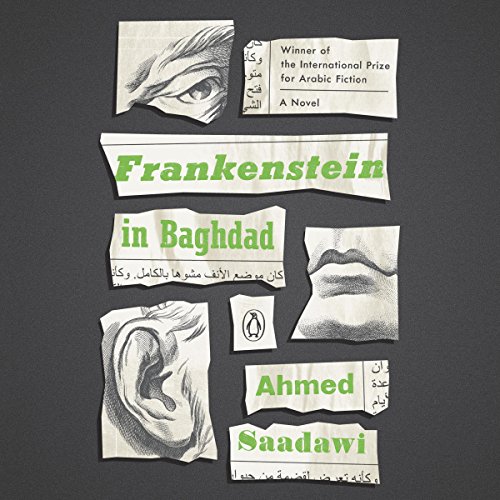
Frankenstein in Baghdad
A Novel
Impossible d'ajouter des articles
Désolé, nous ne sommes pas en mesure d'ajouter l'article car votre panier est déjà plein.
Veuillez réessayer plus tard
Veuillez réessayer plus tard
Échec de l’élimination de la liste d'envies.
Veuillez réessayer plus tard
Impossible de suivre le podcast
Impossible de ne plus suivre le podcast
30 jours d'essai gratuit à Audible Standard
Choisissez 1 livre audio par mois dans l'ensemble de notre catalogue.
Écoutez les livres audio que vous avez choisis pendant toute la durée de votre abonnement.
Accédez à volonté à des podcasts incontournables.
Gratuit avec l'offre d'essai, ensuite 2,99 €/mois. Possibilité de résilier l'abonnement chaque mois.

Frankenstein in Baghdad
Lu par :
Edoardo Ballerini, Kaleo Griffith
Acheter pour 14,30 €
-
Lu par :
-
Edoardo Ballerini
-
Kaleo Griffith
-
De :
-
Ahmed Saadawi
À propos de ce contenu audio
Winner of the International Prize for Arabic Fiction
“Brave and ingenious.” —The New York Times
“Gripping, darkly humorous . . . profound.” —Phil Klay, bestselling author and National Book Award winner for Redeployment
“Extraordinary . . . A devastating but essential read.” —Kevin Powers, bestselling author and National Book Award finalist for The Yellow Birds
From the rubble-strewn streets of U.S.-occupied Baghdad, Hadi—a scavenger and an oddball fixture at a local café—collects human body parts and stitches them together to create a corpse. His goal, he claims, is for the government to recognize the parts as people and to give them proper burial. But when the corpse goes missing, a wave of eerie murders sweeps the city, and reports stream in of a horrendous-looking criminal who, though shot, cannot be killed. Hadi soon realizes he’s created a monster, one that needs human flesh to survive—first from the guilty, and then from anyone in its path. A prizewinning novel by “Baghdad’s new literary star” (The New York Times), Frankenstein in Baghdad captures with white-knuckle horror and black humor the surreal reality of contemporary Iraq.
However, my main problem with the audiobook experience is the performance. The Arabic names were constantly mispronounced and the narrator uses a caricatural accent whenever the characters speak (which is racist and completely unnecessary). Penguin should have at least hired someone who can speak Arabic to read the novel, or even better, someone of Iraqi descent, given how central Iraqi identity is to the novel.
Needed to hire an Arabic speaker
Une erreur s'est produite. Réessayez dans quelques minutes.