

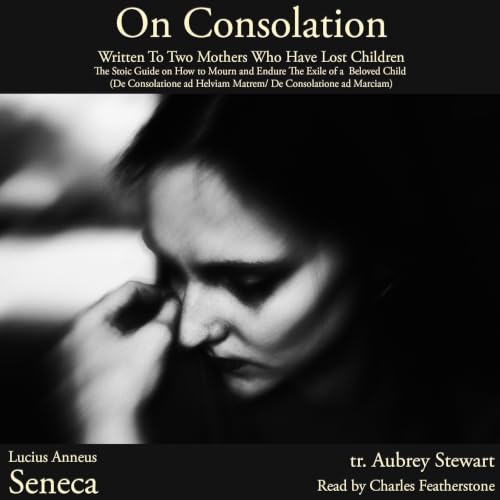
On Consolation: Written To Two Mothers Who Have Lost Children
The Stoic Guide on How to Mourn and Endure The Exile of a Beloved Child (De Consolatione ad Helviam Matrem/ De Consolatione ad Marciam)
Impossible d'ajouter des articles
Désolé, nous ne sommes pas en mesure d'ajouter l'article car votre panier est déjà plein.
Veuillez réessayer plus tard
Veuillez réessayer plus tard
Échec de l’élimination de la liste d'envies.
Veuillez réessayer plus tard
Impossible de suivre le podcast
Impossible de ne plus suivre le podcast
3 mois d'Audible Standard gratuits
3 mois pour 0,00 €/mois, puis 5,99 €/mois. Possibilité de résilier chaque mois.
L'offre prend fin le 15 Juillet 2026 à 23 h 59.

On Consolation: Written To Two Mothers Who Have Lost Children
Lu par :
Charles Featherstone
Acheter pour 5,02 €
-
Lu par :
-
Charles Featherstone
The two most personal letters that Seneca wrote were to his mother, after he had been exiled to Corsica, and to Marcia, who had just lost her son. In both, he consoles a mother who is overwhelmed by grief. No parent should ever lose a child, or have them taken so far away that they may never see them again.
To Marcia, he gives a bracing, almost fierce call to break grief’s stranglehold. He tells her not by denying pain, but also recognise that the dead are beyond suffering, given the release nature grants all things, and that endless mourning dishonours the life she loved.
To his mother Helvia, torn apart by her son’s absence and public disgrace, Seneca consoles her with the fact that exile is no great burden, and she has always been a model of virtue and strength; that his two brothers are still there, and his adopted child needs her.
Written with his classic style, but a strong dose of pathos and sympathy that is often missing from his more abstract ruminations, these are letters from a son, a friend, a fellow sufferer, who is determined to heal wounds he knows firsthand. They overflow with a mix of grit and tenderness, as Seneca shows that grief, when met with reason and love, can transform into a deep, unshakeable memory, and that even the most crushing loss can become the ground on which a sturdier self is built.
adbl_web_anon_alc_button_suppression_t1
Aucun commentaire pour le moment