

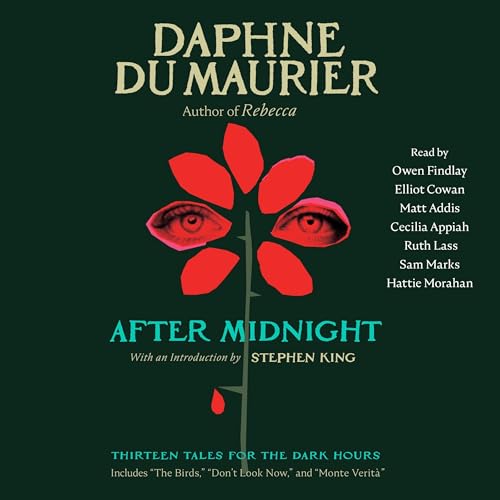
After Midnight
Thirteen Tales for the Dark Hours
Impossible d'ajouter des articles
Désolé, nous ne sommes pas en mesure d'ajouter l'article car votre panier est déjà plein.
Veuillez réessayer plus tard
Veuillez réessayer plus tard
Échec de l’élimination de la liste d'envies.
Veuillez réessayer plus tard
Impossible de suivre le podcast
Impossible de ne plus suivre le podcast
Bénéficiez gratuitement de Standard pendant 30 jours
5,99 €/mois après la période d’essai. Annulation possible à tout moment

After Midnight
Lu par :
Owen Findlay, Elliot Cowan, Matt Addis, Cecilia Appiah, Ruth Lass, Sam Marks, Hattie Morahan
Acheter pour 22,99 €
-
De :
-
Daphne du Maurier
Daphne du Maurier is best known for Rebecca, “one of the most influential novels of the 20th century” (Sarah Waters) and basis for Alfred Hitchcock’s iconic film adaptation. More than thirty-five years after her death, du Maurier is celebrated for her gothic genius and stunning psychological insight by authors such as Ottessa Moshfegh, Maggie O’Farrell, Lucy Foley, Gillian Flynn, Jennifer Egan, and countless others, including Stephen King and Joe Hill.
After Midnight brings together some of du Maurier’s darkest, most haunting stories, ranging from sophisticated literary thriller to twisted love story. Alongside classics such as “The Birds” and “Don’t Look Now,”—both of which inspired unforgettable films—are gems such as “Monte Verità,” a masterpiece about obsession, mysticism, and tragic love, and “The Alibi,” a chilling tale of an ordinary man’s descent into lies, manipulation, and sinister fantasies that edge dangerously close to reality. In “The Blue Lenses,” a woman recovering from eye surgery finds she now perceives those around her as having animal heads corresponding to their true natures. “Not After Midnight” follows a schoolteacher on holiday in Crete who finds a foreboding message from the chalet’s previous occupant who drowned while swimming at night. In “The Breakthrough,” a scientist conducts experiments to harness the power of death, blurring the line between genius and madness.
Each story in this collection exemplifies du Maurier’s exquisite writing and singular insight into human frailty, jealousy, and the macabre. She “makes worlds in which people and even houses are mysterious and mutable; haunted rooms in which disembodied spirits dance at absolute liberty” (Olivia Laing, author of Crudo). Daphne du Maurier is mistress of the sleight of hand and slow-burning menace, often imitated and rarely surpassed.
Stories include:
-“The Blue Lenses”
-“Don’t Look Now”
-“The Alibi”
-“The Apple Tree”
-“The Birds”
-“Monte Verita”
-“The Pool”
-“The Doll”
-“Ganymede”
-“Leading Lady”
-“Not After Midnight”
-“Split Second”
-“The Breakthrough”
adbl_web_anon_alc_button_suppression_t1
Aucun commentaire pour le moment