

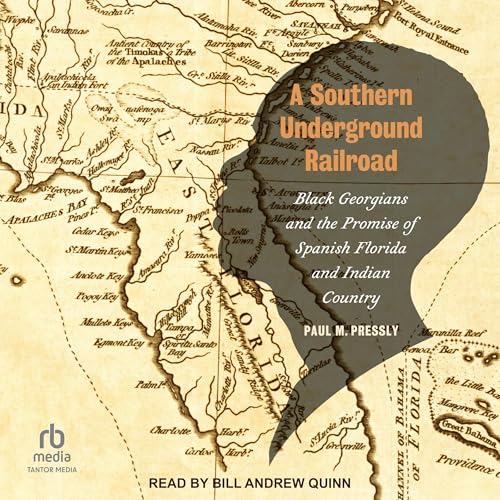
A Southern Underground Railroad
Black Georgians and the Promise of Spanish Florida and Indian Country
Impossible d'ajouter des articles
Échec de l’élimination de la liste d'envies.
Impossible de suivre le podcast
Impossible de ne plus suivre le podcast
Bénéficiez gratuitement de Standard pendant 30 jours

A Southern Underground Railroad
Acheter pour 17,99 €
-
Lu par :
-
Bill Andrew Quinn
-
De :
-
Paul M. Pressly
Despite its apparent isolation, the Southeast provided a vital connecting link between the Black self-emancipation that occurred during the American Revolution and the growth of the Underground Railroad. From the beginning of the revolutionary war to the eve of the First Seminole War in 1817, several thousand Africans and African Americans in Georgia and South Carolina crossed the borders and boundaries that separated the Lowcountry from the British and Spanish in coastal Florida and from the Seminole and Creek people in the vast interior of the Southeast. Even in times of peace, there remained a steady flow of individuals moving south and southwest.
A Southern Underground Railroad constitutes a powerful counter-narrative in American history, a tale of how enslaved men and women found freedom and human dignity not in Jefferson's "Empire of Liberty" but outside the expanding boundaries of the United States. It is a reminder of the strength of Black resistance in the post-revolutionary South and the ability of this community to influence the balance of power in a contested region. Pressly's research shows that their movement across borders was an integral part of the struggle for dominance in the Southeast not only among the Great Powers but also among the many different racial, ethnic, and religious groups that inhabited the region and contended for control.
©2024 The University of Georgia Press (P)2024 Tantor


