Épisodes

  • Ep. 20 | Data Centers: Is There a Middle Ground?
    Sep 26 2026

    Data centers are becoming a political flashpoint—but how much of the concern is grounded in reality?

    In Episode 20 of free 2 think, we dig into the debate over data centers: water and energy use, environmental concerns, the rapid growth of AI, and fears about where the technology is taking us. We separate some of the realities from the rhetoric and ask whether there’s a reasonable middle ground between embracing data centers without limits and trying to keep them out altogether.

    And with an election underway, we ask another question: Is the election cycle turning legitimate concerns into unnecessary chaos?

    Afficher plus Afficher moins
    33 min
  • Ep. 19 | Colorado Ballot Guide: Amendments 84, 85 & 86
    Sep 22 2026

    Colorado voters have some big constitutional questions in front of them.

    In Episode 19, Jacob and Cody continue their breakdown of Colorado's 2026 statewide ballot measures, tackling three more amendments:

    Amendment 84 — Mail Ballot Voter Identification
    Amendment 85 — Plain Language Ballot Questions
    Amendment 86 — Congressional Redistricting

    What does each amendment actually change? How does the system work today? And what are the arguments on both sides?

    We break through the legal language, discuss the potential consequences, and share our own perspectives along the way.

    Know what you're voting on.

    Afficher plus Afficher moins
    1 h
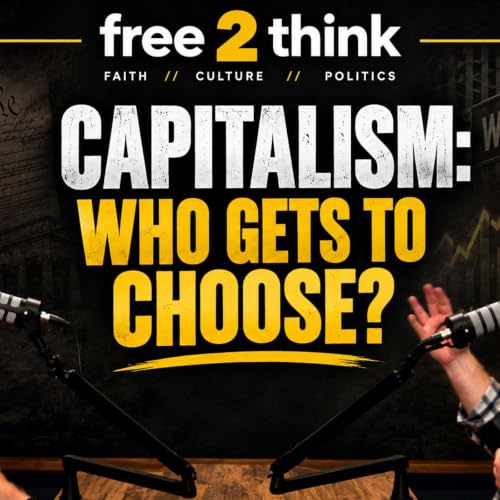
  • Ep. 18 | Capitalism: The Economics of Choice
    Sep 18 2026

    Ep. 18 | Capitalism: The Economics of Choice

    Capitalism is ultimately about a simple question: Who gets to choose?

    In this episode, Jacob and Cody discuss capitalism, individual agency, and why decentralized choice matters. Rather than a handful of people making economic decisions for millions, capitalism allows millions of people to make those decisions for themselves.

    We trace the rise of modern capitalism alongside the protection of individual rights, then dig into interest rates, central banks, liquidity, and what borrowing might look like if rates were driven more directly by the market.

    At its core, capitalism puts choice close to the individual. What happens when government moves that choice farther away? And what does that mean for creativity, innovation, beauty, and prosperity?

    A conversation about economics—but even more about freedom, agency, and who gets to decide.

    Afficher plus Afficher moins
    53 min
  • Ep. 17 | Colorado Ballot Guide: Amendments 81, 82 & 83
    Sep 15 2026

    Ep. 17 | Colorado Ballot Guide: Amendments 81, 82 & 83

    That’s clean, searchable, and gives you an easy repeatable format for the next episode.

    Description

    Colorado voters have 14 statewide ballot issues to sort through this election, so we’re breaking them down a few at a time.

    In Episode 17, Cody and Jacob tackle the first three:

    Amendment 81 — Law Enforcement Reporting Requirements to Federal Authorities
    Amendment 82 — Right to Natural Gas
    Amendment 83 — Constitutional Right to Hunt and Fish

    What would each amendment actually do? What are the arguments surrounding them? And ultimately, how are Cody and Jacob voting?

    We walk through all three, discuss where we agree and disagree, and try to get beyond the campaign slogans to what voters are actually being asked to put into the Colorado Constitution.

    Three down. Eleven to go. We’ll tackle the next three in a future episode

    Afficher plus Afficher moins
    50 min
  • Ep. 16 | Is Right and Wrong Objective? The Lindsay Clancy Case
    Sep 11 2026

    Ep. 16 | Is Right and Wrong Objective? The Lindsay Clancy Case

    What makes something truly right or wrong? Is morality objective—or does it depend on the person, the circumstances, or the society?

    In this episode, we wrestle with moral responsibility through some difficult questions. The Lindsay Clancy case raises one of them: should someone be held responsible for a horrific act if they were not in their right mind or could not understand what they were doing? Where do we draw the line between explanation and excuse?

    We also look at the old principle that ignorance of the law is no excuse—and ask whether that principle works the same way when we're talking about morality rather than law.

    Finally, we zoom out to the American experiment itself. The Founders designed a system built around liberty and limited government, but that system also assumed a people capable of governing themselves. Can a free society survive if its citizens no longer share some basic understanding of good, evil, responsibility, and virtue?

    Is there such a thing as objective right and wrong—and if there isn't, what happens to a free society?

    Afficher plus Afficher moins
    38 min
  • Ep. 15 | Theology: Who Is God?
    Sep 4 2026

    What do we mean when we use the word “God”? In this episode, we start with the historical understanding of the term god and look at the broad range of ways people and cultures have understood the divine.

    Then we bring it home: Who is God according to the Bible? We discuss the biblical names and descriptions of God, what they reveal about His nature and character, and how the Christian understanding of God differs from other ideas of “god.”

    Afficher plus Afficher moins
    54 min
  • Ep. 14 | Internet Trolls: Don’t Feed Them
    Aug 28 2026

    Who are internet trolls, and why do they do what they do? In this episode, we dig into the psychology behind trolling—including the Dark Tetrad personality traits—and why some people seem to thrive on provoking others online.

    We also talk about how to deal with trolls when they come after you.

    Our advice? Don’t feed them.

    Afficher plus Afficher moins
    48 min
  • Ep. 13 | Dead Internet Theory: Are We Losing Our Humanity?
    Aug 25 2026

    What if the internet isn't really people talking to people anymore?

    In this episode, we dive into the Dead Internet Theory—the idea that much of what we see online is increasingly created, promoted, and interacted with by bots and artificial intelligence rather than actual humans.

    Is the internet really becoming dominated by AI-generated content? How much of what we see is authentic? And maybe the bigger question: what happens to us when we can no longer tell the difference?

    Afficher plus Afficher moins
    37 min