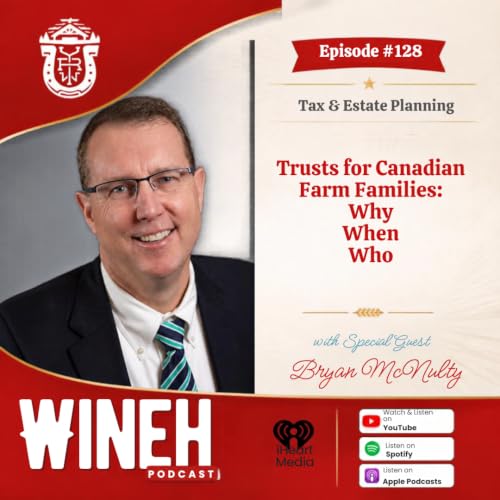
Cover of WinEH! Podcast

WinEH! Podcast

WinEH! Podcast

By: Winnie Lau
Listen for free

Season's Savings | 0.99 €/month for 3 months

5.99 €/month thereafter - terms apply. Cancel monthly.
Summary
The WinEH! Podcast is all about WINNING in Canada EH. Specifically in the world of how we work with Money, think about Money and how we can use it to ELEVATE our life experience. The Financial Philosophy that we live by is based in the use of the Infinite Banking Concept. We believe that every Canadian deserves to know there is a better way to go about the way we think and manage our money. This podcast has 3 DISTINCT SHOWS. We are sharing ONE show at a time. Each show aims to heal the financial divide created by life experience, history, government and the banks. Alright, come lean in and check out our first show, Ranch Your Way.2024 Economics Management Management & Leadership Personal Finance
Episodes
  • Ep. 130 - What Happens to Your Cash Value When You Die
    12 Nov 2026

    What happens to your whole life insurance cash value when you die? Does the insurance company keep it? And if you've spent decades building that value, what does your family actually receive?

    These are some of the biggest questions surrounding participating whole life insurance and The Infinite Banking Concept® (IBC). And the answers are especially important for Canadian families who want to build a family pool of money, maintain access to capital, and prepare the next generation.

    In this episode of Ranch Your Way, Winnie and Lacy break down one of the most misunderstood parts of whole life insurance: the relationship between cash value and the death benefit. They explain what happens when the insured person passes away, how outstanding policy loans affect the payout, and why understanding your contract matters when planning your family's financial future.

    In this episode, you'll discover:

    • The Cash Value Question: Does the insurance company really keep your cash value when you die?

    • The $500,000 Misunderstanding: Why $500,000 in cash value and a $1 million death benefit don't automatically equal $1.5 million.

    • The Home Equity Example: A simple way to understand two different values within one contract.

    • Policy Loans at Death: What happens to outstanding loans, and how do they affect your beneficiaries?

    • Dividends and Paid-Up Additions: How these features can affect cash value and death benefits over time.

    • Whole Life vs. Universal Life: What makes these contracts different, and why does that matter?

    • The Family Legacy Question: How can life insurance provide liquidity for a farm, ranch, or family business when the next generation takes over?

    Whether you're exploring IBC for the first time or already building your own family financial system, this conversation will help you better understand how participating whole life insurance works during your lifetime and what it can provide after you're gone.

    Because building financial resilience isn't just about the money you leave behind. It's also about the knowledge, habits, and systems you pass forward.

    Ready to begin?

    Start with Farming Without the Bank — Canadian Edition. Get the paperback and audiobook bundle at ranchyourway.com

    Start with the book. That's where the shift begins.

    Show more Show less
    28 min
  • Ep. 129 - How Non-Farm Assets Can Cost You the Farm Rollover & Capital Gains Exemptions
    6 Nov 2026

    Holding investments, rental property or cash-value life insurance inside your farm corporation could cost your family the rollover or the capital gains exemption.

    Part 6 of 6, the finale of Keeping the Farm or Ranch Together.

    The intergenerational rollover lets qualifying farm and fishing property pass to a child tax-deferred, and the lifetime capital gains exemption shelters part of the gain on qualifying shares. Both have asset tests. If too much of a farm corporation's value sits in non-business assets (Bryan puts the threshold at roughly 10%), the shares may not qualify for either. Investments, rental properties, excess cash and cash-value life insurance are generally treated as non-business assets, even when a policy is used to help finance the operation.

    Former tax lawyer Bryan McNulty's answer is structure. Move non-business assets into a separate investment holding company, tax-efficiently and as early as possible, without the holding company owning the operating shares. That can add creditor protection too. Then we turn to succession that doesn't go to a child. A transfer to a niece or nephew generally doesn't get the child rollover, which can trigger tax at fair market value. Bryan shares real cases, including a dairy operation passing to a brother's children and siblings using life insurance so one side of the family can buy out the other and keep the land in the family.

    QUESTIONS THIS EPISODE ANSWERS

    • What counts as a non-business asset in a farm corporation?

    • Can cash-value life insurance in my farm corporation affect the rollover or capital gains exemption?

    • Should investments and life insurance be held in a separate holding company?

    • Does the farm rollover apply to nieces and nephews?

    • How can life insurance fund a buyout between two sides of a family?

    • How do you keep a farm intact when the children don't want to farm?

    WHO IT'S FOR

    Incorporated farm and ranch operations building up cash or investments, sibling-owned operations, and families whose successor may not be their own child.

    QUESTIONS TO TAKE TO YOUR PROFESSIONALS

    • What happens if I die tomorrow?

    • If my spouse dies?

    • If one of our children doesn't want to farm, or none of them do?

    • Where will the tax money come from?

    • What would have to be sold?

    • Does our corporate structure still make sense?

    HOSTS AND GUEST

    Winnie Lau and Lacy Rowan, Ranch Your Way. Life insurance advisors who help farm and ranch families plan with The Infinite Banking Concept®. Bryan McNulty, former tax lawyer with more than 25 years in tax and estate planning for business owners and families.

    A NOTE ON TIMING

    Recorded December 4, 2024. Tax rules and amounts may have changed; work with your accountant, lawyer and insurance advisor together.

    This episode is for education only and is not tax, legal or financial advice.

    Get Farming Without The Bank — the Canadian version, includes audio.

    Start at ranchyourway.com

    Watch the full series: youtube.com/@WinEHpodcast

    Show more Show less
    21 min
  • Ep. 128 - Trusts for Canadian Farm Families: Why, When, & for Whom?
    29 Oct 2026

    A trust isn't the goal. The question is what you'd need one to accomplish.

    Part 5 of 6 of Keeping the Farm or Ranch Together.

    A trust is an arrangement, not a separate legal person. A settlor (or, in a will, a testator) creates it, trustees manage the assets, and beneficiaries receive the income or the capital. Former tax lawyer Bryan McNulty explains that newer rules have limited income splitting through trusts, but trusts still offer real value in two areas.

    The first is the estate freeze. Parents lock in the current value of their company shares, and a family trust holds the future growth. That can cap the parents' tax at death, keep options open about which child eventually takes over, and, if the shares qualify, potentially let several family members each use their lifetime capital gains exemption. The second is control. A trust can hold life insurance on a child or grandchild so the policy can't be cashed in by that person or a future spouse, and life insurance isn't subject to the trust's 21-year deemed disposition rule.

    Bryan is equally clear about the costs: setup and legal fees, annual trust tax returns, trustee resolutions, a separate bank account, and the need for a trust lawyer and a tax specialist rather than a generalist. For most operations just starting out, a trust comes later, once the business has grown significantly in value.

    QUESTIONS THIS EPISODE ANSWERS

    • What is a trust in Canada, and what do the settlor, trustees and beneficiaries do?

    • How does a family trust work with an estate freeze?

    • What is the 21-year rule for trusts?

    • Can a trust own life insurance on my children or grandchildren?

    • Does a trust protect assets in a divorce?

    • What does it cost to set up and run a trust?

    WHO IT'S FOR

    Families with a growing incorporated farm or ranch, and parents or grandparents who own life insurance on the next generation and want it protected.

    HOSTS AND GUEST

    Winnie Lau and Lacy Rowan, Ranch Your Way. Life insurance advisors who help farm and ranch families plan with The Infinite Banking Concept®. Bryan McNulty, former tax lawyer with more than 25 years in tax and estate planning, including drafting wills and trusts.

    A NOTE ON TIMING

    Recorded December 4, 2024. Trust tax and reporting rules can change; confirm current requirements with a qualified professional.

    NEXT IN THE SERIES

    Part 6: Keeping the farm or ranch together.

    This episode is for education only and is not tax, legal or financial advice.

    Get Farming Without The Bank — the Canadian version, includes audio.

    Start at ranchyourway.com

    Watch the full series: youtube.com/@WinEHpodcast

    Show more Show less
    25 min
adbl_web_anon_alc_button_suppression_t1
No reviews yet