Épisodes

  • Doing Your Job Is Not the Same as Doing It Well
    Nov 2 2026

    What is the difference between simply doing your job and taking pride in doing it well?

    In this episode of The Monday Message with Dan Dillon, we explore how the small decisions we make every day shape our professionalism, our character, and the people who depend on us. Showing up and completing an assignment may meet the basic expectation, but doing the job well means taking ownership, paying attention to the details, following through, and caring about the quality of the work we put our name to.

    Whether you work in public service, lead a team, or contribute to an organization in any capacity, your work affects someone else. The preparation you complete, the details you catch, and the commitments you keep can make a difference long after your part is finished.

    This episode is not about working endless hours, chasing perfection, or doing everyone else's job. It is about choosing to bring professionalism, consistency, and purpose to the responsibilities entrusted to you—even when nobody is watching and recognition is unlikely to follow.

    Because the true measure of your work is not simply whether you got the job done. It is the care and commitment you brought to doing it well.

    This week, ask yourself: If everyone approached their responsibilities the way I approach mine, what kind of team would we have?

    Afficher plus Afficher moins
    12 min
  • Do Not Judge a Book by Its Cover | The Value of an Open Mind
    Oct 26 2026

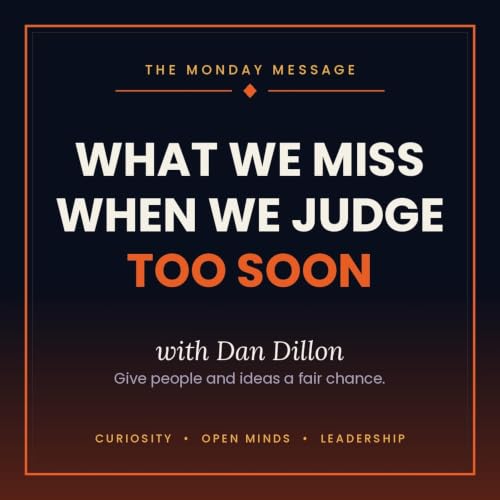
    How many opportunities have we missed because we made a judgment before giving someone or something a chance?

    We all make assumptions. We form opinions about people based on their experience, personality, or first impressions. We dismiss new ideas because they challenge the way we have always done things. And sometimes, without realizing it, we close the door on opportunities that could make us better.

    In this episode of The Monday Message, we explore the importance of looking beyond first impressions, staying curious, and recognizing the value that different people and perspectives can bring to the table.

    For leaders, this matters even more. The way we respond to new ideas can determine whether people feel encouraged to contribute or decide it is not worth speaking up. Tradition and experience are valuable, but they should never become excuses to stop learning or improving.

    Being open-minded does not mean accepting every idea. It means being willing to listen, ask questions, and give people and possibilities a fair chance before making a decision.

    Because sometimes, the person you least expected has something important to teach you. And sometimes, the idea you were ready to dismiss is exactly what you needed.

    Stay curious. Challenge your assumptions. Give people and ideas the opportunity to prove their worth.

    Afficher plus Afficher moins
    10 min
  • What Great Supervisors Do When Nobody Is Watching | Teamwork, Trust, and Leadership
    Oct 19 2026

    What does a successful team look like when the supervisor is not in the room?

    Great leadership is not about making every decision, having every answer, or controlling every outcome. It is about building a team that understands the mission, makes sound decisions, takes ownership, and succeeds without needing constant direction.

    In this final episode of our supervisory leadership series, we explore four essential elements of effective leadership: building a team with a clear purpose, developing trust and independent decision-making, sharing credit while accepting responsibility, and measuring success by what happens when you are not there.

    Whether you lead a fire company, manage a division, supervise a team, or want to become a better leader, this episode offers practical lessons in leadership, accountability, teamwork, and professional development.

    The true measure of a supervisor is not how much depends on them. It is how capable the people around them become because of their leadership.

    Build the team. Support the mission. Give credit where it belongs. And keep moving the line forward.

    The Monday Message with Dan Dillon — Leadership, character, and personal growth, shaped by more than three decades in public service.

    Choose the harder right over the easier wrong!

    Afficher plus Afficher moins
    12 min
  • Who Is Ready to Take Your Place? | The Real Responsibility of Leadership
    Oct 12 2026

    Every position is temporary.

    Eventually, someone else will sit in your chair, wear your badge, or carry the responsibilities you hold today. The question is not whether that will happen. The question is whether they will be ready when it does.

    Good leadership is not about becoming indispensable. It is about developing people who are capable of succeeding without you.

    That means sharing knowledge, creating opportunities, allowing others to make decisions, teaching the why behind what we do, and sometimes letting people make mistakes so they can grow.

    It also means not being threatened by the person who may eventually replace you.

    If the people around you are becoming more capable, that is not a threat to your leadership. It may be the evidence of it.

    This week on The Monday Message, we continue our conversation about leadership and supervision by exploring succession, development, and the responsibility we have to prepare the people who will eventually carry the responsibility forward.

    The question is simple:

    If you left tomorrow, would they be ready?

    Because leadership is not just about what happens while you are there.

    It is about what happens after you leave.

    Afficher plus Afficher moins
    10 min
  • What Makes a Good Supervisor? How Great Leaders Make People Better
    Oct 5 2026

    What Makes Someone a Good Supervisor?

    What makes someone a good supervisor?

    Is it experience? Knowledge? Authority? The ability to make decisions?

    Or is it something deeper?

    A good supervisor does more than manage people and enforce standards. They create trust. They communicate clearly. They listen. They hold people accountable. They develop those around them. And they understand that caring about people does not mean lowering expectations.

    Supervision is not simply about directing work. It is about accepting responsibility for the people entrusted to your leadership. That means setting clear expectations, providing honest feedback, recognizing potential, and helping others grow.

    The real measure of leadership may not be how well we perform while we hold the position. It may be what happens to the people around us because we were there.

    If someone worked for you for five years, would they be better because you were their supervisor?

    That question reaches beyond productivity or performance. It asks whether your leadership helped someone become more capable, more confident, more accountable, and more prepared to lead others.

    In this episode of The Monday Message with Dan Dillon, we explore the qualities and characteristics of good leadership, the responsibility that comes with supervising others, and why the goal of leadership should not simply be to have good employees—but to help make better people and better leaders.

    Because eventually, every position ends.

    The title will be gone. The authority will be gone. The daily responsibilities will be passed to someone else.

    The question is: What will you leave behind in the people you led?

    This week’s reflection:

    If someone worked for you for five years, would they be better because you were their supervisor?

    Follow The Monday Message with Dan Dillon for weekly reflections on leadership, character, accountability, and personal growth.

    Choose the harder right over the easier wrong.

    Afficher plus Afficher moins
    11 min
  • Friendly Is Not the Same as Friends
    Sep 28 2026

    What happens when you get promoted and suddenly find yourself responsible for leading the people who used to be your peers?

    Promotion can change relationships in ways we do not always expect. The rules may be the same, but the dynamics are different. Suddenly, you may have to hold people accountable, set boundaries, have difficult conversations, and make decisions that affect people you care about.

    So, can you really be friends with the people you supervise?

    Maybe the better question is whether friendship is the right goal.

    Being friendly is not the same as being friends. Leadership requires trust, consistency, accountability, and sometimes a willingness to give up a little of the relationship you once had in order to fulfill the responsibility you accepted.

    This week on The Monday Message, we explore what happens when the person you used to stand beside becomes the person you are responsible for leading.

    Because leadership is not about being liked.

    It is about being someone others can trust.

    Afficher plus Afficher moins
    12 min
  • The Glass Half Full!
    Sep 21 2026

    Life does not always turn out the way we planned. We lose things. Plans change. Relationships end. Financial struggles appear. Sometimes, it can feel like everything we built has been dismantled.

    In Episode 11 of The Monday Message, I reflect on the idea of living with a “glass half full” perspective and what he learned during one of the most difficult seasons of his life.

    Being optimistic does not mean pretending everything is fine. It means being willing to acknowledge what is hard while still recognizing what remains.

    The circumstances may not change. The loss may still be real. But we can choose where we place our attention.

    Sometimes the question is not whether the glass is half full or half empty.

    The question is: What are you looking at?

    Afficher plus Afficher moins
    11 min
  • Die With Zero: What Are You Saving It For?
    Sep 14 2026

    What if the goal of life is not to accumulate as much as possible, but to make sure we actually use what we have?

    In Episode 10 of The Monday Message, Dan explores the idea behind “Die With Zero” and what it really means. This is not about reckless spending or ignoring the future. It is about recognizing that money can be earned again, but time cannot.

    We spend our lives saving money, preparing for retirement, planning for tomorrow, and waiting for the right time. But what happens when we become so focused on the future that we forget to live in the present?

    Our money, time, health, relationships, experiences, and opportunities all have valueand all have limits.

    So the question is simple:

    What are you saving it for?

    Maybe the goal is not to die with zero dollars.

    Maybe the goal is to live with as little unused life as possible.

    Afficher plus Afficher moins
    10 min