Cover of The Great Upgrade for Pan-American systems

The Great Upgrade for Pan-American systems

The Great Upgrade for Pan-American systems

By: Ranfery Sanchez
Listen for free

Season's Savings | 0.99 €/month for 3 months

5.99 €/month thereafter - terms apply. Cancel monthly.

Summary: How do we prevent our cities and systems from falling decades behind? The Great Upgrade (La Gran Actualización) is a disciplined, pre-partisan invitation to reject inherited systems merely because they are familiar. In this episode, we explore an evidence-based methodology that moves public policy away from rigid ideologies and toward practical, measurable results.

We introduce the "systems lens"—which examines relationships and feedback loops rather than treating symptoms in isolation—and walk through a structured library of six ambitious, system-level proposals:

  1. Regulate, Reinvest, Repair (Proposal 001): Transitioning underground substance economies into regulated, health-centered systems to fund harm reduction.

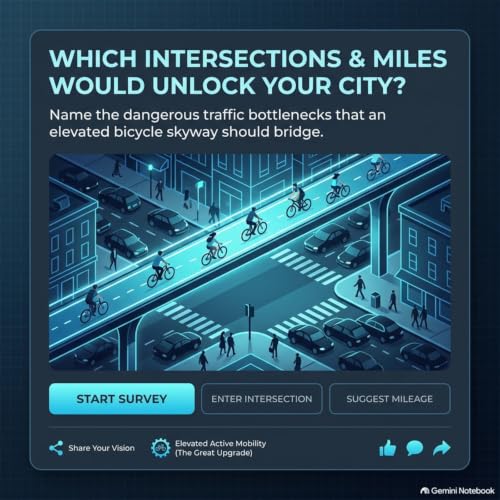
  2. Elevated Active Mobility Infrastructure (Proposal 002): Building continuous active-mobility networks, using vertical separation only where it generates enough safety and lifecycle value.

  3. Evolucracia (Proposal 003): Organizing skilled crews, citizens, and shared equipment into a citywide operating system for weekly public improvements.

  4. The City Upgrade Fund (Proposal 004): Implementing progressive, legally restricted funding structures (such as modernized catastres and property taxation) to sustain urban maintenance without displacing vulnerable households.

  5. International Infrastructure Workforce Partnership (Proposal 005): Bilateral labor agreements that connect infrastructure demand with safe, legal temporary jobs without reducing worker rights.

    1. Auditable Southbound Weapons Inspection (Proposal 006): Implementing technology-assisted, audited vehicle portals at border crossings to interdict smuggled weapons while protecting privacy and flow

Ranfery Sanchez
Political Science Politics & Government
Episodes
  • Elevated Active Mobility – Is the Bicycle Skyway Worth It?
    7 Oct 2026

    Hey! I'd love to hear your thoughts, send me a voice note.

    > Episode Summary: Can building elevated bicycle routes make daily trips safer and more accessible without overspending city budgets? In this episode of The Great Upgrade Podcast, we dive into Proposal 002: Elevated Active Mobility[1].

    > We examine the strategic case for selective elevation—elevating bicycle paths only where they resolve severe physical barriers like dangerous arterial roads or railway lines[1]. We also discuss why elevated structures must always integrate with protected street-level feeder networks, secure parking, and transit connections[2].

    > What You’ll Learn in This Episode:

    1. The Selective Elevation Rule: Why elevation is a targeted solution, not a mandate to lift every bike lane[4][18].
    2. Equity and Access: How connected routes benefit households, shift workers, and cyclists of all ages and abilities[5].
    3. Ramp Arithmetic & Land Use: Why entry slope, gradient length, and elevator reliability dictate whether a bridge succeeds or fails[8].
    4. Financial Framework: Testing pilot assumptions using a 20-year MXN 60M capital model to calculate realistic costs per trip[14][15].
    5. Evidence vs. Hypotheses: Lessons from global physical activity data (WHO)[21] and real-world infrastructure like Xiamen's 7.6 km skyway[13].

    > 📄 Source Document: Proposal 002: Elevated Active Mobility – Full Explanation (Ranfery Sánchez, Oct 2026)[1].

    > 🏷️ Episode Keywords: Elevated Active Mobility, Urban Planning, Bicycle Infrastructure, Transit Equity, Urban Transport Economics, The Great Upgrade

    Show more Show less
    22 min
  • Three Operating Systems for Drug Policy: Prohibition, Decriminalization, and Regulated Supply
    17 Sep 2026

    Hey! I'd love to hear your thoughts, send me a voice note.

    In this episode of the Great Upgrade series, we break down Proposal 001: Three Alternatives for Drug Policy—a structured public decision tool designed to evaluate drug policy reform beyond binary arguments. Instead of asking vague questions about legalization, Proposal 001 presents three distinct operating systems side-by-side to compare what each model actually achieves across public health, criminal justice, and community safety: 1. Option 001-A — Prohibition + Improved Treatment: Retains legal prohibition while prioritizing rapid healthcare diversion and accessible treatment for opioid-use disorders. 2. Option 001-B — Decriminalization + Health Diversion: Replaces criminal courts with administrative Drug Health Commissions for personal possession below defined thresholds while keeping commercial trafficking criminalized. 3. Option 001-C — Regulated Medical Supply: Decriminalizes qualifying personal use and establishes a controlled, prescription-based pharmaceutical pathway to separate dependent patients from illicit cartel supply chains. Key Topics Covered in This Episode: • Entering the Medical Pathway: How clinicians assess and voluntarily enroll "Program Patients" based on clinical dependency and risk rather than arbitrary deadlines. • The 5-Level Access Ladder: How patient autonomy progresses from Supervised Clinics (Level 1) and Authorized Pharmacies (Level 2) to Secure Medical Kiosks with biometric authentication (Level 3), Limited Take-Homes (Level 4), and Controlled Delivery (Level 5). • Voluntary Recovery Day Centers: Daily support services providing meals, showers, case management, medical care, and employment assistance. • Institutional Safeguards & Dealer Exit Ramps: Why the framework enforces a strict Medical-Data Firewall between police and clinical records, prohibits volume-based pay for clinicians or hosts, and creates a Legal Transition Program to move former distribution workers into non-commissioned outreach roles. • Measuring Success: Evaluating outcomes using a transparent decision matrix focused on overdose mortality, cartel revenue displacement, police clearance rates, and net public cost.

    Chapter Markers / Timestamps

    • 00:00 — Introduction & The Purpose of Proposal 001[1]
    • 01:30 — Comparing the Three Policy Architectures (001-A, 001-B, 001-C)[2][3]
    • 04:15 — Clinical Enrollment & Entering the Medical Supply Program[4]
    • 06:45 — The 5-Level Access Ladder: From Supervised Clinics to Biometric Kiosks[5]
    • 09:30 — Recovery Support Services: The Voluntary Recovery Day Center Model[6]
    • 12:00 — Non-Negotiable Guardrails: The Medical-Data Firewall & Dealer Exit Ramp[7][8]
    • 15:10 — Metrics of Success: The Decision Matrix & Public Decision Points[9][10]
    Show more Show less
    35 min
  • Evolucracia and the local implementation gap. Can a city stop normalizing visible neglect?
    10 Sep 2026

    Hey! I'd love to hear your thoughts, send me a voice note.

    Good governance is not proven in committee rooms; it is proven on the asphalt. In this episode, we unpack Proposal 003: Evolucracia and confront the "local implementation gap"—the breakdown between municipal funding, administrative authority, and the neglected physical spaces citizens navigate daily.

    Using concrete field data and physical proof-of-method workflows tested in Ciudad Juárez, we move past abstract civic tech to look at real-world mechanics: before/after sector inventories, mobile repair units, the Upgrade Card model, and verified public maintenance records. We also red-team the model against its toughest institutional hurdles: bureaucratic jurisdiction disputes, deferred maintenance debt, and long-term lifecycle sustainability.

    Key Topics Covered:

    • Normalizing Neglect: Why inherited civic maintenance systems default to decay and path-dependency.
    • The Evolucracia Framework: How physical inventories, rapid mobile crews, and transparent response timers close the delivery gap.
    • The Implementation Audit: Why real receipts, work logs, and photographic baselines matter more than algorithmic governance or political promises.
    • The Dissenter’s Case: Addressing supply constraints, municipal labor capacity, and the risk of institutional capture.
    • Stop, Revise, or Scale: Establishing measurable thresholds to determine whether a local pilot succeeds or fails
    Show more Show less
    21 min
adbl_web_anon_alc_button_suppression_t1
No reviews yet